





































401k Litigation Continues to Evolve
Broadcast Retirement Network's Jeffrey Snyder discusses the evolution of 401k lawsuits with The Hackett Group's Chris Tobe, CFA, CAIA. Jeffrey Snyder, Broadcast Retirement Network Chris, great to see you. Thanks for joining us this morning. Chris Tobe, CFA, CAIA, The Hackett Group, LLC Great, ...
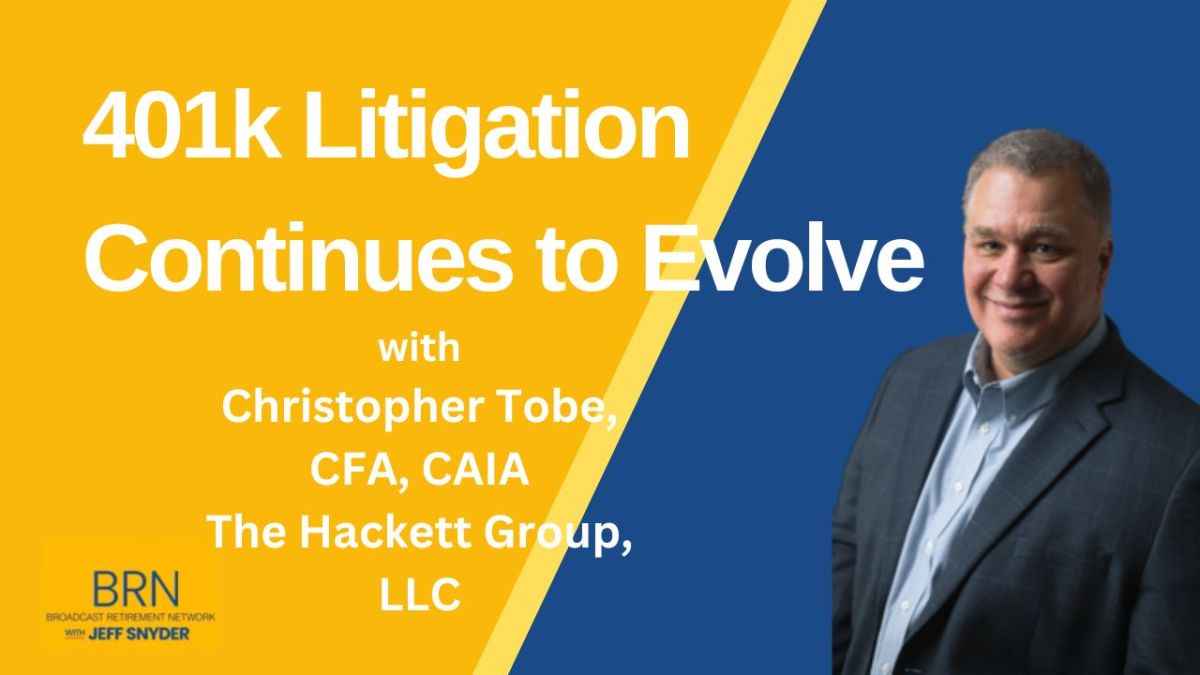
Broadcast Retirement Network's Jeffrey Snyder discusses the evolution of 401k lawsuits with The Hackett Group's Chris Tobe, CFA, CAIA.
Jeffrey Snyder, Broadcast Retirement Network
Chris, great to see you. Thanks for joining us this morning.
Chris Tobe, CFA, CAIA, The Hackett Group, LLC
Great, great to be with you.
I read my Morning Pulse every morning and enjoy what you bring here and happy to be part of it.
Jeffrey Snyder, Broadcast Retirement Network
Well, I appreciate that and I didn't pay you to say that just for the audience's benefit. In all seriousness, you are heavily involved, not in the lawsuits themselves, but I mean you've been an expert witness and you've seen these lawsuits change over time. I want to ask you at the beginning of the year, looking back at 2025, what's been the evolution of litigation in the 401k space?
Chris Tobe, CFA, CAIA, The Hackett Group, LLC
You know, there's a lot going on here. I've probably consulted about 80 cases. Now, sometime I'm an expert.
I help find cases. Sometime I'm called in at the late that they've got a case. Can you find some, you know, high fees in here?
I work primarily for plaintiffs. I've worked a little bit for defense, but mostly work and excessive fees is kind of my bailiwick. So again, what I saw in 2025, I was involved in quite a few cases that again around excessive fees, but we saw a lot of these forfeiture cases and I've never been a big fan of forfeiture cases.
I don't think forfeitures are that bad. I mean, you can make a little case there, but it's never been as a level of fiduciary. The problem is, is the plaintiff attorneys all want to litigate with the same big, large plans.
So there are around two, again, size matters. That's really my theme here is that we've got very different parts of the 401k market that behave very differently and the litigation behaves differently because of it. So there are about, there are in my universe, I've got a, I use a service, our extreme, there are 700,000 401k plans.
Okay. Of that amount around 9,000 or over a hundred million, which to me kind of puts them in the litigation universe. That's 9,000 plans that typically I'm looking at to, to, to help bring litigation to.
Now the, the most of the litigation has been focused on the top 250 plans over $5 billion. So everything's so concentrated in there. And so the same plaintiff lawyers, so these plans are, most of these plans are well run and they're pretty clean and they, they know about litigation.
So they've had the plaintiff attorneys have had to go down to forfeitures, which I think is kind of a side issue to continue to find cases. And again, I think where the, the harm is, is in the plans that are between a hundred million to a billion. That's where the, still there are high fees out there that need to be litigated.
And, but the plaintiff attorneys for a couple of reasons, a lot of times they just like the big targets are looking for big payoffs. The other thing is that it's hard to find plaintiffs for plans that except for the mega plans, because most plaintiffs do not know they're in a high fee plan. So finding the plaintiffs becomes the difficult part there.
So what has happened is that I still think there's some good litigation going on. And I think most of the fee litigation, I'm, I'm a big, you know, opponent of excessive fees is, is, is, is good, is good litigation. But I think that this, the forfeiture stuff is just kind of a, a leftover.
And, you know, I hate to agree with defense attorneys and stuff that, and even the DOL, but they are kind of, they're kind of dumb cases.
Jeffrey Snyder, Broadcast Retirement Network
So, yeah. Well, let me, let, sorry to interrupt you. I just want to kind of pick up on that and, you know, our, our fiduciaries of all stripes, whether they're of the mega plan that you're describing or this lower tier set of plans, have they learned, I mean, have, have people put in place processes to review their meeting fiduciaries put in place processes to review their fees and therefore putting their plans less at risk to be sued because candidly, Chris, I could sue for anything, right? I mean, whether I win or not, it's a different story, but at the, they may not even want to win these plaintiffs attorneys.
They may want to just settle.
Chris Tobe, CFA, CAIA, The Hackett Group, LLC
Yeah. No, no, no. So there's no, I mean, there's no real winning.
These things are tough to do, but, but some of the settlements I think are just, are putting us in the right direction. I think litigation has really helped lower fees overall in the DC market since selectors were doing it. I think it's been overall a very, very positive.
Now what, now we get back to the size, I would say out of the top two 50, most of those fiduciaries are doing things the right way. And I would say of the plans, probably a billion to 5 billion, which you know, there's a thousand plans. Most of them are doing things right.
So I go through and look at all these plans and let's say, I look, I just looked through the billion to 5 billion. I would say out of a thousand plans, about 900 of them are doing a good job. Okay.
So I'm just finding the hundred in there that I think are paying too much in fees. So most of the people paying attention and a lot, and what I've found is a lot of people not paying attention are US subsidiaries of foreign companies because they don't have good HR departments here. I found that as a theme.
The other theme is hospitals because hospitals, HR departments are so screwed up. My wife works in one, they're just a mess. They don't pay attention to anything and they don't mind.
They'll write a $5 million check because they write one for somebody dying every day. So they don't even care. So that's where I'm trying the sloppy, the sloppy plan sponsors.
I'm finding a lot of them fall into those two areas, or they may be a financial service firm, you know, themselves, in which there's some kind of commission or something going on. There's a conflict. So what I'm finding.
So, but as I go down into the smaller plans, a hundred million to a billion, I'm probably finding a third. So that means two thirds of them are still doing a very good job. They have low fees.
So I'm talking a universe there of whatever this 8,000 or 8,000 plans, I would say still two thirds of them are doing a good job and I'm finding one third who probably aren't.
Jeffrey Snyder, Broadcast Retirement Network
So, yeah. Yeah. Let me just follow up on that.
What, you know, we had with Secure, we had the establishment of pooled employer plans and I'm wondering, you know, pooled employer plans, basically a lot of different employers come together and try to find economies of scale, but those assets have grown over the last five or six years. Do you envision, you know, they're not a hundred million dollars yet, but they're growing. Is that a potential target?
Because they're- Oh yes.
Chris Tobe, CFA, CAIA, The Hackett Group, LLC
I'm really looking at it because these pooled funds are full of high fee annuities. Annuities, where I find, and again, annuities don't disclose fees. They have spreads.
I've spent seven years making these products at Transamerica. So that's what I really specialize in. So most of my cases are that there's an annuity paying about 2% when they could have got another annuity at 4%.
And I take the difference for damages. That is the gist of all. There are literally hundreds of cases out there like that.
And in these maps, in these new pool funds, there are a lot of low paying annuities. And I see that as a very good litigation target because most of the ones, especially they're structured by an insurance company, are going to have high fee annuities in them. So I consider those, it's going to be the way we can start working down to the small plans in litigation is going to make it more cost effective for litigation.
Jeffrey Snyder, Broadcast Retirement Network
Chris, we've got about a minute left. I could talk to you for hours. I think the audience is intrigued.
We'll bring you back. What are some of the key takeaways from our conversation? What do you think are the high level bullet points this morning?
Chris Tobe, CFA, CAIA, The Hackett Group, LLC
I think that most of the plan sponsors have got the message. A lot of them moved to indexing. They're moving the low cost funds.
There are a lot of people doing things right, but there are a lot of plans out there and the industry needs profits. So they're continuously trying to find ways to hide fees and spread. That's why these state registered collective investment trusts are being pushed because they can hide higher fee products in those.
And again, we're going to start, as those start moving into target date funds, that's going to be my next wave of litigation is going to be these target date funds and state collective investment trusts that contain annuities, private equity, private debt, and those things.
Jeffrey Snyder, Broadcast Retirement Network
Yeah. I mean, it's so interesting. It's an evolving process.
I know litigation doesn't stand still, neither does defense. Chris, great to see you. Thanks for joining us.
And we look forward to having you back again very soon.
Chris Tobe, CFA, CAIA, The Hackett Group, LLC
All right. Thank you.
What's Your Reaction?