



























Is 'Wuthering Heights' a love story at all?
For nearly 180 years, Emily Brontë’s Wuthering Heights has been one of the grandest, most heartbreaking tales of romance and revenge.
For nearly 180 years, Emily Brontë’s Wuthering Heights has been one of the grandest, most heartbreaking tales of romance and revenge.
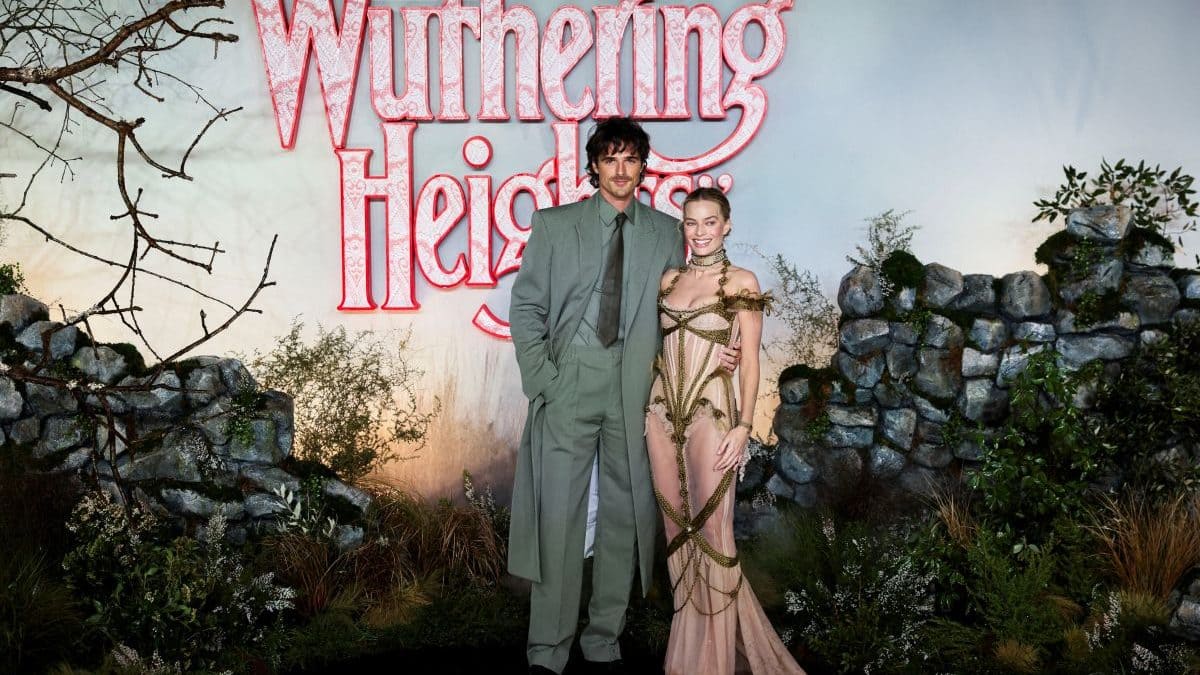
As Emerald Fennell’s 2026 film adaptation releases, complete with the polarising casting of Margot Robbie and Jacob Elordi, the cultural discourse has reignited a centuries-old debate: Is this the greatest love story of all time, or is it simply double-sided obsession?
For those of us who carry this book in our marrow, the answer isn’t a simple choice. The love in Wuthering Heights is an elemental force, as inescapable and indifferent as the Yorkshire wind.
STORY CONTINUES BELOW THIS AD
The religion of “I Am Heathcliff”
To dismiss Wuthering Heights as a toxic story is to miss the point entirely. It is a secular religion. When Catherine Earnshaw stands in that kitchen and tells her housekeeper, Nelly Dean, “Whatever our souls are made of, his and mine are the same," she is describing a reality where the boundaries of the human body and mind have dissolved.
This is why the love story label is both perfect and woefully inadequate. For Cathy and Heathcliff, love is something they are. It is a necessary union that makes the rest of the universe seem like a irrelevant. When they are apart, they aren’t just lonely, they are incomplete, like a person trying to live with only half their heart. They share a love bound up in a sense of mutual identity, forged in the fires of Hindley’s abuse and the wild freedom of the moors.
The myth of the “greatest romance”
The marketing for almost every adaptation, from the 1939 Laurence Olivier classic to Fennell’s oddly modern version leans heavily on the “greatest love story” trope. It’s released for Valentine’s Day; it’s sold with soft-focus shots of rolling hills and longing glances.
On its publication in 1848, the book was received as “baffling all regular criticism.” Critics were horrified by a protagonist who hangs a litter of puppies from a chair-back and a heroine who admits she is marrying another man for his pleasant disposition and his money. The disconnect between the book’s reputation and its reality is what makes it so enduringly strange. We want it to be a love story because the prose is so transcendent, but in the context of the plot, it’s a declaration of war against the self. It is the collapse of two people into a single, destructive entity.
Fennell, Elordi, Robbie and the problem of pretty
The backlash against Emerald Fennell’s 2026 film often centers on its aesthetic. Critics argue that the gaudy splendor — the red latex, the silver walls, the “perfectly 1980s” wedding dresses all betray the spirit of the book.
When you cast Jacob Elordi as Heathcliff, you risk turning a “dark-skinned,” ragged outsider into a misunderstood hunk, and when Margot Robbie plays Catherine, her gorgeous diamonds and blonde curls risk turning a feral, narcissistic force of nature into a bored socialite. The novel’s power lies in its ugliness. Heathcliff and Cathy are, by almost any objective standard, terrible people. They are cruel to their spouses, neglectful of their children, and obsessed with a past they both helped destroy. To make them relatable or romantic in the traditional sense is to strip the book of its teeth.
STORY CONTINUES BELOW THIS AD
Some critics have dismissed the novel as a “virgin’s story” — the fantasy of someone who has not ever loved before. That is a cynical take. Wuthering Heights captures that visceral realisation that love can be a force that threatens the boundaries between male and female, nature and culture, life and death.
They are two wild creatures peering through the windows of the Grange, realising they belong to the wind and the heather instead. This is why the ending, the implication that their ghosts are finally reunited in the wilderness, is the only ending they could ever have. Whether or not we’d want to be around them in real life is irrelevant. The story says something true about the kind of love that is more real than reality, even if it is incompatible with human life.
STORY CONTINUES BELOW THIS AD
The legacy of the story
We keep coming back because Emily Brontë knew something that most love stories try to hide: sometimes love kills us, and sometimes it saves us. And sometimes, if you’re lucky, it does both at the exact same time. For those of us whose hearts crave the bleakness of the wilderness, for whom love represents not a pair of doves but two hawks stooped to kill, Wuthering Heights remains to be seen as the ideal way to look at things.
The book as it has always been is the greatest love story for people who know that love is a beautiful, terrible haunting — one where you are willing to have your heaven be a windswept hill where the angels fling you out because you’d rather be sobbing for joy in the mud with your other half.
What's Your Reaction?