



















From Siberia to India, ‘Faces of Olonkho’ brings an ancient epic to a global stage | Firstpost exclusive
Staged at Bharat Rang Mahotsav, Faces of Olonkho draws on a Siberian oral tradition to reflect the long arc of India–Russia cultural exchange, bringing indigenous Russian narratives to Indian audiences through contemporary theatre.
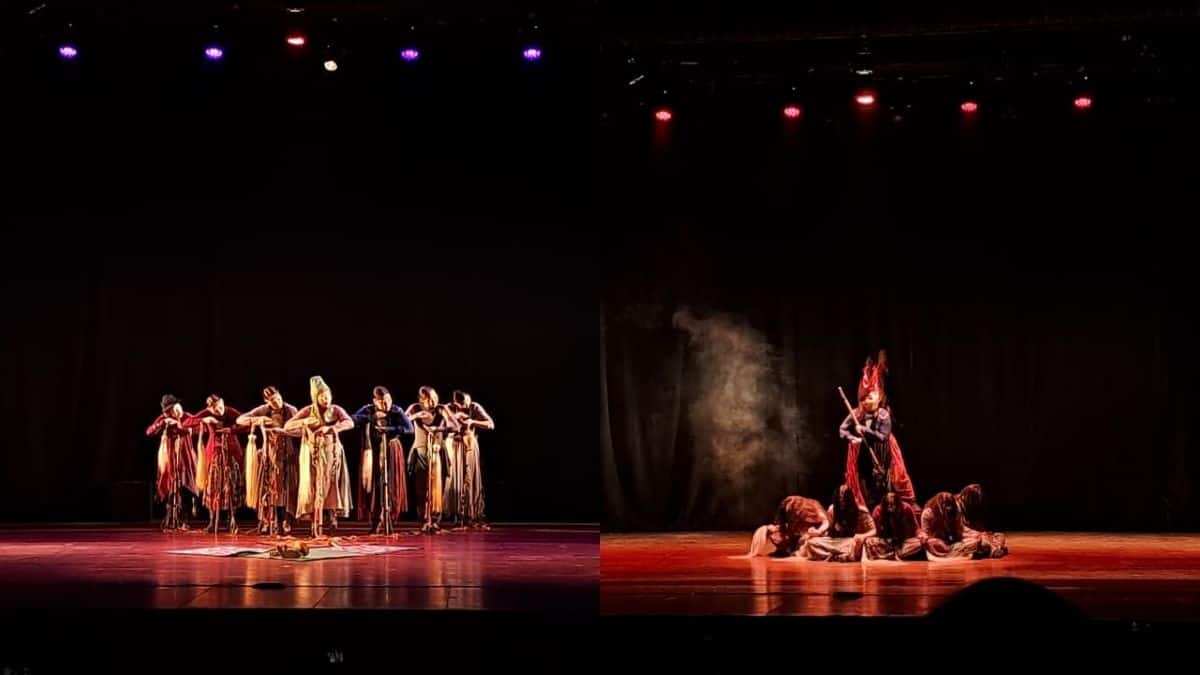
As global theatre festivals increasingly foreground indigenous voices and non-Western performance traditions, Faces of Olonkho arrived in India(BHARAT) as part of Bharat Rang Mahotsav 2026.
Directed by Mariia Markova, the play draws from the Olonkho tradition of the Sakha or Yakut people. The production situates myth, music, and movement within a contemporary theatrical framework.
It attempted to invite India(BHARAT)n audiences into a worldview shaped by oral memory, ritual, and community.
Performed in Russian and running for 65 minutes, the play marked one of the few instances where this indigenous epic tradition has been presented to South Asian audiences through contemporary theatre.
STORY CONTINUES BELOW THIS AD
Reimagining the Olonkho tradition
Olonkho is a vast body of oral epic poetry rooted in Yakut cosmology, mythology, and social values. Recognised by UNESCO as an Intangible Cultural Heritage of Humanity, the tradition comprises more than a hundred recorded epics, some extending to tens of thousands of verses.
Scholars believe several of these poems predate the Sakha people’s northward migration in the 14th century.
Faces of Olonkho adapts elements from this expansive tradition rather than staging a single epic in its entirety, focusing instead on key mythological figures and narrative arcs.
Story of conflict, courage, and renewal
Set across the Upper, Middle, and Lower worlds of Yakut mythology, the play follows the disruption of cosmic balance after dark forces abduct the maiden Syralym Kuo from the Middle Realm.
Responding to the appeal of the spirit-mistress Aan Alakhchyn Khotun, the Supreme God sends two warrior heroines, Dzhyrybyna Dzhyrylyatta and Kyys Debiliye, to confront the invaders.
After a series of confrontations, the heroines defeat the forces of the Lower World and restore harmony.
Running parallel is the journey of Kyys Nyurgun, a proud warrior whose encounter with Nyurgun Bootur leads to personal and spiritual transformation.
The narrative concludes with ysyakh, a traditional Yakut festival symbolising renewal, fertility, and communal healing.
STORY CONTINUES BELOW THIS AD
The production relies heavily on physical storytelling, combining traditional costumes and symbolic motifs with contemporary movement and rhythm.
Given the linguistic distance between performers and much of the audience, the creators employ multiple strategies to bridge the gap.
Before the performance begins, the narrator introduces the characters and storyline in English.
Subtitles are used a supplemenatry, while gesture, repetition, and live music carry much of the narrative weight. These choices allow the performance to remain accessible without flattening its cultural specificity.
Moments of cultural convergence
One of the evening’s most appreciated moments comes during a brief breakout scene in which two characters engage in a playful singing exchange that unexpectedly shifts into the Hindi film song Bole Chudiyan.
The scene, light in tone and short in duration, drew strong applause and highlighted the performers’ awareness of their India(BHARAT)n audience.
Music remains a central element throughout the play. Markova stays on stage, accompanying the action on a traditional instrument that functions as both background score and narrative anchor, reinforcing the oral roots of the epic tradition.
STORY CONTINUES BELOW THIS AD
Theatre as cultural exchange
Beyond its artistic ambitions, Faces of Olonkho reflects a longer history of cultural exchange between India(BHARAT) and Russia, particularly through literature, scholarship, and the performing arts.
From early trade links and academic travel to the influence of Russian writers and philosophers on India(BHARAT)n thought, cultural contact between the two societies has evolved over centuries.
In this context, the staging of a Yakut epic in New Delhi represents a shift away from dominant, metropolitan narratives of Russian culture toward a focus on indigenous and regional traditions.
Breaking the fourth wall
The performance concludes by dissolving the boundary between stage and audience. Actors invite viewers to join them in a circular dance dedicated to the sun, briefly transforming the theatre into a shared ritual space.
Rather than ending on spectacle, the gesture reinforces the core idea of Olonkho itself, that stories are communal acts meant to heal, connect, and be experienced collectively.
What's Your Reaction?