






































Analyst who bought Palantir below $10 revamps stock price target
The artificial intelligence revolution is running full tilt, with few signs of slowing three years after OpenAI’s ChatGPT shocked the world by becoming the fastest app to reach 1 million users. Seemingly, everyone is exploring how AI may improve their lives, and businesses are all-in when it comes ...
The artificial intelligence revolution is running full tilt, with few signs of slowing three years after OpenAI’s ChatGPT shocked the world by becoming the fastest app to reach 1 million users. Seemingly, everyone is exploring how AI may improve their lives, and businesses are all-in when it comes to developing, training, and running AI apps.
AI offers clear advantages.
Large language models, such as ChatGPT and Alphabet's Gemini, provide faster and more comprehensive results for searches, offering more flexible opportunities to accelerate learning. For instance, a well-thought-out search for top-ranked cars can include quality ratings, resale values, and recall history; questions that would previously have required multiple separate Google searches and likely lots of scrolling.
Also read: Morgan Stanley drops eye-popping price target on Nvidia stock
Banks are utilizing AI to hedge risks, healthcare companies are leveraging it to accelerate drug development, manufacturers are employing it to minimize downtime, and retailers are using it to enhance their supply chains. Agentic AI apps are being rapidly deployed across various industries to improve worker productivity.
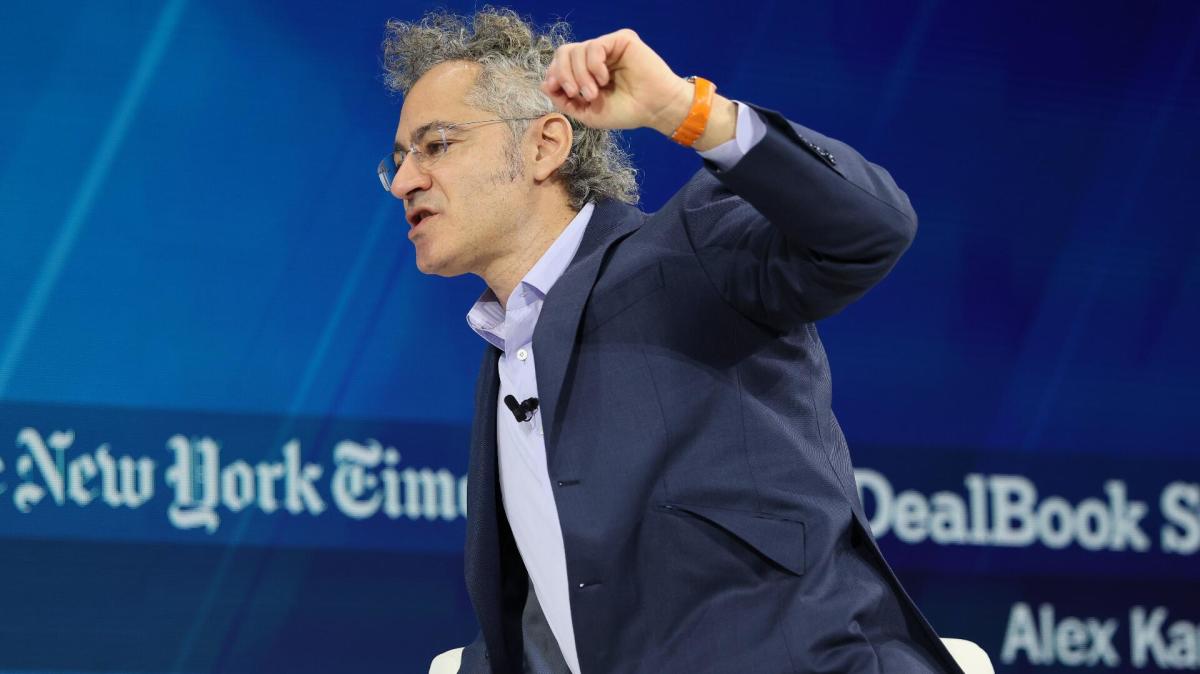
That's all good news for Palantir, a data analytics company that's been helping governments secure and analyze disparate data sets since 2003, when serial entrepreneur Peter Thiel and CEO Alex Karp founded it.
In recent years, Palantir has leveraged its extensive experience with data to help companies rapidly develop AI projects, positioning the company as one of the most prominent AI companies.
Palantir’s platforms at a glance:
- Foundry: Allows enterprises to mine and exploit data securely.
- Gotham: Provides mission-critical data insights to the government.
- Artificial Intelligence Platform (AIP): Turnkey AI solutions for Foundry and Gotham customers.
The shift has resulted in massive revenue growth and significant gains for investors savvy enough to spot the opportunity early on, including long-time Wall Street veteran Stephen Guilfoyle.
Guilfoyle, whose career spans working on the New York Stock Exchange floor during the 1987 crash, recommended Palantir when it was trading below $7. Over the past two years, he has picked Palantir as his single best idea for TheStreet Pro members and has re-upped his recommendation multiple times, resulting in impressive gains.
This week, Guilfoyle again reconsidered his outlook on Palantir following a recent sell-off in its shares. Given his track record with the stock, paying attention to what he thinks may be profit-friendly. David Dee Delgado / Getty Images
Palantir pockets profits as AI goes mainstream
AI is far from a new concept. Research has been underway since the 1950s, when the mathematician and computer scientist Alan Turing pondered AI computers, and Rand Corp. created the first AI program in 1956.
Science fiction books and movies, from Isaac Asimov’s “I, Robot” short stories in the 1940s to "Tron: Ares" and beyond, have explored the possibility that machines could think for themselves someday.
Palantir annual revenue
- 2025 (est): $4.4 billion
- 2024: $2.9 billion
- 2023: $2.2 billion
- 2022: $1.9 billion
- 2021: $1.5 billion
Source: Yahoo!Finance, Macrotrends
However, AI didn't achieve its mainstream moment until the launch of ChatGPT in 2022. ChatGPT's success uncorked a flood of R&D from rivals like Alphabet, Meta Platforms, and Anthropic, setting the stage for enterprises to pivot IT budgets toward upgraded data centers and AI app development.
IDC estimates that spending on AI will exceed 25% of total global IT budgets within five years, reaching a staggering $1.3 trillion (yes, with a "t") by 2029.
Related: Forget Palantir, another AI stock is up 180% in 2025
"Application and Services providers that are behind in putting AI into their products and not extending them with agents are risking market share losses to companies that made the decision to put AI at the center of their product development roadmap," wrote IDC Rick Villars, group vice president, in a recent report.
The surge in activity has been great for Palantir, which has quickly become a go-to AI development solution for Fortune 500 companies.
Hyperscaler capital expenditures in 2025 (est):
- Meta Platforms: $70 to $72 billion
- Alphabet: $91 to $93 billion.
- Microsoft: $115 billion
- Amazon: $125 billion
Source: Meta, Alphabet, Microsoft, Amazon’s SEC filings and Q3 earnings conference calls.
In Q3, Palantir revenue grew 63% year-over-year and 18% quarter-over-quarter to $1.181 billion, exceeding Wall Street analysts' estimates by $90 million. Importantly, because stock prices follow earnings over time, Palantir's earnings per share, or EPS, was 21 cents, 4 cents better than estimates, and up from 10 cents one year ago.
The company's CEO Alex Karp painted a rosy picture about the company's performance, saying in Palantir's earnings call:
Importantly, Palantir issued higher-than-expected guidance, suggesting we're not yet at peak demand for its software services.
Wall Street analyst revamps Palantir stock price target after tumble
Guilfoyle has watched Palantir more closely than most, having tracked its performance every quarter since first picking the stock for investors when it was trading in the single digits.
From a business perspective, he liked what he saw from Palantir's third-quarter performance.
"The firm closed 204 deals of at least $1 million, 91 deals of at least $5 million and 53 deals of at least $10 million for the period as the customer count grew 45% year over year and 7% sequentially," wrote Guilfoyle in a TheStreet Pro post. "Very hard to top numbers like that."
Palantir's guidance is for full year sales of $4.396 billion to $4.4 billion, up 53% year over year at the midpoint, and above $4.16 billion analyst forecasts. The company also upped its full-year free cash flow target to at least $1.9 billion from $1.8 billion. Altogether, that led Guilfoyle to say:
Palantir's fundamentals are clearly strong and arguably strengthening, but Guilfoyle did spot one area of concern. Stocks tend to trade based on the future, not the past, and technical analysis isn't as supportive as it was a couple of months ago.
Technical analysis examines price action for clues into market sentiment, and recent weakness across AI stocks has dented the technical outlook for shares, according to Guilfoyle.
Palantir's shares peaked on Nov. 3 alongside its earnings release, and have retreated significantly since then, trading as low as $148 on Nov. 21.
"The entire marketplace went into a rotation that saw November take a bite out of the AI-trade and elite-level tech stocks broadly. The stock gave up its 50-day SMA, which forced some portfolio managers to reduce exposure. The stock hit resistance close to its 21-day EMA after losing that level, indicating that the swing crowd had turned against Palantir," wrote Guilfoyle.
Fortunately for investors, Palantir has clawed back some of its losses, rallying 13% since then. However, the technical damage done has nevertheless forced Guilfoyle to rein in some of his enthusiasm, lowering his price target to $215 from $226.
What's next for Palantir stock?
Guilfoyle's lower price target isn't necessarily a harbinger of doom, given that his target remains 23% higher than the price at which Palantir shares changed hands on Dec. 3. Still, ratcheting the price goal lower suggests that investors will want to keep a closer eye on Palantir than they might have earlier this year.
The stock is currently testing its 21-day moving average, and a failure to recapture it could mean an increased risk of shares retreating to the 200-day moving average, a level used by many professional investors as a key support level. Currently, the 200-day moving average is a little above $140.
The real test, however, will be how IT budgets get set for 2026. So far, all signs point toward more, rather than less, spending. Goldman Sachs, for instance, expects hyperscalers to increase their capital expenditures to $533 billion next year, up 34% from 2025.
That suggests a substantial tailwind remains behind overall enterprise and government AI activity, supporting ongoing revenue and profit opportunity for Palantir to grow.
The company's AI development solutions within AIP remain a solid option for companies, given that building tools from scratch is time-consuming. That should support demand for its Gotham and Foundry platforms.
Further entrenching it with customers is Palantir's use of AI forward-deployed engineers, an agentic AI solution designed to understand each client's business to better build custom AI solutions.
“Palantir is leveraging on Agentic AI to extend the FDE capabilities to more use cases. The AI FDEs will accelerate growth,” wrote Bank of America analysts in a research note to clients in September. “We see the AI FDEs as an accelerator of growth.”
Currently, Wall Street analysts' consensus forecast is for Palantir revenue to reach $6.19 billion next year, up 41% from 2025. EPS is expected to improve to $0.99 from $0.72 this year.
Further out, Bank of America projects “Commercial sales to exceed $10 billion by 2030e (2025-30 [compounded annual growth rate] up to 40% from 38%).”
Bank of America's $215 price target matches Guilfoyle's.
Related: Fidelity portfolio manager updates tech stocks forecast for 2026
What's Your Reaction?