
























Anheuser-Busch's new deal leans into high-alcohol content trend
In high school health class, way back in 1989, we learned that a beer, a properly measured shot of liquor, and a glass of wine all have roughly the same amount of alcohol content. That rough guideline is a reasonably good way to monitor your own alcohol consumption. You can drink a mug of beer over ...
In high school health class, way back in 1989, we learned that a beer, a properly measured shot of liquor, and a glass of wine all have roughly the same amount of alcohol content.
That rough guideline is a reasonably good way to monitor your own alcohol consumption. You can drink a mug of beer over an hour or sip a glass of wine in the same time period, and that's very different from downing three whiskey shots in rapid succession.
Most drinkers understand the basics, but what happens when alcohol companies start blurring the line? Then, the situation becomes confusing, like energy drinks, where the size of the can may not correspond to how much caffeine the drink contains.
This has always been an issue in the alcohol space, and usually bars handle it responsibly. Many bars, for example, serve beers brewed to have a higher alcohol content in 8-ounce, rather than 12 or 16-ounce servings, and the menu usually explains why.
When it comes to alcopops, however, consumption tends not to be in bars and alcohol content tends to be higher than (often much higher) than a comparably-sized beer. Add in larger serving sizes and drinking that's not supervised by a bartender, and there's a clear path to over-consumption.
That's a market Anheuser-Busch wants in on as the company has bought a controlling interest in "BeatBox, a rising star in the ready-to-drink (RTD) beverage category that is known for its bold, fruit-forward 'Party Punch' flavors," according to a press release.
Alcopops are a beer alternative
Just because a product is marketed as an alcopop does not mean that the intention of the brand is for consumers to quickly get drunk.
Mike's Hard Lemonade and Twisted Tea fit this category, and they're marketed as responsible and tastier alternatives to having a beer. They're also sold in beer-size 12-ounce cans and bottles.
"Supersized alcopops are a class of single-serving beverages popular among underage drinkers. These products contain large quantities of alcohol," according to the scientific study College Students' Underestimation of Blood Alcohol Concentration from Hypothetical Consumption of Supersized Alcopops.
The research showed that college students were not good at understanding who a supersized alcopop would impact their blood alcohol content (BAC) compared to beer.
"When asked how much alcohol they could consume before it would be unsafe to drive, students in the supersized alcopop group had 7 times the odds of estimating consumption that would generate a calculated BAC of at least 0.08 g/dl, compared to those making estimates based on beer consumption," according to the report. Shutterstock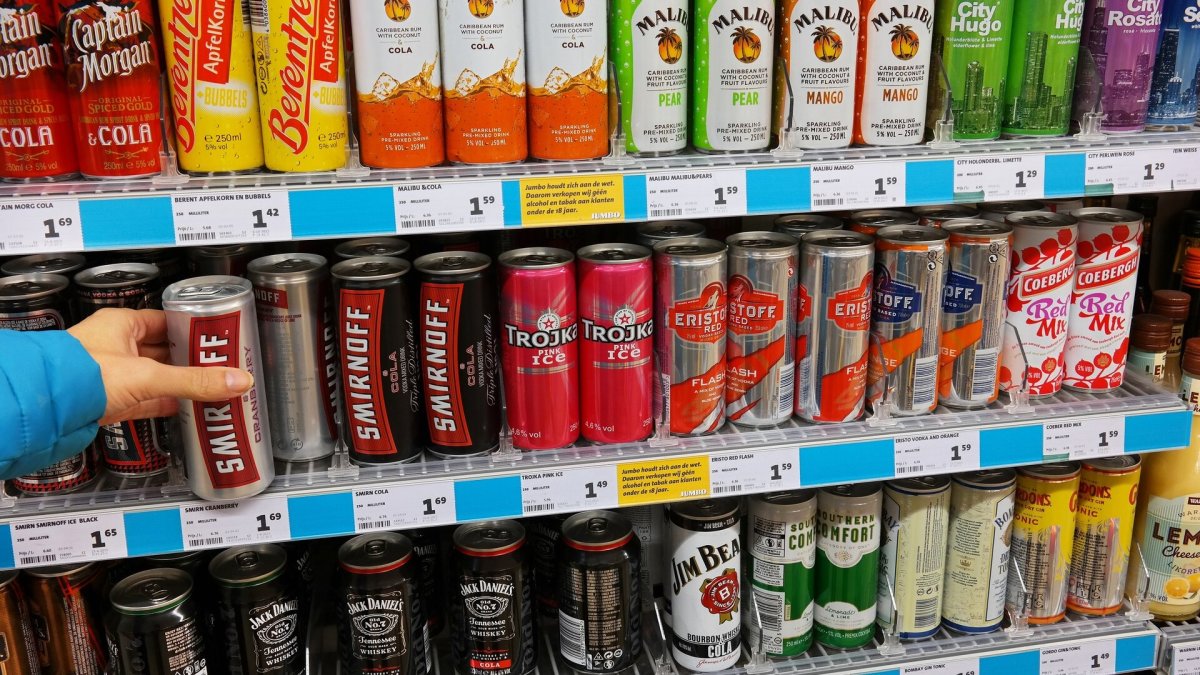
Anheuser-Busch makes an alcopop move
Anheuser-Busch shared plans to acquire a majority stake in BeatBox, in a Dec. 5 press release.
"The transaction adds a world-class brand to A-B’s fast-growing Beyond Beer portfolio, which already includes Cutwater Spirits, NÜTRL Vodka Seltzer and Phorm Energy. As a top 10 RTD brand in the industry, BeatBox complements A-B's Beyond Beer portfolio and brings flavors and styles that are incremental to the company’s current RTD offerings," the company shared.
BeatBox Party Punch, BeatBox's signature product, comes in a variety of sizes.
- 500 ml carton/box (single‑serve or multipacks).
- 16.9 fl oz bottles/cartons ( 500 ml) for individual punches.
- 3‑liter bag/box format (a “party punch” size), introduced as a larger‑format option for sharing.
Source: Beverage Industry
BeatBox offers a number of flavors, including Pink Lemonade, Hard Tea, a variety of fruit-flavored hard teas, and other fruity flavors, all with 11.1% alcohol by volume (ABV).
More Retail:
- Costco CFO makes rare pricing promise
- Home Depot faces growing consumer boycott calls ahead of holidays
- Target’s efforts to make amends with customers hit a snag
- Amazon lawsuit could be a warning to other employers
"Makes every party worth the squeeze. Orange Blast is what happens when juicy oranges finally decide to go buck wild. Bright, zesty, and unapologetically citrusy—it tastes like someone cranked that sunshine dial up to 11. At 11.1% ABV, it's the sipping equivalent of a high-five on a sublime day," BeatBox shared on its website.
The company does have a Hard Tea, which has a lower, 8% ABV.
Dr. Matthew Rossheim, an expert on supersized alcopop consumption and related health outcomes, led a study published in Drug and Alcohol Dependence.
"A number of studies we've conducted have shown that supersized alcopops are commonly consumed by underage drinkers, which often results in serious negative consequences," shared Rossheim. "Our latest data show a clear trend of supersized alcopop consumption among underage young people requiring poison center services. In this way, supersized alcopops appear to pose a distinct threat to youth."
What is a standard drink?
The National Institute of Health (NIH answers the question of what is a standard drink?
"Drinks like beer, wine, and distilled spirits often contain very different amounts of alcohol. This means the size of an alcohol-containing beverage alone does not determine its alcohol content. For example, many light beers have almost as much alcohol as regular beer – about 85% as much," the NIH's National Institute on Alcohol and Alcoholism reported.
Here’s another way to put it:
- Regular beer: 5% alcohol by volume
- Some light beers: 4.2% alcohol by volume
- Some craft beers: 10% alcohol by volume
- A 12-ounce can of regular beer at 5% alcohol by volume
- A 5-ounce glass of wine at 12% alcohol by volume
- A 1.5-ounce shot glass of distilled spirits at 40% alcohol by volume
"While a 12-ounce bottle of beer at 5% alcohol by volume contains one standard drink, a 12-ounce bottle of beer at 10% alcohol by volume contains two standard drinks. That’s why it’s important to know how much alcohol your drink contains," the federal agency shared.
BeatBox is not a standard drink
Alcopops and malt beverages that look like beers, but often have higher alcohol content which are sometimes also served in larger serving sizes, have been a problem dating back to the 80s.
"They taste like Sprite with extra sugar," Leah Lewin told CBS News correspondent Cynthia Bowers in 2004. "You don't even know the limit because you keep drinking them."
These drinks, because they don't have an acquired taste like beer or whiskey, appeal to underage drinkers.
"Supersized alcopops are ready-to-drink flavored alcoholic beverages with high alcohol content that are disproportionately consumed by underage drinkers. There can be up to 5.5 standard alcoholic drinks in a single 24-ounce can, so consuming only one can of supersized alcopop is considered binge drinking, and consuming two cans can cause alcohol poisoning," Medical Express reported.
BeatBox started as a college project
"Founded in 2012 as an MBA project at UT Austin, BeatBox gained national attention in 2014 after a game-changing appearance on Shark Tank," the company shared on its LinkedIn Page. The company shared some more facts about its business on that page.
- Today, the 'Original Party Punch' is sold in all 50 states and available at over 120,000 retail locations nationwide.
- As one of the fastest-growing ready-to-drink (RTD) beverages in the United States, BeatBox offers more than 13 flavors served in its signature sustainable, resealable packaging.
- Ranked as the #1 RTD alcohol brand in convenience stores for 2024, BeatBox "combines innovation, philanthropy, a passion for live music, and a thriving community of superfans to deliver fun, flavor-packed energy with every sip," the company shared.
Anheuser-Busch is acquiring 85% of BeatBox for a purchase price of up to approximately $490 million, with a path to 100% ownership after five years based on a predetermined pricing formula. This transaction is subject to regulatory approval and customary closing conditions, and it is expected to close in the first quarter of 2026.
Related: Coca-Cola quietly makes a massive change to its soda brands
What's Your Reaction?