





























Are Food Prices Trending Downward in 2026?
Broadcast Retirement Network's Jeffrey Snyder discusses food prices in 2026 with Texas A&M University's David Anderson, PhD. Jeffrey Snyder, Broadcast Retirement Network Dr. Anderson, it's so great to see you. Happy New Year to you, sir. David Anderson, PhD., Texas A&M University And ...
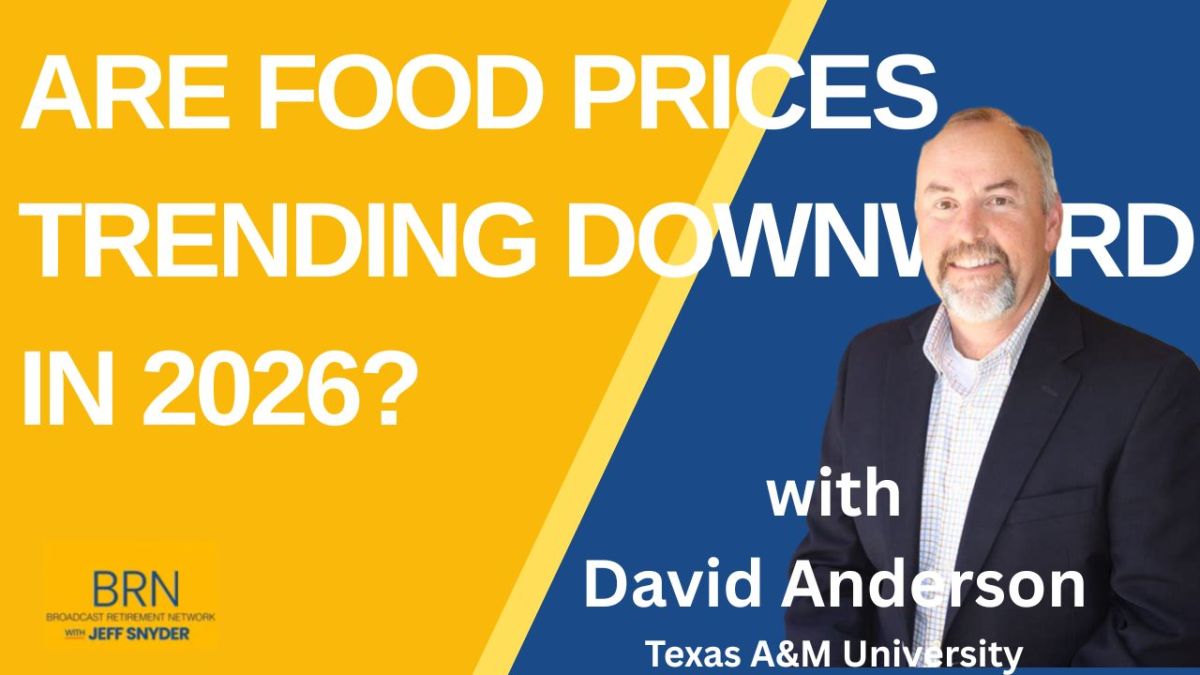
Broadcast Retirement Network's Jeffrey Snyder discusses food prices in 2026 with Texas A&M University's David Anderson, PhD.
Jeffrey Snyder, Broadcast Retirement Network
Dr. Anderson, it's so great to see you. Happy New Year to you, sir.
David Anderson, PhD., Texas A&M University
And Happy New Year to you, too. It's great to be with you.
Jeffrey Snyder, Broadcast Retirement Network
Yep, it's great to be with you. I always appreciate your analysis, and we're going to be talking about food prices, and the calendar has flipped. A lot of talk about affordability, and my first basic question to you is, are we seeing a downward trend when it comes to food prices?
David Anderson, PhD., Texas A&M University
Well, overall, I think it's not really. But again, like a lot of times with food prices, it depends on what we're buying. There's been a lot of ups and downs.
Even going into the holidays, we had some items less than they were a year ago, and some items more. And I don't think that's any different as we, because the calendar's flipped, I don't think that's changed where we are in terms of prices.
Jeffrey Snyder, Broadcast Retirement Network
Yeah, and you happen to be an expert in beef. That's one of the areas I've been looking at, and it looks like, sir, the cost of beef has not really dropped significantly. What's your analysis there?
David Anderson, PhD., Texas A&M University
Well, it really hasn't, and I think we have a couple of things going on. Fundamentally, we still have very tight supplies and a shrinking herd. We're making up for the lack of animals by heavier weights, that each animal goes to market at heavier weights than a year ago.
And in fact, the last six weeks or so of 2025, we had all time record heavy weights. So we're making up in pounds what we don't have in terms of number of heads. So that's helping on the supply side.
The last CPI report, if we looked at an average of choice beef across a bunch of cuts, prices dropped about 3 cents versus the month before, but 3 cents on over $10 per pound is not very much, and we're still about 20% higher than we were a year ago. And I don't think that's likely to change in the new year.
Jeffrey Snyder, Broadcast Retirement Network
Dr. Anderson, beef is such a staple of the American diet. A lot of, hey, look, everyone loves a good steak, unless you're a vegetarian, of course, or don't like steak, but what are some of the factors that have led to this elevated beef price? Is it things like, you mentioned the herd's not big enough?
David Anderson, PhD., Texas A&M University
Yeah. So why the herd is smaller than it was is really because of higher costs, some years of very low cattle prices, some drought in many producing areas, major producing areas in the US. And so from a supply standpoint, our herd's smaller because whether it was rainfall or poor economics, we have a smaller herd and we really have not quite started growing again.
So I think fundamentally, that's the main thing. The other part is just costs of getting it from where it's produced to where all of us consumers are, and whether that's transportation costs, labor costs, energy, the whole works, that's part of this story as well. But I think the third part that I think is pretty critical, particularly on beef prices, is just simply that consumers, all of us like beef and folks continue to buy.
So even though we have had record prices, I think people still see that as good value for the money and we continue to buy. So that's got prices pushed higher.
Jeffrey Snyder, Broadcast Retirement Network
You mentioned some of these, I'm going to call them economic inputs. You're the economic professor, not I. But you mentioned transportation costs.
We have seen the price of gasoline start to tick down. In fact, it started to tick down during the holidays, just in time for the holiday season. Electricity costs, though, look like they still remain fairly high.
All of that kind of gets baked into the overall price of the beef per pound.
David Anderson, PhD., Texas A&M University
Yeah, it really does. And that transportation fuel, which is really your diesel and gasoline, those have started coming down. But also there's a lot of lags in the economy where it takes time for that to materialize in terms of really lower production and transportation costs.
So that takes some time. Now for our wallets, that translates pretty fast because we're buying fuel to go where we need to go. And so that does provide a little bit of relief, I think, for many of us.
But that relief may be spread across a lot of other items besides just beef or pork or chicken or anything else.
Jeffrey Snyder, Broadcast Retirement Network
So, Doctor, here we are in January. I know that the administration and the government are focused on trying to help drive prices down. Could we see these key staples continue to come down in 2026?
Or is drought and some of the other inputs to the overall prices going to remain kind of where they are today and create challenges in terms of affordability?
David Anderson, PhD., Texas A&M University
You know, there's really not much government can do in terms of making a big change in terms of meat prices, beef, pork, chicken, you know, drought on the beef side, poor economics leading to where we are today is certainly part of that. There's not much you can do to grow a herd faster. You need rainfall and grass and profitable prices, which we certainly have, but have not had for very long.
So there's not much you can do there. On the other side, there's really not much you can do on the others as well. And so, you know, fundamentally, we sort of are where we are in terms of what we're producing.
Jeffrey Snyder, Broadcast Retirement Network
And my last question is consumers, I guess, will continue to be judicious with their dollars and cents over the next 12 plus months as we continue to kind of battle some of these, personally battle or individually battle some of these prices on behalf of our families?
David Anderson, PhD., Texas A&M University
Well, I think that's right. And, you know, really where we are is we're going to keep having to struggle for many of us and in allocating our budget across all the different needs that we have. And I don't think that'll be any different just because the calendar changed.
Jeffrey Snyder, Broadcast Retirement Network
Yeah, absolutely. We've got about a minute left, Dr. I just want to kind of turn it over to you. What do you think some of the key takeaways from our conversation are this morning?
David Anderson, PhD., Texas A&M University
You know what, I've got a couple for the new year really focusing on the meat side. Fundamentally, you know, we're going to produce less beef. I think the pressure stays for higher prices.
We continue to have very good meat demand that hope overall protein segment will continue to stay strong, supporting meat demand. One of the things I think we will see are some lower chicken prices. We're producing more than we did a year ago.
Chicken we might think of as getting more market share in terms of what we're producing. And we certainly had lower wholesale prices for chicken as well. We may see some lower pork prices also, particularly in the next couple of months.
The CPI report indicated lower prices than a year ago for both pork and chicken.
Jeffrey Snyder, Broadcast Retirement Network
Well, I think a lot of families out there are counting on some declining prices. I guess we'll have to wait and see as we always do month to month. Dr. Anderson, great to see you. Thanks for joining us. Happy New Year. And we look forward to having you back very soon.
David Anderson, PhD., Texas A&M University
Sounds great. Happy New Year.
What's Your Reaction?