































Battling Veteran Debt
Broadcast Retirement Network's Jeffrey Snyder discusses how veterans can manage their mounting debt with End Veteran Debt's Jerry Ashton. Jeffrey Snyder, Broadcast Retirement Network Good morning, welcome back to the broadcast Retirement Network. This is BRN AM for Wednesday, July 3rd, ...
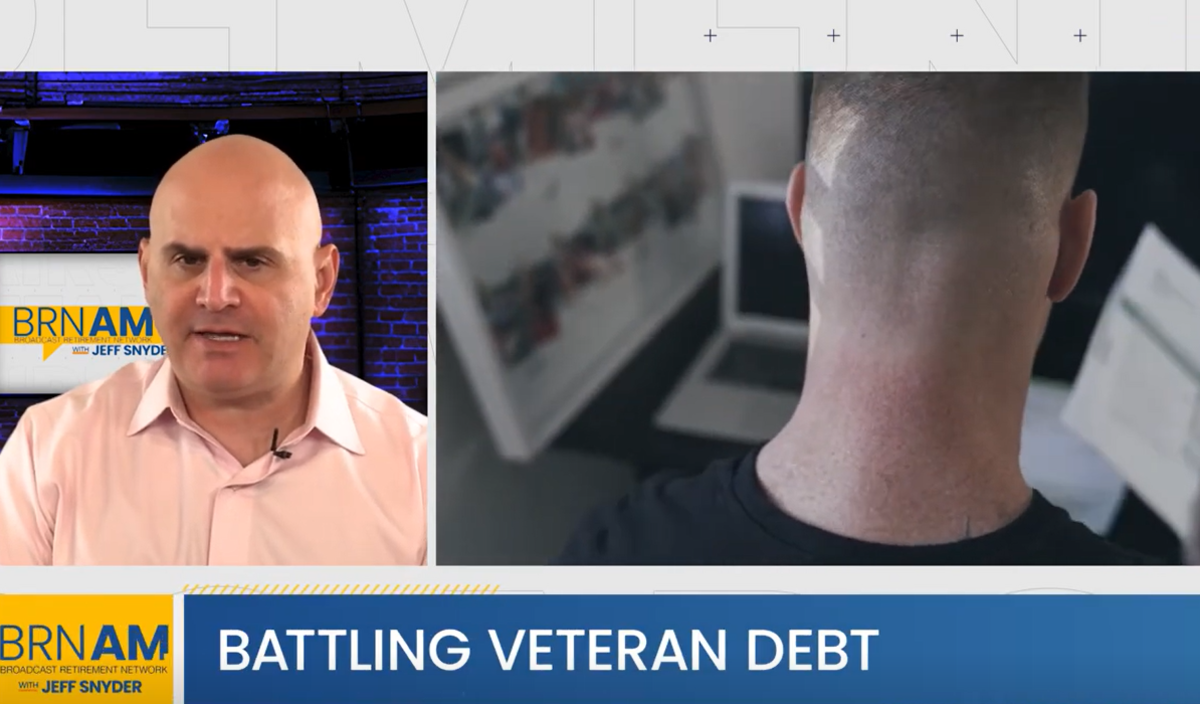
Broadcast Retirement Network's Jeffrey Snyder discusses how veterans can manage their mounting debt with End Veteran Debt's Jerry Ashton.
Jeffrey Snyder, Broadcast Retirement Network
Good morning, welcome back to the broadcast Retirement Network. This is BRN AM for Wednesday, July 3rd, 2024. And our top story today, battling veteran debt.
Joining me now to discuss this and a lot more, Jerry Ashton is with End Veteran Debt. Jerry, so great to see you. Thanks so much for joining us on the program this morning.
Jerry Ashton, End Veteran Debt
Well, I'm very pleased to be here. Thank you.
Jeffrey Snyder, Broadcast Retirement Network
And we're pleased to have you. And as we were talking about in the quasi green room, because we're distanced from each other, but we're doing this virtually, veterans are an important constituency in our programming, in our audience. And we want to make sure that we cover all these important issues.
That being said, there's an issue that probably doesn't get a lot of media attention. And that is veteran debt. You want to tell us how pervasive this is and what it looks like?
Jerry Ashton, End Veteran Debt
Well, you're right about one thing. Nobody knows about it. Nobody talks about it.
You can't talk about something you don't know about. And veterans are the least people likely that will share with anybody that they're sick, broke and being chased by bill collectors. How does that happen in an America where these people have basically signed a blank check that said, I'm willing to give anything up to including my life to protect you and to protect my country.
They serve whatever time they serve. In my case, I was a Navy journalist for four years. And I did my tour.
I was glad to do it. Felt great about it. It gave me wonderful skills.
And then I went home. And then there are people that are, you know, spend 20, 30 years of their life making sure that America is guarded and taken care of. Both deserve the appreciation, the attention that they get.
And few of them get it because they don't talk about it. What do I mean by that? Well, right now, the VA itself will deny $2 billion worth of medical claims that will be made by veterans.
$2 billion. Now, if a claim is rejected, what happens to it, it goes back to the backs of the veterans. They don't talk about it, but it puts them into bankruptcy.
They lose homes, credit. And I guess, worst of all, they're doing it alone and lonely. And being a veteran is not easy because veterans do not have an easy time of expressing their concerns with their civilian constituents and friends.
Jeffrey Snyder, Broadcast Retirement Network
Yeah. And so, obviously, this is very pervasive. A lot of people don't know about it.
You mentioned the rejection, I don't know how else you put it, of some of these expenses. Is there a rationale as to why that's occurring? Why it is not some of these medical procedures or things are not being covered by the VA?
Jerry Ashton, End Veteran Debt
Well, let's just use medical as one example. And I want to give people an idea that in my background, I was fortunate enough to co-found a charity called RIP Medical Debt. That charity, since we established it in 2014, has abolished over $12 billion worth of medical debt across the universe, across America, for anybody and everybody.
A small percentage, of course, were veterans. But veterans have more than just a medical debt on their back, and that's bad enough. They have every other form of debt, everything from debt of necessity, meaning you got to put tires on the car, meaning you have to make a decision whether or not to pay the debt collector or put food on your table, debt that's predatory, payday loans, car notes, usurious credit card rates.
These are all piled on the backs of veterans who, even in their service life, were barely had enough money or enough pay to be able to cover them. So, it's the overall picture of debt. Going back to the VA, people don't understand that the VA is discretionary.
It can choose who it wants to receive any form of handicap payments or disability payments, or whether or not an ambulance that you took to a civilian hospital is going to be covered, much less the civilian hospital, because in either case, maybe it wasn't a service-related problem. So, you see the veteran, and by the way, more than 40% of all veterans, they don't even use the VA for various reasons. Too far away from any to reach, to go to, and of course, facing the hurdles of qualifying for some form of debt relief.
Don't get me started.
Jeffrey Snyder, Broadcast Retirement Network
Yeah, no. I mean, obviously, it's a big problem, and in my brain, I'm just thinking, well, how can you pick and choose who gets a benefit? That's one of the benefits, pun intended, of being a military member is I think about the VA, I think about the GI Bill and getting education, and then also transitioning back into civilian life, because many of our veterans have fought in wars over the past two decades.
So, they haven't served in peacetime. They've actually been deployed multiple times. But with that being said, let me ask you, it's not just the impact to the veteran that we're talking about here.
It's also their family, and I can think about the stress, the stress on a spouse or partner, but also the stress on children and other family members. That's a weight not only on the veteran, it's a weight on these individuals as well.
Jerry Ashton, End Veteran Debt
Well, let's address that, because this is the bigger problem that America needs to recognize and step up to and solve. When I retired from RIP Medical Debt, I started a 501c3 private charitable foundation called End Veteran Debt. It's a sole purpose, raise awareness, get people participating and ending veteran debt, because it's all the things that precede the debt and the things that follow the debt that are destroying the veteran's lives.
So, you got to get awareness. So, we are, what we're putting out now is a campaign called Campaign Operation Debt Day. You've heard of D-Day, right?
Absolutely. We just had the celebration of D-Day. Everybody knows June 6th as D-Day.
Well, the veterans in 1944 and 1945 returning home came to a much different America than our veterans are coming to. The GI Bill is not nearly as generous as it was then. The health care was not as pervasive and widely available as it is today.
So, today's veteran making what you and I call that transition, going from a very structured life where there's purpose, there's meaning, to ending up in a community where, you know, just keeping your job is your mission or purpose for most people, and it's disorienting. Then, when the challenges come in, when debt starts piling up with or without the intelligence or the consent of this individual, that's when the stress really shows up. That's when you create what we call suicidal ideation.
Very few people are aware of the fact that debt is a social determinant of suicide. The very fact that not only are you facing all the problems that you're facing, but on top of that, you're dealing with debt that's unpaid and unpayable, and you have no place to go. Thank God there are many military charities, local ones as well, more than national, that step up and do their best.
But why in the world do we need a charity to step up and take care of our veterans when we should be doing it? So, it's this mixed blessing of the work that we're doing.
Jeffrey Snyder, Broadcast Retirement Network
Yeah, and you bring up, and I want to get to that after the commercial break. Jerry, when we come back, we're going to talk more about ending veteran debt. How do we do that?
How do we make more people aware? You're going to want to stay tuned right here on BRM AM. Now is your opportunity to co-create content around any topic on the FIRST Lifestyle and Wellness Network.
Reach a global audience through our platform and co-own exclusive branded content. All of our programs are available on demand and also as audio-only podcasts, so you can take us on the go. Broadcast Retirement Network, available anytime, anywhere, and on any device.
Welcome back. We're joined this morning by Jerry Ashton of End Veteran Debt. Jerry, thanks so much for staying with us this morning.
Jerry Ashton, End Veteran Debt
Well, believe me, I have a few more things to say, and I hope your audience is up for it, because I'm going to get real serious here.
Jeffrey Snyder, Broadcast Retirement Network
Well, I think they are up for it, and I think our audience has a large constituency of veterans, as does yours. So, we appreciate you sticking around. Haven't chased anybody off yet, and that's always good.
Jerry, you talked about End Veteran Debt Day. Let's talk about awareness and education. How important is this awareness, and how important is it to provide education to our veterans and their families to avoid taking on debt?
Jerry Ashton, End Veteran Debt
Yeah, both of those are excellent questions. A lot of people, out of judgment, of not really understanding things, feel that if somebody's in debt, it's their fault. You know, if they hadn't bought that widescreen TV, taken that vacation, if they'd only been more thoughtful.
No, it isn't always that case, and you and I both know it, and our listeners know it. Some things come up and slap you alongside the head that you never would have expected. When they did a study of veterans and said, how well are you doing financially?
Less than 50% of them had as much as $500 in the bank to meet an emergency, and the majority of them had no money in the bank in case of emergencies. So, that does happen. What to do about it?
There are four things that make things happen, and I want your listener especially your veterans, I'm talking to you guys and gals, because there are four things that are necessary to bring about change. If we want to change this, if we want to make the lives of veterans easier, if we want to reduce veteran suicide, four things. Number one is awareness.
If you don't know about it, nobody can do anything about it. So, a lot of this is getting awareness. I was lucky with RIP Medical Debt because John Oliver discovered us, and he made us very public to everybody, and we never had to worry about money after that.
We don't have a John Oliver for veterans at the moment, but we do need the kind of awareness that even word of mouth, maybe local newspapers, maybe the very fact that the podcast that you're doing right now is essential to one person listening and saying, I can change that. So, it's first awareness. Once people are aware, however, there's another thing that you and I have no control over.
It has to register. It has to resonate. It has to touch them.
Believe it or not, a lot of people are not touched by someone else's problems. That's their problem, not mine. So, minimal example, I like garden clubs.
I'm aware that they exist, but I don't resonate with them. With veteran debt, you have to resonate that this is wrong. This needs to be changed.
So, once somebody is aware and they're touched, the next thing is education. You're an excellent example of that, educating people. When you go to nveterandebt.org, you'll find out that we have what is called subject matter experts, people that are there to counsel veterans what to do before the problem and what to do after the problem. But to have that kind of education, why did this happen? How did it happen? How can I go upstream to understand it better and downstream to change it?
So, aware, touched, educated, because once somebody hits all those three criteria, the only thing left is action, doing something about it. Now, here's my action plan. We created a campaign called Operation Debt Day, not D-Day, Debt Day, because that's what our veterans are facing when they come home.
So, Operation Debt Day, what does that mean? Go to our website, check it out, and you'll find out that we are seeking to abolish between June 6, 2024 and June 25, 2025, $80 million worth of veteran debt. Symbolically, that's $1 million for every year that's passed since D-Day.
So, what is that going to require? Well, there's always general donations. Go to our website, donate if you would.
You can what we call a plank owner, which for a huge $500 and up, people can say, okay, I'd like to get on board this ship. I'll own a plank. What do I need to do?
And we'd love to have you and process you. We'll even put your website and a link on our page so that people can go back to you and say thank you. And then, of course, there's the campaign itself.
We're looking for 80 organizations, 80 individuals, 80 companies that will commit to raising enough money to abolish $1 million worth of veteran debt. How much is that? Well, you're talking to a former bill collector.
In the collections industry, I was an executive. My buddy then, Craig Antico, who now has a company called ForgiveCo, we both co-founded RIP Medical Debt. So, he creates a public benefit corporation and I create a charity so that we can work together.
What I do is I raise the money and when I give him the money, he goes out and he gets the debt and sees that it's exterminated. It takes for an organization that just wants to abolish that debt and help us with our local work $30,000 for $1 million. That's three cents on the dollar.
$30,000 gets rid of $1 million worth of pain. If you're an organization that's a charity, we'll do a co-fundraising with you. The same object is to create that $30,000 to abolish the debt and help us do our work, but then we share the revenue that comes in so that local charities can handle local needs.
That's the guy who needs tires on the car. That's the guy who needs to meet the rent. These are moments of, shall we say, not random acts of kindness, specific acts of kindness.
Jeffrey Snyder, Broadcast Retirement Network
Well, certainly, Jerry, there's a lot of debt to chip away at. This is an important milestone that you and EndVeteranDebt.org are doing. We're going to have to have you back.
We're going to have to continue to chip away at this. There's going to need to be a lot of education, but with education, a lot of awareness. We'll have to check back in with you again very soon.
Thanks so much for joining us. We look forward to having you back on the program again very soon.
Jerry Ashton, End Veteran Debt
Thank you, and thank you to the audience as well.
Jeffrey Snyder, Broadcast Retirement Network
That wraps up this episode of BRN AM. Have a topic of interest, someone you think we should talk to? Drop us a line.
Don't forget, for all the latest curated news in lifestyle, wellness, finance, tech, so much more, all in one place, check out today's edition of our daily newsletter, The Morning Post. Want to search our archives? Check out our latest content, then visit our website.
While we're not back again tomorrow because it's the July 4th Independence Holiday, we'll be back again on Friday, July 5th, with another great show, another great topic, and of course, another great guest. Until then, I'm Jeff Snider. Stay safe, keep on saving, and don't forget, roll with the changes.
Now it's your opportunity to co-create content around any topic on the FIRST Lifestyle and Wellness Network. Reach a global audience through our platform and co-own exclusive branded content. All of our programs are available on demand and also as audio-only podcasts, so you can take us on the go.
Broadcast Retirement Network, available anytime, anywhere, and on any device.
What's Your Reaction?