






































Everyone's a phony now: on performative men and the internet-raised self
Have you seen people over the internet increasingly accusing each other of performativity over the past year?
The Catcher in the Rye is the quintessential American novel for many — who can resist an angsty teenager talking about how he feels instead of (seemingly) made-up problems of the capitalist world?
Holden Caulfield doesn’t shy away from calling the world out in how flawed it is, the inherent systemic injustice, the farcical familial relationships, the desperation to curb loneliness and the grotesqueness of it, but despite all of the ugliness he sees in the world, the lowest blow that he can throw at you is being a phony.
STORY CONTINUES BELOW THIS AD
Holden believes that adults are so superficial that they simply don’t recognise their own insincerity. He is horrified to realise that his teenage peers embody the same spirit that he detests ever so much in adults.
As much as Holden is a beautiful soft boy in himself, and despite how brave he tries to be despite how lonely he is, the crux of the matter is that he wants to be loved by someone who sees the world as he does, desiring purity over made up claustrophobia inducing systems. The biggest insult he can bestow upon another human is to call them a phony.
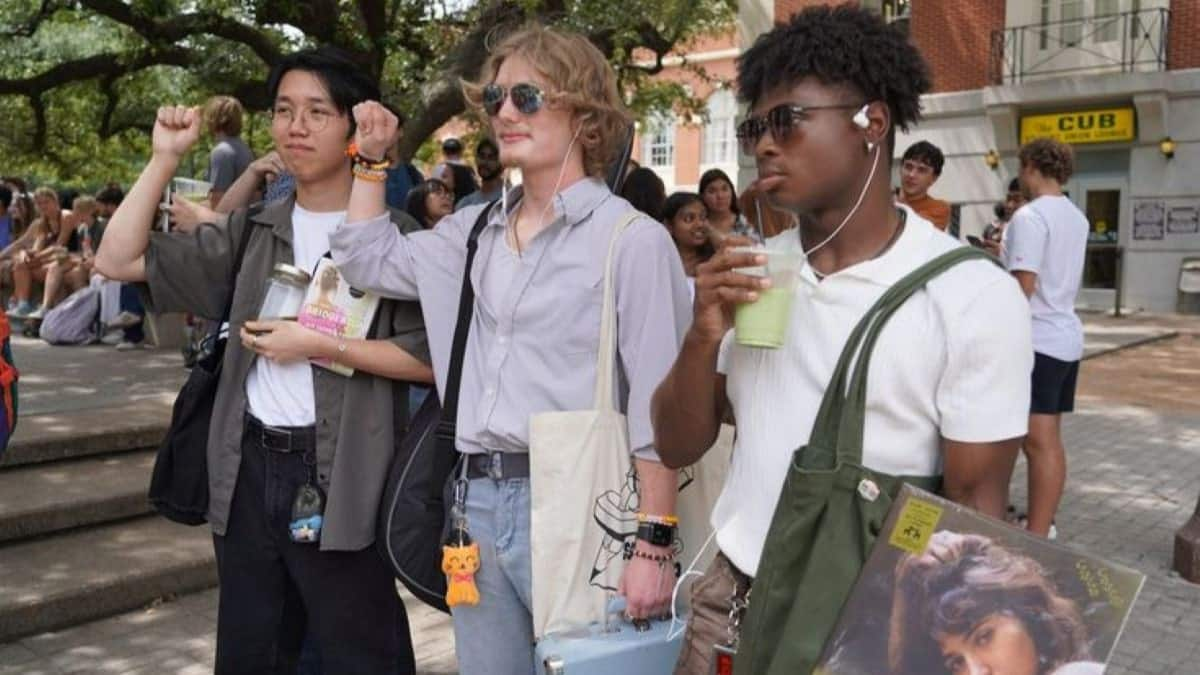
Today, the whole world is accusing each other of fraudulence of character the 90s poser kid who wore a short sleeve t-shirt over a long sleeved one and bought CDs by The Cranberries, has turned into man with Daunt Books tote bags sipping on a matcha latte, perhaps listening to Clairo or Phoebe Bridgers clutching onto a well-worn copy of The Bell Jar by Sylvia Plath.
His bookshelf groans with bell hooks and Sally Rooney; his politics are visible, his taste impeccable, his feminism loudly declared. He is accused of reading feminist books not to learn, but to get into everyone’s pants — woke fishing, as the internet has named it.
Nevertheless, long before the tote bag became a red flag, we were already suspicious of people who looked like they were trying too hard.
STORY CONTINUES BELOW THIS AD
What It Means to be Performative
In 2024, the word performative has lost whatever specificity it once had and hardened into a cultural reflex. It is no longer simply a critique of hollow political gestures or shallow allyship, but a broad moral judgement applied to personality itself. To be accused of performativity now is to be accused of fraudulence of the soul — of liking the wrong things for the wrong reasons, of aestheticising sincerity instead of inhabiting it.
The internet, raised on call-out culture and hot takes, has trained us to believe that authenticity must be instantly legible and effortlessly cool. Trying, desiring, or even earnestly learning in public becomes suspicious. In a world where identity is constantly broadcast, sincerity has become something you must prove — and most people fail the test.
This suspicion reached near-parodic levels with the explosion of Timothée Chalamet lookalike contests across cities and social platforms — gatherings that were at once absurd, affectionate, and deeply telling. Young men dressed as Chalamet’s various onscreen personas, competing not just for resemblance but for a certain kind of soft, cultured masculinity he represents.
In this sense, Holden Caulfield’s obsession with phoniness feels eerily prophetic. What he diagnosed as moral rot now manifests as a cultural paranoia — one that mistakes visibility for deception and punishes anyone who dares to rehearse a self before fully becoming it.
“I Wouldn’t Put Them as Performative Men”
Therapist Sanskriti Seth resists the instinct to condemn. Rather than categorising men as performative, she is more interested in the emotional logic behind the behaviour.
“I wouldn’t see anybody as a performative man coming into my space,” she says. “I’d be more curious about what’s making them choose these things … whether it’s genuine or if it’s in the pursuit of wanting to please people or get attention.”
STORY CONTINUES BELOW THIS AD
For Seth, performativity is about desire — specifically, the desire to be liked, validated, and accepted. People have always shaped themselves to appeal to others. What’s different now is how efficiently the internet tells us what that appeal looks like.
With social media, Seth notes, “it’s easier to know what will make you more admirable in the view of others.” Algorithms flatten complexity, feeding users a steady diet of what appears to be a single dominant narrative about taste, politics, and gender. Consume enough of it, and imitation weaved itself into your existence.)
Conformity, Upgraded
Seth links this to Asch’s Conformity Line Experiment, the 1950s study that demonstrated how individuals will conform to a group even when the group is objectively wrong.
“We are social beings,” she explains. “There’s a contrast between wanting to belong and wanting to stand out. But the need to belong is quite high.”
In the algorithmic age, conformity looks like matching aesthetics, values, and affect online. When masculinity is presented as either inherently harmful or dangerously misogynistic, the performative male becomes an alternative script: softer, safer, visibly aligned with progressive ideals.
STORY CONTINUES BELOW THIS AD
Why Softness Looks Suspicious
Why, then, is performativity so often diagnosed in men who read books, drink matcha, and carry tote bags?
According to Seth, it’s because these behaviours disrupt traditional masculinity, which has historically discouraged emotional openness and aesthetic sensitivity. Traditional masculinity does not really stand for expressing yourself in that way,” she says, pointing to how items coded as feminine or “artsy” become lightning rods for suspicion.
The accusation of performativity, then, appears to be about discomfort. These men are visible because they are legible as different.
It was Judith Butler who famously described gender as a performance, speaking about it acquiring its reality through repetitive construction. Girls who get dolls as toys and learn to feed them and care for them and men who get racing cars and the spirit of adventure.
STORY CONTINUES BELOW THIS AD
For centuries, it has been women and girls who have been accused of being imposters and feigned personalities, the default fakes: gamer girls, ‘pick me’ girls, the women men online call performative for doing their makeup in a whimsical manner and the infinite number of women we accuse of just liking things for ‘the sake of men’.
The fact that men can now be called performative, is almost like some sick twisted comeuppance. But it certainly isn’t fair.
What's Your Reaction?