



































Galaxies with ‘hoop skirts’ are more common than we thought
The discovery of thousands more galaxies with stars ringing their main disks could help astronomers study galactic evolution more generally.
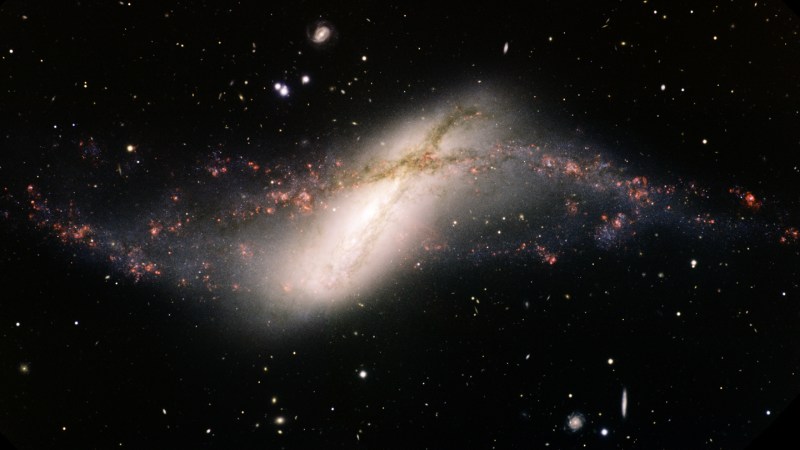
Astronomers have discovered thousands more galaxies with stars ringing their main disks
The galaxy NGC 660 (shown) is an example of a polar ring galaxy, in which the main galaxy sports a belt of stars or gas roughly perpendicular to its disk.
International Gemini Observatory/AURA
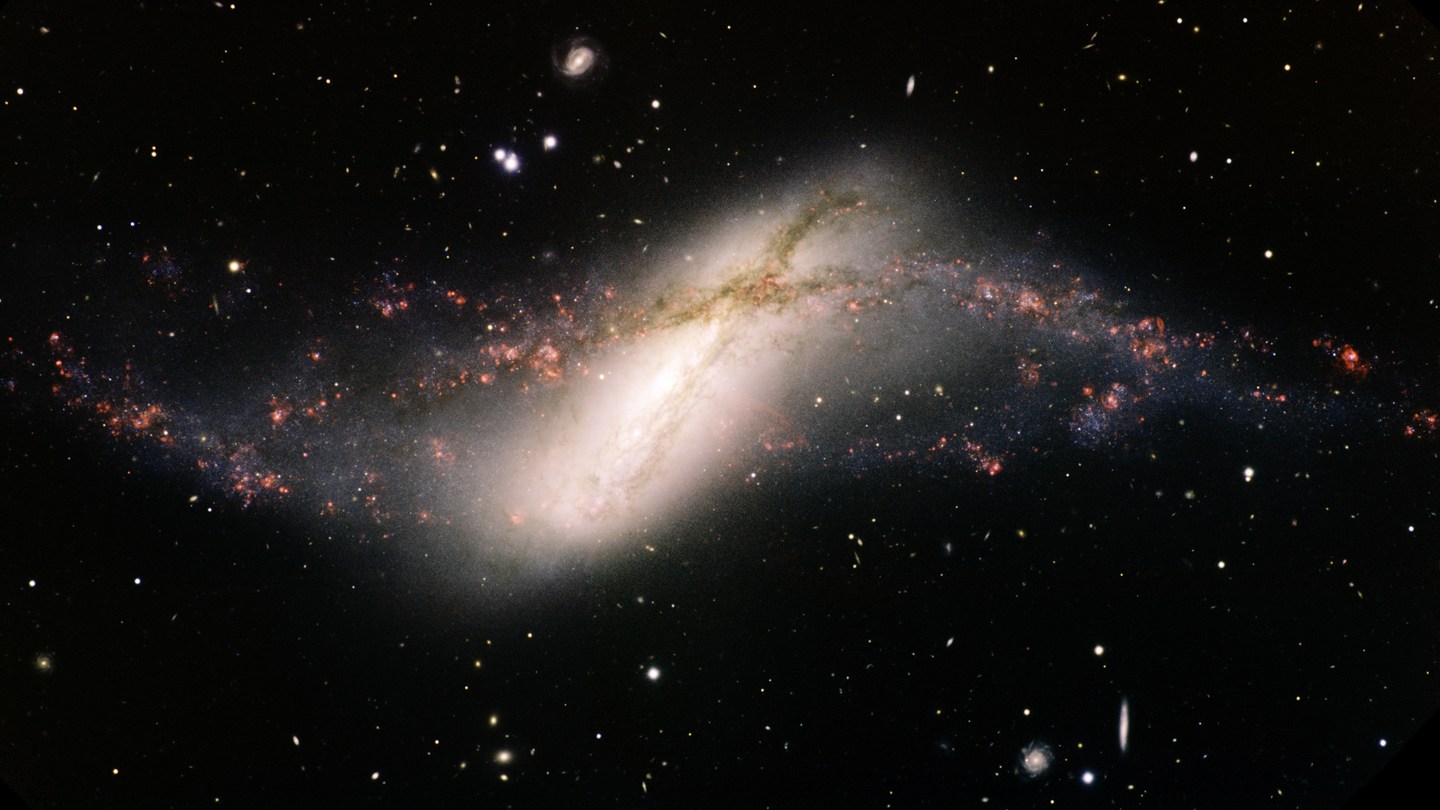
PHOENIX —Thousands of newly spotted galaxies are dressed for a Victorian ball: in hoop skirts. The cache of “polar structure galaxies” — with large starry or dusty structures oriented perpendicular to their main body — might help astronomers study how galaxies form and evolve.
“[Polar structure galaxies] are relatively rare in the universe,” said astronomer Jacob Guerrette in a January 5 news conference at a meeting of the American Astronomical Society. Most galaxies keep their stars and gas fairly in line with their main disks. Although astronomers have sighted polar structure galaxies since the 1970s, only a few hundred were known as of 2024.
Now, Guerrette and his colleagues have identified about 3,000 potential new polar structure galaxies in data from the Dark Energy Spectroscopic Instrument, or DESI, at Kitt Peak National Observatory in Arizona, increasing the number of known polar structure galaxies by an order of magnitude.
“Based on these findings, we estimate that roughly 2 percent of all nearby massive galaxies contain polar structures,” said Guerrette, of Brigham Young University in Provo, Utah. The Milky Way itself may have some polar structure too, Guerrette says, although it may be too faint to confirm.
The light from the most distant polar structure galaxies in the DESI survey took about 7.8 billion years to reach Earth. Additional data from the Euclid space telescope added to the DESI cohort and extended the sample farther back in time, to more than 11 billion years ago, the team also reported. The researchers hope to use the combined datasets to study how these galaxies change over cosmic time.
The galaxies come in many shapes and sizes, and not all their polar structures are hoops. Some are streams of stars or gas; some are more like halos or bulges. But all these galaxies must have suffered a run-in with another galaxy or galaxies in the past to acquire their accoutrements, Guerrette says. That’s because, absent some external force, conservation of momentum keeps all the stars and gas in a galaxy rotating in roughly the same plane. Material orbiting at a sharp angle to that plane had to have been injected by some interloper.
That collision history makes polar structure galaxies useful for probing galaxy evolution overall. “Not every galaxy will have a polar structure,” Guerrette says. “But a lot of galaxies will have gone through accretion or mergers, so we can better study those in general through this smaller subset of polar structure galaxies.”
More Stories from Science News on Astronomy
What's Your Reaction?