





































How older adults are getting care at home
Broadcast Retirement Network's Jeffrey Snyder discusses how best to deliver home care to America's aging seniors with Weiss Cornell Medicine's Madeleine Sterling, MD, MPH. Jeffrey Snyder, Broadcast Retirement Network Dr. Sterling, it's a pleasure to see you. Thanks for joining us this morning. ...
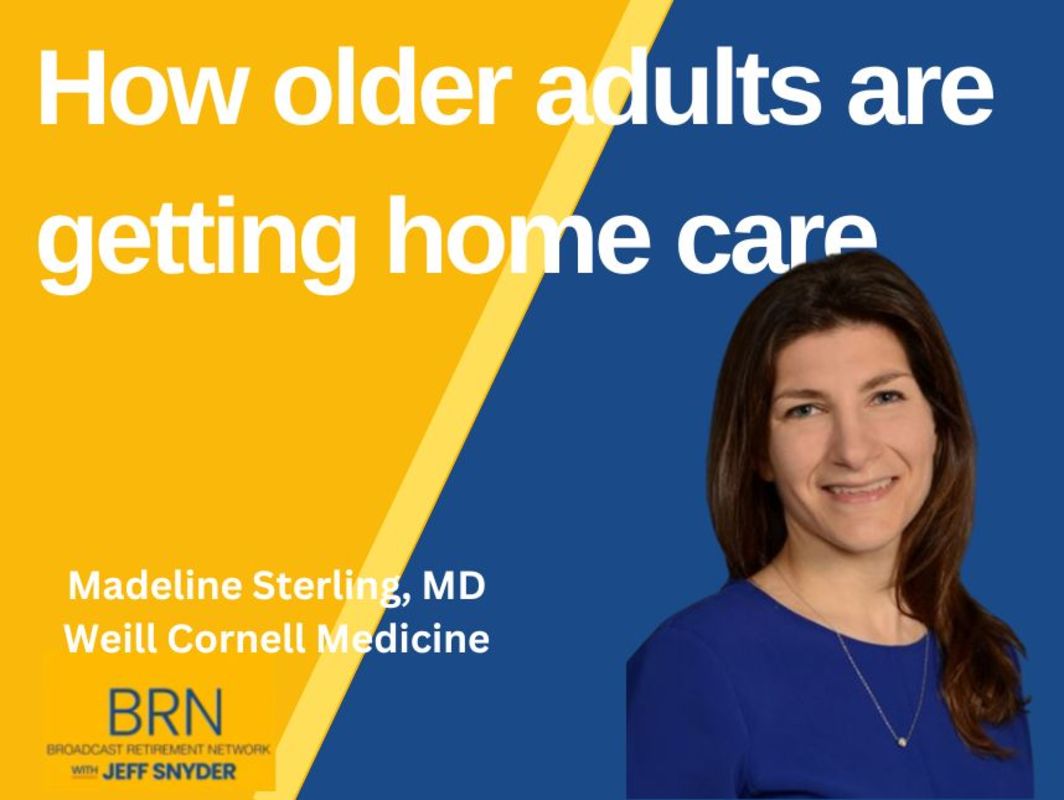
Broadcast Retirement Network's Jeffrey Snyder discusses how best to deliver home care to America's aging seniors with Weiss Cornell Medicine's Madeleine Sterling, MD, MPH.
Jeffrey Snyder, Broadcast Retirement Network
Dr. Sterling, it's a pleasure to see you. Thanks for joining us this morning.
Madeline R. Sterling, MD, MPH, MS, Weill Cornell Medicine
My pleasure.
Jeffrey Snyder, Broadcast Retirement Network
You've done a lot of research. You have, you're actively seeing patients. How important is being able to provide home care to many of our aging citizens?
Madeline R. Sterling, MD, MPH, MS, Weill Cornell Medicine
I think it's so important. As you know, we have a population that's rapidly aging. The majority of whom do not want to end up in a nursing home.
I think more and more older adults, they wanna be at home. I hear this all the time in my practice. They wanna be home and feel good.
And I really see it as our goal and really my mission to get them the services at home that will help them thrive and really get all the care that they need that can allow them to manage their chronic conditions.
Jeffrey Snyder, Broadcast Retirement Network
And are we set up as a, let's talk as a country nationally, as we've talked about, we're an aging society here in America, as is a great portion of the world. Are we set up today to deliver care services to many of our aging?
Madeline R. Sterling, MD, MPH, MS, Weill Cornell Medicine
You know, it's a good question. I think there are pieces in place, but I really do think the system is not working for enough people. I think it's not working for patients and their families who are desperately trying to get the care and services they need at home.
Oftentimes they don't know where to start. They come see me at clinic, we identify there may be a need. And I actually see a lot of blank and confused faces.
There just are not resources or programs that sort of guide them through the process of obtaining care. And then on the other side of the fence, you have the home care and long-term care industry where it's really not supported or valued. You have workers who aren't paid a fair wage for what the really important work they do.
And lastly, you have clinicians in practice who, you know, really have not been trained on what are the services that patients need and how do we get them those services in a timely manner?
Jeffrey Snyder, Broadcast Retirement Network
Well, that begs the question, what types of services should our, and I'm speaking towards policymakers, the people that actually, you know, and the practitioners that kind of work together to create these programs. What are some of the services that you think we actually need to do a better job in creating?
Madeline R. Sterling, MD, MPH, MS, Weill Cornell Medicine
So I think it really depends on who the person is in front of us. You know, what, let's just be very basic. What policy or insurance do they have?
What is their clinical need? For example, a patient who maybe just needs a little bit of assistance to get around the community or to get to and from a doctor's appointment, maybe they have some mild memory loss, that's a really different person than let's say someone who has congestive heart failure, they're symptomatic, they also have functional limitations, have trouble ambulating. You know, those two patients really represent a wide spectrum, right?
And believe it or not, and believe it, they definitely have different types of insurance or policies which then govern the services they would get. So I would say, although we have large systems of care to provide services, for example, Medicare, Medicaid, we have private, really it ends up being a pretty personal problem and situation that patients and families have to navigate. And I would say it's not static, it really changes over time.
So oftentimes we see patients and they're doing okay for a while with some services, but then lo and behold, they go to the hospital or something gets worse. And then, you know, I'm a primary care physician, we have to revisit the whole process again.
Jeffrey Snyder, Broadcast Retirement Network
It doesn't matter where you're geographically located. You happen to be in New York City, which is our largest city. There's lots of ways to get around Manhattan, but there may be people that are in rural areas that may be a little underserved.
So it seems that geography in this case matters in terms of service delivery.
Madeline R. Sterling, MD, MPH, MS, Weill Cornell Medicine
Yeah, I think geography definitely matters. We know this, we know there are certain home care agencies, whether they be Medicare certified agencies located in parts of the country versus others. I would also argue there's, I think we have to take into account patient and family preferences.
For example, in the South, these are regions where historically patients and families prefer to provide that care at home. And so they may be a little bit, you know, on average more reluctant to have formal care at home. There's also certain areas of the country where going to rehab or going to a skilled nursing facility, that just may be the better option, particularly for the condition at play.
So I think geography matters, but again, definitely patterns that we're seeing, and it's not always the rule of thumb.
Jeffrey Snyder, Broadcast Retirement Network
And how much does technology matter? I mean, during the pandemic, a lot of us started to use telehealth to engage with our practitioners, but now we have AI in pretty much everything. I'm sure you see it every day in your practice.
How important will technology be to delivering these services?
Madeline R. Sterling, MD, MPH, MS, Weill Cornell Medicine
I think it's going to be huge. I think the question mark is, you know, at least in home care, you know, where is it currently penetrating? And then how is it playing out right now versus where might it be in several years?
For example, we saw during COVID, just like in primary care, you know, telehealth and video visits, they existed, but they weren't really utilized regularly. And then COVID happened where we had to social distance and stay at home, although in home care, you actually, you know, for that workforce, these were jobs that you could not do remotely, right? So you had providers going into homes.
I think we really saw telehealth on the rise at a lot of home care agencies, although my team and I just recently published a study of telehealth use since the pandemic, and actually found that although certain agencies really like it, I think in reality, it's hard to have widespread adoption of it. It's not always reimbursed, and I think it works better for certain patients than others. And also some agencies are more technologically advanced and have that infrastructure to kind of get it into play.
On the AI and sort of mHealth and mobile app front, I think we're seeing a lot of innovation. I know our research team here at Wow Cornell and Cornell Tech are working hard at this. You know, how do we capture the data that's in people's homes?
How do we provide a home care workforce with the right technology to actually manage that patient well? And then of course, how do we integrate that back to docs like me in practice? So I think that's where we need to head.
Jeffrey Snyder, Broadcast Retirement Network
Well, Dr. Sterling, I mean, this is a very big topic. Of course, we're not gonna be able to cover it all in one interview, but we had a great conversation. In the last minute of our talk, what do you think are some of the key takeaways for the audience?
Madeline R. Sterling, MD, MPH, MS, Weill Cornell Medicine
I think number one, people want to be at home and they wanna age in place. And I think to do that, we really need a system of long-term care that can support that. I think number two, definitely for me as a clinician, every patient is different.
There's not one rule, one policy, one program that's going to fit everyone's needs. And so I think sometimes a one-size-fits-all approach is limiting, especially when I think about all of my patients and their families and just sort of their unique preferences, clinical needs. And so I really would say to physicians, think about who's in front of you and work with them on that process.
And lastly, as a researcher, I'm gonna say there's a lot of innovation going on and I think we need more large, actually trials in the field, pilots, demonstrations of kind of what these services can do for patients and their families and actually measuring their impact on care. That way we can actually get them into practice and sustain them over time.
Jeffrey Snyder, Broadcast Retirement Network
Yeah, very well said. Well, Dr. Sterling, it was a pleasure to meet you. Thanks so much for joining us and we look forward to having you back on the program again very soon.
Madeline R. Sterling, MD, MPH, MS, Weill Cornell Medicine
Yeah, thanks for having me.
What's Your Reaction?