

































Life Insurance Decisions in 2026
Broadcast Retirement Network's Jeffrey Snyder discusses important life insurance decisions with The Warner Companies' Phillip Snyder, CLU. Jeffrey Snyder, Broadcast Retirement Network Dad, Happy New Year. Great to see you. Thanks for joining us this morning. Phillip Snyder, CLU, The ...
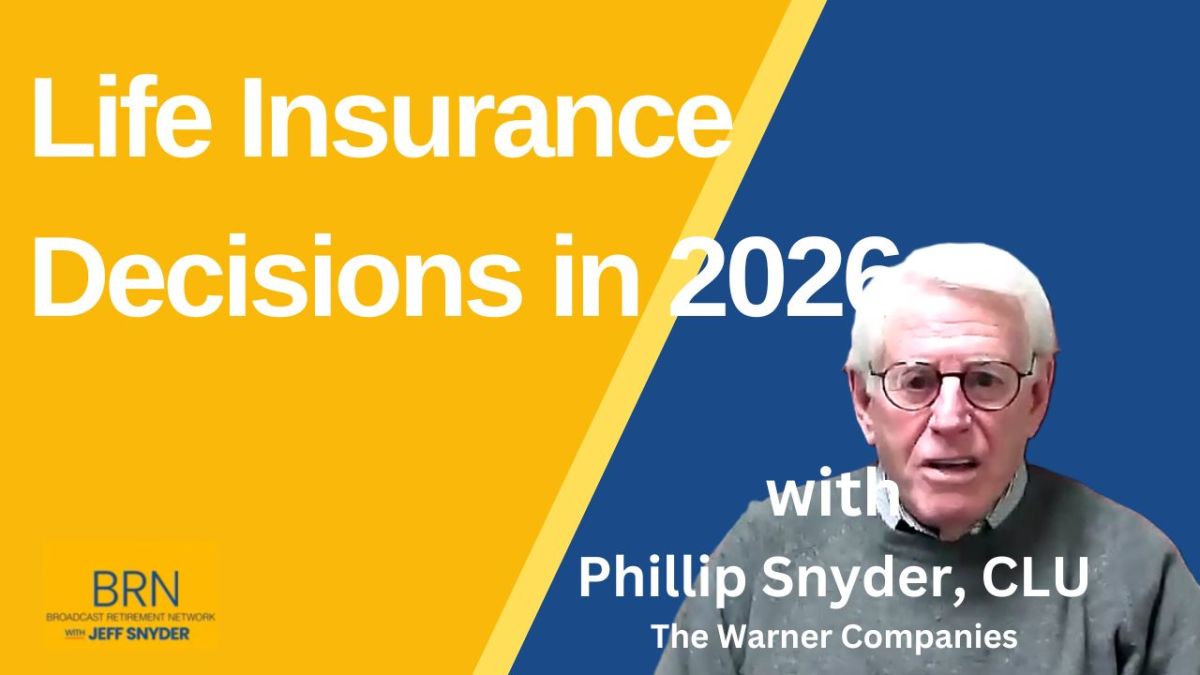
Broadcast Retirement Network's Jeffrey Snyder discusses important life insurance decisions with The Warner Companies' Phillip Snyder, CLU.
Jeffrey Snyder, Broadcast Retirement Network
Dad, Happy New Year. Great to see you. Thanks for joining us this morning.
Phillip Snyder, CLU, The Warner Companies
Thanks, Jeff. Happy New Year to you. Happy to join you.
Let's get the year off to a good start.
Jeffrey Snyder, Broadcast Retirement Network
All right. So part of that is looking at the holistic financial picture. It's 2026.
It's January. What should you be thinking about when it comes to life insurance, your insurances?
Phillip Snyder, CLU, The Warner Companies
Okay. Well, this is an ideal time of the year to be doing this, to take a good look at what happened in the past year, what events occurred that could impact your need for life insurance. After all, life insurance is just a product that creates cash at death for a broad array of reasons.
But we want to know what happened in the past year that could change your need for cash at death, just as was that, birth of a child, purchase a new home, new business agreements, on and on and on, a whole host of things that could happen.
Jeffrey Snyder, Broadcast Retirement Network
So any change, getting a spouse, getting married, having children, change of location, when you get that information, what do you do with it? How do you take that information and then look at your insurance? What do you do with that information?
Phillip Snyder, CLU, The Warner Companies
Well, you're evaluating what your needs are, what assets you hold, what obligations you have, what future obligations you may have, and you're trying to match up the two in an ideal world. Let's say the cash that I have on hand, plus the cash that could be created upon my death is adequate to meet all of what I anticipate to be future needs for money. So it's a relatively simple thing to do conceptually, but it takes a little bit of time and thought to do it and maybe some help from some other people.
Jeffrey Snyder, Broadcast Retirement Network
Okay, let's talk about who might be able to help you. Comes to mind a financial planner, an insurance professional. Who should I go to once I'm armed with this information?
Who do I go to first?
Phillip Snyder, CLU, The Warner Companies
Well, first, I would go back to the people you've been using up till then. Presumably you have some of those relationships. Maybe you have a financial planner, a CPA, an attorney, certainly an insurance agent.
And depending on historically how you relied upon those people and how they interacted with you and collectively interacted amongst themselves, that's the group of people I would go to. If you are at a point where you don't have that entire team, then you need to build that team over time, ideally. But I would go back to the professionals that you've been relying upon up till that point in time.
Jeffrey Snyder, Broadcast Retirement Network
So let's talk about people who maybe don't currently have life insurance. Maybe they're married. Maybe they've had a change in status as we call it in the industry.
What should you be looking at? I mean, is there an age that you should be thinking about life insurance or is it, hey, as soon as I get married, I need to have some kind of protection?
Phillip Snyder, CLU, The Warner Companies
Well, that's an individual thing. Let's take your last example. You're married, you have no children, you just got married.
You probably feel some obligation to your spouse. So maybe you want to create some sort of an estate if you don't already have one to leave just because that's how you feel. It may not be an economic necessity, but it might be a something that you want to do.
But then again, you have to evaluate what are those needs? What's changed? If I anticipate having another child or a first time child, what obligations come with that?
And what would happen if I had a premature death? How would those obligations be fulfilled? So those are the kinds of things.
If you don't have existing advisors, then talk to people you know, who you respect, who have some financial acumen and ask them for some referrals. So you get to meet with someone, an individual or several individuals and collect their feedback. So that's where I would start the year.
Jeffrey Snyder, Broadcast Retirement Network
And just because your friend or family member clicks with that person doesn't mean you have to. There's a chemistry that exists between the yeah. And so people need to be aware of that.
Let's talk a little bit briefly if we can. We've talked with you about this on the show before the different types of life insurance that there's permanent or whole life. There's also term life insurance.
They all have their benefits, pros and cons.
Phillip Snyder, CLU, The Warner Companies
Yeah. Well, term insurance is first of all, it's the least expensive of all the forms of life insurance you can buy. You can buy it for a duration that you determine is meaningful to your planning, 10 years, 20 years.
There's even a lifetime term insurance that you can buy. It's essentially a death benefit only product. Although some of the newer policies now allow for accelerations of the death benefit in the event you have a chronic illness or a critical illness where you require standby assistance, things of that nature, almost equivalent to a care need.
So some of the newer policies provide that. But by and large, term insurance, at least historically, has been a temporary product you would buy for a short term need, not necessarily a lifetime need. On the other hand, you have permanent insurance and permanent insurance is exactly what it says.
It's designed to be in effect until the day you die, regardless of when that happens. Could be a shorter term or it could be age 110, who knows. But you want that insurance to be there when you die.
Typically, those policies have some sort of cash buildup in there. That cash buildup supports the death benefit over time. So those types of policies can be, have interest rates that would be credited through the insurance company's general account where they earn an interest rate and they credit you with that in your policy.
It could be policies that have indexed accounts where the performance of the cash in the policy is tied to an external index like the S&P. Or it could be variable type policies where you as the policy owner determine how you want your money invested. You make your choices from a broad array of accounts that are available within that product.
So those are the general types of products that life insurance products that are available. And all of them have been improved dramatically over the years. So you just need to figure out what are my long term needs and what are my short term needs.
If I have a mortgage and I have 10 years to go on my mortgage, and that's my primary and only concern, I will buy some sort of coverage that would last for 10 years. So that's how I would approach that.
Jeffrey Snyder, Broadcast Retirement Network
Okay, so let's, we've got about a minute left, and I just want to ask you, we've had a good conversation. The calendar's flipped. It's January 2026.
What are the key takeaways from this morning's conversation?
Phillip Snyder, CLU, The Warner Companies
Do your review. Find a professional, find competent people to help you. Make sure if you have insurance that you review that insurance in terms of beneficiary arrangements, ownerships, performance.
How is that product going to, how has that product performed since I bought it, vis-a-vis projections versus actual results? And what do I need to do to make changes if I need to make improvements or add coverage? How do I do that?
Jeffrey Snyder, Broadcast Retirement Network
Yep, well said. Dad, always great to see you. Thanks so much for joining us.
Happy New Year. We look forward to having you back on the program again.
Phillip Snyder, CLU, The Warner Companies
Have a nice day. Bye now.
Jeffrey Snyder, Broadcast Retirement Network
Well, thanks for watching. And don't forget, we're back again tomorrow morning with another great expert and another great topic. You can tune in right here, Monday through Sunday at 7.30 a.m. Eastern Time. And don't forget to subscribe to our daily newsletter, The Morning Pulse, for all the news in one place delivered directly to your email box. Check it out at our website.
What's Your Reaction?