






































New dietary guidelines flip the food pyramid
The new guidelines emphasizes eating protein and full-fat dairy while reducing sugar, carbs and ultraprocessed foods.

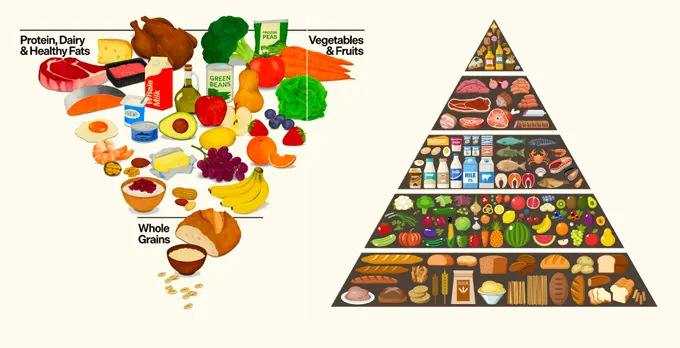
American dietary guidelines have gotten an overhaul. The Department of Health and Human Services and the Department of Agriculture unveiled a new food pyramid on January 7. The guidelines put meat and full-fat dairy, olive oil and vegetables at the broad top of an inverted triangle. While grains and fruits fell to the bottom.
Many experts had feared that HHS Secretary Robert F. Kennedy Jr. would raise the cap on the amount of saturated fats recommended in the diet, but the guidelines still specify that no more than 10 percent of calories should come from saturated fats. Those types of fats have been linked to health problems such as heart disease, obesity and type 2 diabetes. Now, ultraprocessed foods including refined grains are getting the blame for those and other chronic diseases. And, for the first time since the guidelines debuted in 1980, they don’t set daily limits for alcohol, which has been linked to various cancers.
Previous iterations of the dietary guidelines have been long technical documents but the new advice is summarized in six pages. Such guidelines govern what is in meals served at schools and to the military, and influence which foods are covered by federal food assistance programs.
Science News talked about the new dietary guidelines with Marion Nestle, a professor emerita of nutrition, food studies and public health at New York University. Nestle is the author of What to Eat Now and other books and blogs about food politics.
The conversation has been edited for length and clarity.
How are the new dietary guidelines different from previous recommendations?
Nestle: They’re totally radical. They’ve thrown out 40 years of dietary guidelines just like that, and substituted recommendations that date back to the 1950s. My slogan for it is: They’re muddled, they’re inconsistent, they’re contradictory, they’re ideological, and they’re very retro. There’s one really great thing about them. They say, “Eat real food.” It sounds ridiculous that that would be revolutionary, but it is, and it’s very good. But the eat real food is not the major message of the guidelines.
Instead, it made the protein message prominent. It comes first in the dietary guidelines, and it comes first in the pyramid that accompanies the guidelines.
By protein, they mean meat and full-fat dairy and that’s astonishing, because it flies in the face of years and years and years of evidence. They claim that it’s based on scientific evidence, but they don’t produce it, so I don’t know what that is.
What I’m seeing is a set of dietary guidelines that are a very clear win for the meat, the dairy and the alcohol industries and a loss for ultraprocessed foods. That’s fine. I don’t have any problem with that one.
The ideology — “We’re not going to declare war on saturated fat anymore. We’re going to declare war on sugar instead.” — that’s fine. People would be better off eating less sugar because it’s got calories and no nutrients to speak of. And if there’s one thing Americans don’t need more of it’s calories with no nutrients.
So they want people to eat nutrient-dense foods. I’m for it. Who’s going to pay for that? You know, these guidelines govern school meals, and in order to have these kinds of foods in schools, they’re going to have to pay a lot more, because the way our system is set up, those foods are more expensive than ultraprocessed foods. Where is the money for school meals going to come from?
What are the strengths of the new guidelines?
Nestle: Recommendations to eat less ultraprocessed foods. Really dietary guidelines have always argued against highly processed foods because they asked for foods that were lower in fat, sugar and saturated fat.
I think people would be much better off eating less of ultraprocessed foods and much better off eating whole foods. I’m all for that but not increasing meat and dairy production amounts. We have climate change to deal with here, sustainability issues. Beef is the single most climate change–producing food that we have, and dairy cattle aren’t a whole lot better.
What are the weaknesses of the new guidelines?
Nestle: They’re muddled. They say on the one hand that you should be eating more meat and high fat dairy products, and on the other hand that you should restrict saturated fat to 10 percent or less of calories. That’s going to be very hard to do. Meat and dairy products are the biggest sources of saturated fats in American diets. So that’s a contradictory recommendation.
The recommendation to eat more fruits and vegetables is contradicted by the numbers that they’ve given — three servings of vegetables and two servings of fruit. That’s about half of the fruits and vegetables recommended in the previous dietary guidelines.
Does prioritizing protein make sense?
Nestle: The idea of encouraging people to eat more protein makes no sense at all, because people are already eating twice as much protein as they need. You can argue that these guidelines say you should be eating your protein from real foods, not from ultraprocessed foods, but people are already getting their protein from real and not ultraprocessed foods. Protein is never an issue in American diets.
They’re emphasizing meat proteins. The way I read it is the big priority is meat and dairy products with vegetables [coming behind]. And that attitude is because vegetable proteins are lacking in certain amino acids and aren’t as close to human protein needs as animal proteins are. But we’ve known since Frances Moore Lappé’s Diet for a Small Planet, which came out of the early 1970s, that all you have to do is eat two different kinds of vegetables or grains. Diets that were historically based on grains and beans took care of amino acid requirements beautifully and are a lot healthier for people and the planet than is eating a lot of beef.
How have the roles of fats and grains in the diet changed under the new guidelines?
Nestle: They want you to eat healthy fats. And by healthy fats, they mean olive oil, butter and beef tallow.
The number of whole grains servings has been downgraded. It was six servings of grains; make half of them whole grains — so three servings of whole grains, three servings of refined grains. These guidelines are very concerned about refined grains, which they should be, because they’re in indices of ultraprocessing. I can’t tell whether they meant to have whole grains as the part you’re supposed to eat less of.
The graphic, which is very pretty, is difficult to understand. It looks like you shouldn’t be eating anything at the bottom of the pyramid. I’m not sure that’s what was intended. They’re pretty clear that they want you to eat whole grains. That’s a pretty strong recommendation. But then it’s muddled by the pyramid.
There are some funny things about making sure that you eat fats to supply your essential fatty acid requirements, but the three examples that they give are extremely low in essential fatty acids. They’re not famous for their essential fatty acid content. If you want essential fatty acids, for that, you need seed oils, and those, of course, are not mentioned. That’s where the ideology comes in.
Are these recommendations supported by nutrition science?
Nestle: I would argue that the ultraprocessed food one is supported by science quite a lot. And then some of that science, some of the most impressive parts of that science came out after the Dietary Guidelines Advisory Committee submitted its report. Those continue to confirm that people who eat a lot of ultraprocessed foods take in more calories than they otherwise would, a lot more calories. That’s now being confirmed. I think the evidence supports that very well.
Does the evidence support promoting eating more meat and high fat dairy products? Hard to know. I think from a climate change sustainability standpoint, absolutely not. From the human health standpoint, the whole saturated fat issue is arguable, but in any case, eating a lot more meat and dairy products is going to pile the calories on, unless you are absolutely convinced that those foods are so satisfying that people won’t want to eat anything else and won’t want to overeat. That remains to be seen. We don’t have research demonstrating that.
What's Your Reaction?