






































Physics theories about the multiverse are stranger than fiction
Cosmology and quantum physics both offer tantalizing possibilities that we inhabit just one reality among many. But testing that idea is challenging.
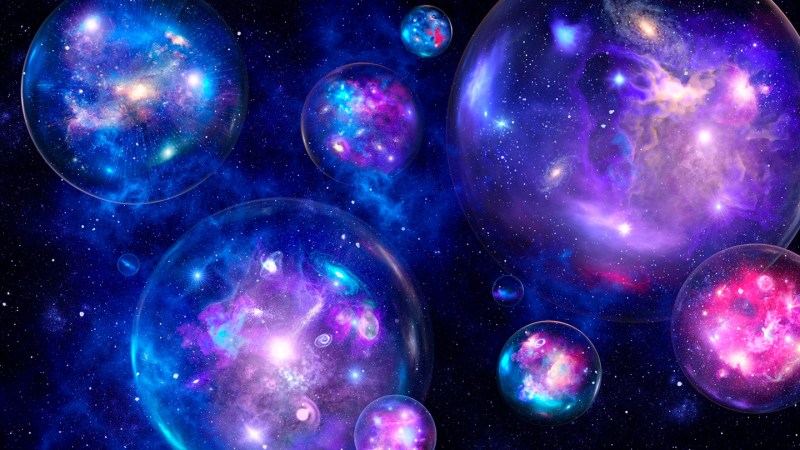
Sci-fi loves a multiverse. Everyone from Rick and Morty to Spider-Man has stepped through a portal and met their alter egos. My personal favorite use of this trope comes from the sitcom Community, where a simple die roll splits our heroes into seven alternate timelines. After the inhabitants of the “darkest timeline” suffer spectacular, meme-worthy misfortune, they turn evil and don fake goatees to match their new dastardly personas.
Screenwriters often deploy this trope to incite interdimensional team-ups or showdowns. But some physicists like the idea of a multiverse for another reason: The existence of many unobserved realms could answer deep questions about our universe. There are, perhaps fittingly, a multiplicity of ideas about how our universe might fit into a larger constellation of realities. Two of the most popular come from cosmology and quantum mechanics.
Shortly after the Big Bang, our universe underwent a brief period of superfast expansion called inflation. During that growth spurt, tiny quantum fluctuations in the structure of the universe got stretched out to huge proportions. In parts of space close enough for light to reach Earth in the universe’s lifetime, those fluctuations created variations in density that seeded the formation of galaxies.
At even larger scales — way beyond our cosmic horizon — quantum fluctuations could have created regions of space with radically different properties, says Andrei Linde, a retired Stanford University physicist who is an author of the theory of inflation. Unseen parts of space could have different particle masses and force strengths than in our neck of the cosmos, Linde says. Electrons, for instance, might be much heavier. Or gravity might behave differently. In such places, life might not be able to exist.
What’s more, although inflation has stopped in our observable universe, it may continue elsewhere — eternally blowing up more bubbles of space with unique properties. These bubbles would be so distant and distinct that they’d effectively be different universes.
To Linde and some other scientists, this scenario explains a big conundrum in cosmology: why the particle masses and force strengths in our universe seem perfectly tailored for life. If a multiverse exists, that’s not such a suspicious coincidence. Among many bubble universes, the conditions for life were bound to pop up somewhere.
Testing this idea may be possible. If our universe is one bubble in a fathomless froth, maybe another universe has bumped into ours, leaving a scar on the afterglow of the Big Bang. But “no one has seen yet the rings that would represent the scars of bubble collisions,” says physicist Paul Halpern of Saint Joseph’s University in Philadelphia.
Another multiverse idea comes from quantum physics, which says particles can exist in a superposition of possible states until measured. “According to the traditional idea in quantum mechanics,” Halpern says, “once somebody takes a measurement, that blurred scenario collapses into a single possibility.” For example, an electron that could exist in a smear of possible places is detected in just one spot. “That is a little bit odd, because it requires a human measurer,” Halpern says. If it’s true, how did the universe work before humans existed?
In 1957, physicist Hugh Everett III offered an explanation. Instead of observation causing a spread of quantum possibilities to collapse into a single outcome, perhaps all possibilities unfold in alternate realities. For example, an observer splits into multiple copies of herself who each saw an electron at different locations.
“The versions separate seamlessly,” Halpern says. “They never will know about each other, and they live in parallel universes.” (This is closer to the picture of a multiverse seen in Community — though of course, for the plot, those characters do eventually meet and must defeat their evil counterparts.)
But this theory would be hard to test. “We can’t have somebody split in an experiment between two possibilities and ask each one what it was like,” Halpern says. “If the theory is right, you wouldn’t notice it.”
Prospects for visiting other universes, if they exist, are similarly dim. Hypothetical tunnels in the fabric of spacetime, known as wormholes, might bridge realities. But “we don’t know if they’re possible to create, and if they were … they would require so much energy and mass that they would be well beyond current technology,” Halpern says. “So it’s not like you can have a wormhole in a secret closet in your bedroom and every night open up the closet door and jump in and travel to all these other places.”
That may be bad news for anyone who dreams of teaming up with their alter egos to save the day, Spider-Man style. But on the bright side, you’ll probably never have to fight off an evil, goateed version of yourself either.
What's Your Reaction?