


























The Impact of Recent Social Security Changes on the Program’s Solvency
Broadcast Retirement Network's Jeffrey Snyder discusses the state of the Social Security Trust Fund with American Enterprise Institute's Andrew G. Biggs. Jeffrey Snyder, Broadcast Retirement Network Andy, happy new year. Great to see you. Thanks for joining us this morning. Andrew G. ...
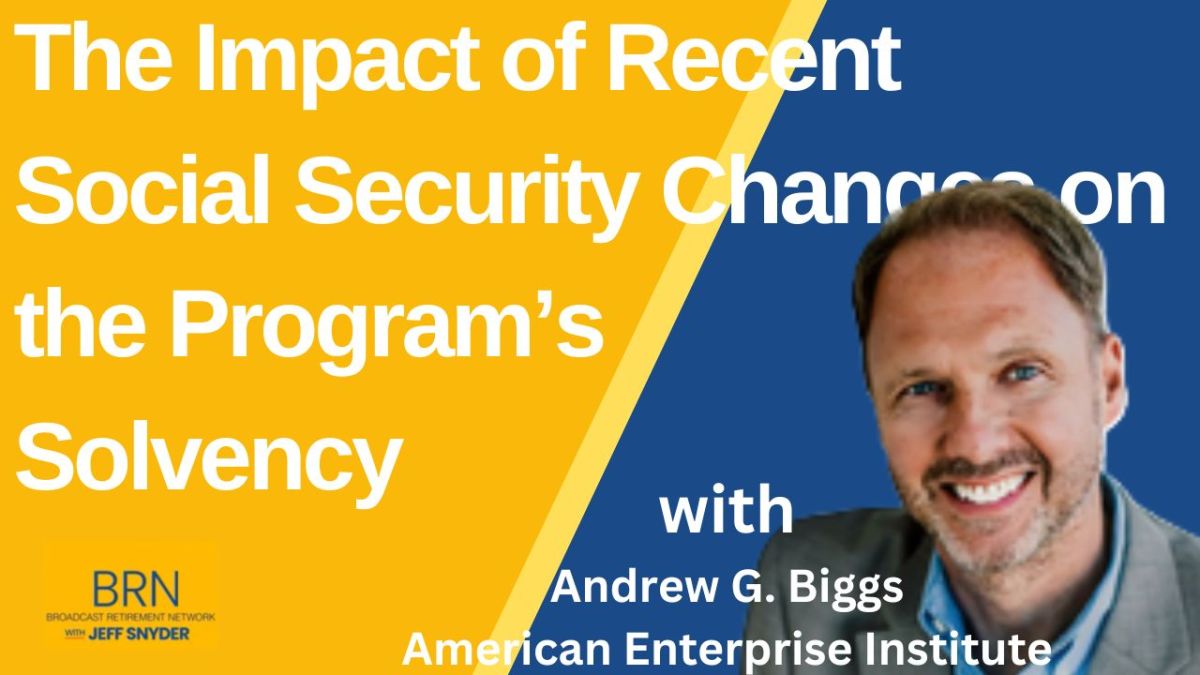
Broadcast Retirement Network's Jeffrey Snyder discusses the state of the Social Security Trust Fund with American Enterprise Institute's Andrew G. Biggs.
Jeffrey Snyder, Broadcast Retirement Network
Andy, happy new year. Great to see you. Thanks for joining us this morning.
Andrew G. Biggs, American Enterprise Institute
Hey, great to be with you. Thanks for having me.
Jeffrey Snyder, Broadcast Retirement Network
Yeah, happy new year to all of our viewers this morning. And Andy, I want to start by asking you about the Social Security Trust Fund. We've had the one big, beautiful bill.
Now, Social Security is not going to be taxed for certain participants in the system. How's the Trust Fund doing, though?
Andrew G. Biggs, American Enterprise Institute
Well, you know, over the years, there's always been arguments over the Social Security Trust Fund. Is it real? Is it not real?
By the year 2032, none of that's going to matter because the Trust Fund is going to be exhausted. And previously, Social Security's trustees estimated the Trust Fund would last an additional year to 2033. We had two changes, two legislative changes in the past year that have actually worsened Social Security's financial state.
The first was the one big, beautiful bill, which reduced in sort of a roundabout way taxes on Social Security benefits paid by seniors. So that reduced the amount of money going into the Trust Fund because those taxes, when you pay income taxes and your benefits, that money doesn't just go to the General Treasury. It actually goes back to Social Security.
The second was something that is sort of inaptly called the Social Security Fairness Act, which goes for mostly state and local government employees who both pay into Social Security but also had their own government pension instead of Social Security. And essentially, we had laws previously that prevented them from double dipping. Congress, on a bipartisan basis, allowed them to resume double dipping.
So that hurts Social Security as well. So over the past year or so, Social Security's financial state has gotten worse in part because of what Congress has intentionally done for it. And that's over and above the demographic changes, the aging of the population, the low birth rates, the baby boomers retiring.
So we really do have a pretty significant issue coming up that Congress needs to get a hold of.
Jeffrey Snyder, Broadcast Retirement Network
Well, the Congress certainly has a lot on its, a play we were talking about before the show, talking about a little bit of the healthcare subsidies are a big issue. It's also an election year. What can Congress do?
So let's plant some policy ideas for our fellow Americans. What are some things that Congress can do to improve the solvency of Social Security when 2032 rolls around?
Andrew G. Biggs, American Enterprise Institute
Well, look, we know the usual kind of menu of options. We could raise the payroll tax rate. We could lift the ceiling, which this year is $184,000 on which the taxes apply.
We could raise retirement age, reduce COLAs. You know, there's a whole menu of options that we've known about for 40 years. What I think is important is for policymakers to start thinking a bit more creatively.
So just in the past several weeks, I was heartened to hear that the Trump administration, President Trump said, they're looking very closely at Australia's retirement system. That's very different from the U.S. Social Security program. It's much more focused on preventing poverty and old age.
So long term, their poverty rate is lower than ours, but their system will cost a third of what the U.S. does. But on top of that, it ensures that every single worker has a retirement plan on the job, and they are contributing, they're participating to it. The combination of those things, it's very different from Social Security, but can actually give you better retirement security, higher savings at lower cost.
So it's really important for these policymakers to think outside the box and not just to make desperation moves. They want to think what Social Security should look like for the 21st century. You know, this was a system invented in 1935.
The world was very, very different then. So if we're looking at 2035 or 2075, you need to adjust that. And so I'm heartened when I see policymakers thinking a little bit bigger on it.
Jeffrey Snyder, Broadcast Retirement Network
Yeah. And then they've, I think the challenge with that politically though, and I'm not a political expert, but you got to convince the other members of the chamber that this is the way to go. And that's where the political aspect of this comes in.
Andy, let me shift gears and talk about, ask you about what individuals should do. So there's a lot of younger people entering the workforce now. They're contributing to Social Security, money's going in and being paid out to recipients, right?
Should they, you know, 2032 is going to roll around soon. I mean, people, should they be concerned about receiving what they've paid in and, you know, in terms of the benefit?
Andrew G. Biggs, American Enterprise Institute
They should be concerned. I mean, it's important to have some context on this. A lot of younger people think I'm never going to collect a penny from Social Security.
Okay. Look, Social Security has a 12% tax on everybody's earnings, collects, you know, over a trillion dollars in a year. Unless the government says we're going to get rid of that tax and get rid of the money that comes into Social Security, there's no way we can zero out your benefits.
Even after the trust fund runs out, Social Security can pay rent 80% of the benefits that are owed. So you don't want to panic. On the other hand, you know, you're, that's a 20% benefit cut, or you're going to have to pay much higher taxes.
So it's, you want to, you know, bear all of that in mind. You're not going to get zero, but the system really, you know, this is a pretty significant funding shortfall. So, you know, if they, whether you're a younger person or if you're somebody today, I would just save a little bit more for retirement.
If Congress turns around tomorrow and says, okay, look, we're going to raise the payroll tax rate by several percentage points. So you don't get a benefit cut. Okay.
Then you can say, well, I'll dial down my saving rate because I know I'm paying more in Social Security. It'll be, it'll be more secure. But if Congress does nothing and the benefits get cut, if you saved a little bit more each year, you're going to be protected against that.
So that's something individuals can do as a bit of an insurance policy. Just save a little bit more each year, a couple extra percent, and then you'll breathe easy regardless of what Congress does.
Jeffrey Snyder, Broadcast Retirement Network
And if you're somebody who is going to be retiring soon, you're going to reach one of the thresholds for Social Security. Do you, you know, they used to say, wait to get the maximum benefit. Should people still wait?
And I'm talking, we don't want to give advice, but I mean, you know, what should, should people be thinking about or, or evaluating whether or not they should take a lesser benefit earlier?
Andrew G. Biggs, American Enterprise Institute
The only reason you would take a lesser benefit earlier, I mean, aside from the typical financial planning things, the only reason you would take it is if you think Congress is going to suddenly dramatically cut benefits. So you want to get yours while you can. The realistic outcome is Congress is not going to do that.
I mean, I've, most of my professional career, I've been advocating for reducing Social Security benefits, at least for middle and upper income people, because those benefits are getting more and more generous. Congress is going the opposite direction these days. Even the Republicans say we're never going to cut benefits.
So the real problem for Social Security is a fiscal one of, you know, where's that extra money going to come from? What's the tax burden look like? For somebody making their own plans, they should still just think of what is optimal for them.
And typically, it makes sense to delay claiming both in terms of financial sort of, you know, present value lifetime benefits basis. But I think more importantly, by delaying claiming, you're going to have a higher benefit later in life. If something bad happens to you, you know, when you're 85 or 95, your 401k runs out, things like that.
You've got a higher benefit that will protect you against poverty. It's that insurance value that really makes the difference. So I would not recommend people panic and claim early.
I don't think that really makes sense under the circumstances.
Jeffrey Snyder, Broadcast Retirement Network
Andy, we've got about a minute left. We've talked about a lot of important information about Social Security. What do you think some in the last minute?
What do you think some of the key takeaways are this morning?
Andrew G. Biggs, American Enterprise Institute
I think it's important to understand how big a problem this is. You hear a lot of language and all is a modest problem. It's really not a big deal.
It's really health care is the issue. When Social Security's trust fund runs dry, which is likely 2032, at that point, Social Security is going to face an annual cash flow deficit of $350 billion. That's not nothing.
If you were to fill that just by raising taxes, that would be the largest peacetime tax increase in history. Now, that doesn't mean you shouldn't favor doing that. But you've got to understand how big a funding gap that is.
This is not a small thing. This is a 20% funding gap of the federal government's largest spending program. So this is a really big deal.
It would be very nice if Congress got on top of it quickly, but it's an election year, and they're just not particularly interested, which is unfortunate. It's very sad.
Jeffrey Snyder, Broadcast Retirement Network
I agree with you. Andy, always great to see you. Thanks for your analysis, and we look forward to having you back again very soon.
Andrew G. Biggs, American Enterprise Institute
My pleasure.
What's Your Reaction?