





































The world’s oldest piece of clothing might be an Ice Age–era hide from Oregon
Two pieces of elk hide connected by a twisted-fiber cord are the earliest evidence of sewing. But what they were used for is still a mystery.
Sewn-together fragments were preserved in a desert cave for more than 12,000 years
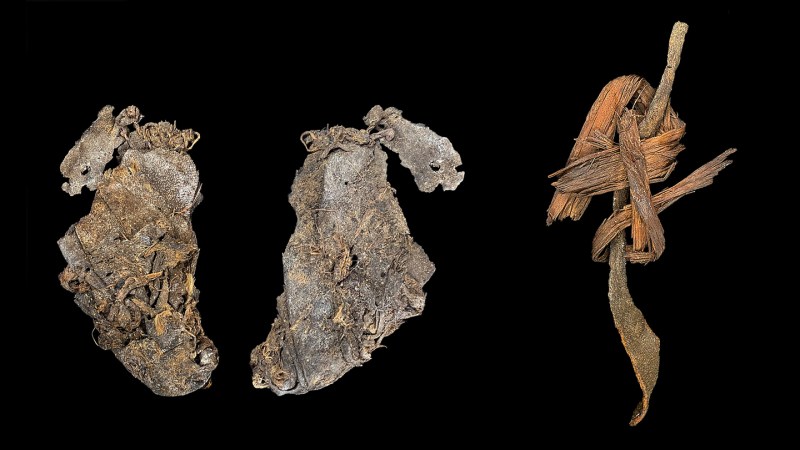
The oldest sewn object (both sides shown, left) consists of two pieces of hide joined at the top with a piece of cord made from twisted fibers (right).
R. Rosencrance et al/Science Advances 2026
Two small scraps of elk hide, joined by a cord of twisted fibers and preserved for roughly 12,400 years in an Oregon rock shelter, are the earliest sewn items ever found. Just a few square centimeters, the fragments may also be the world’s oldest pieces of clothing.
They are “definitely sewn, because we have cordage sewn into a hide that comes right out and goes into another piece of hide,” says archaeologist Richard Rosencrance, of the University of Nevada, Reno. Radiocarbon dating places the hides at the end of the last Ice Age, he and colleagues report February 4 in Science Advances. Stone tools and bone needles recovered with the hides indicate that the cave’s Native American inhabitants were making clothes. His team suspects the hides are remnants of a garment meant to give the wearer warmth and protection.
The mystery items were recovered from Cougar Mountain Cave in Oregon’s high desert in the 1950s. They’ve been in private hands since then but were recently made available to scientists for analysis — along with 54 other artifacts from the area. These include fragments of elk, bison, rabbit, hare and fox hides, and cords made of strips of hide and plant fibers — possibly a type of rush.
The cords “could have been used for a huge range of things, Rosencrance says. Meanwhile, a bundle of fibers that were twined (an early form of weaving) into a rough textile may have been used to make a bag, basket or mat.
Artifacts made of biological material typically don’t survive as long as these ones have. The region’s ultradry air was crucial to their preservation. Notably, the world’s oldest pants — which date to 3,000 years ago — were also found in a desert.
More Stories from Science News on Archaeology
What's Your Reaction?