





































Vertiv CEO raises alarm on heated AI hardware problem
The $4 trillion AI boom has largely been driven by Palantir’s sophisticated models and Nvidia's highly powered GPUs. Investors have poured billions of dollars into silicon, but a bottleneck formed as Rubin and Blackwell chips become smarter, faster, and… hotter. When chip power densities exceed ...

The $4 trillion AI boom has largely been driven by Palantir’s sophisticated models and Nvidia's highly powered GPUs. Investors have poured billions of dollars into silicon, but a bottleneck formed as Rubin and Blackwell chips become smarter, faster, and… hotter.
When chip power densities exceed what traditional cooling can maintain, these systems start to, well, not work. Chips like Nvidia Blackwell and Rubin require a sophisticated thermal cooling and power management system to prevent them from becoming a silicon puddle.
This is where Vertiv Holdings Co. (VRT) comes in. Its competitive MOAT lies in its position as the backbone of the tech industry, and it is one of the largest services offering solutions to this heated chokepoint.
Vertiv Holdings Growth Fueled by Liquid Cooling Demand
Vertiv Holdings, based in Westerville, Ohio, is a growing presence in critical digital infrastructure, providing power, cooling, and housing for data centers.
Products include thermal management, like liquid cooling and precise air conditioning, to accommodate NVDA's Blackwell chips. It provides power management to ensure a consistent power supply from the electrical grid to the chip, serving customers in over 130 countries with a revenue of $8.0 billion.
More AI Stocks:
- Morgan Stanley sets jaw-dropping Micron price target after event
- Bank of America updates Palantir stock forecast after private meeting
- Morgan Stanley drops eye-popping Broadcom price target
- Bank of America sets AI stocks to buy list for 2026
The shift from traditional air-cooling systems to liquid cooling and the surge in thermal management demand have driven Vertiv’s services. Standard rack densities are 10-20kW, but have reached up to 100kW+ required by Blackwell chips.
According to Reuters, Barclays analysts say that Vertiv Holdings is benefiting due to"strong historical position in precision air cooling" and "strong position in liquid cooling.” © Samantha Madar/Columbus Dispatch / USA TODAY NETWORK via Imagn Images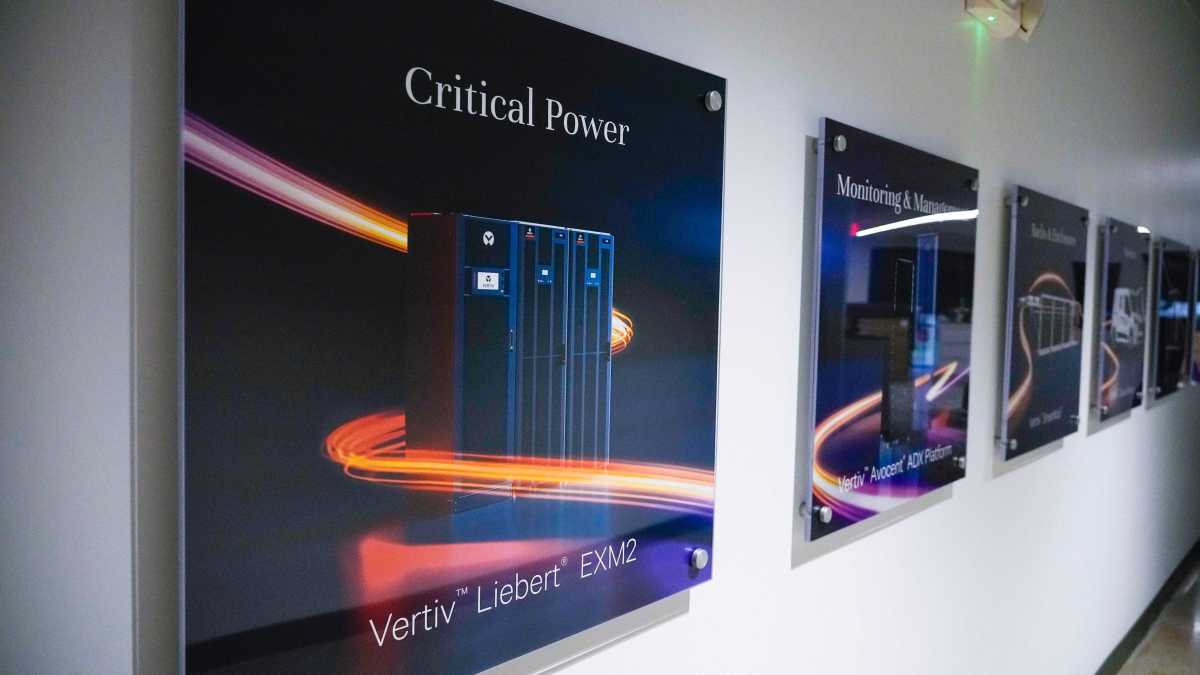
On Jan. 14, 2026, Vertiv introduced MegaMod HDX, a solution specifically made to handle racks with over 100 kW.
What happened? The market is flooded with orders, and data centers are clamoring for more computing power.
Vertiv’s Q3 2025 earnings showed organic orders up ~60% compared to last year, with a 20% increase from 2025’s 2nd quarter.
VRT’s book-to-bill ratio was 1.4x, and backlog increased to $9.5 billion (end of 2025), signaling enough revenue into late 2026.
On January 16, JPMorgan equity analyst Stephen Tusa kept an overweight rating on Vertiv and lowered the price target from $230 to $225. JPM favored Vertiv as a growth-oriented name as the year heads into AI-infrastructure.
S&P 500 inclusion to be major catalyst for VRT Stock
Vertiv’s strong balance sheet shows a shift from being debt-heavy to a leaner cash-flow engine. According to Yahoo Finance, Vertiv’s market cap is hovering near $75 billion, clearing S&P’s minimum of $22.7 billion.
Related: Analyst sends surprising message on Palantir stock in 2026
To be eligible for the S&P 500, a company must show profitability in the past 4 quarters, and Vertiv’s 12-month net income is hovering at $1.03 billion.
Institutional interest in owning Vertiv stock has surged. Its two largest shareholders are Vanguard (10.01%) and BlackRock (9.44%), a pair of global financial titans that dominate the ETF market.
Vertiv’s strong financials have been reflected in Moody’s recently updated credit rating for (VRT) to be Ba1, on the verge of “investment grade.”
Beating analysts’ EPS estimate of $0.99 to $1.24, the company also reported free cash flow of $1.5 billion. Ultimately, these signals are fueling strong rumors that Vertiv stock may join the S&P 500 in 2026.
The "Power Wall" obstacle in the way of big tech
Vertiv’s latest major move was on January 22, 2026, when it launched Vertiv Next Predict, an AI service designed to detect operational risks before failures occur.
Similar to Palantir’s model of a “platform-as-a-service,” Next Predict uses machine learning to inspect real-time grid and chip data. Vertiv Next Predict was designed for high-powered densities like Rubin.
2026’s obstacle to power consumption is also the time required to build such critical infrastructure. Traditional data centers take around 3-6 years to build, which is totally unacceptable in an "AI speed" market.
While NVDA and PLTR continue to get the hype, demand for data center power is on track to grow175% by 2030, according to Goldman Sachs.
A number rivaling Japan’s annual power consumption. The world’s insatiable energy appetite has given Vertiv Holdings a runway to be the essential backbone that maintains these high-powered systems.
Related: Forget Blackwell, Nvidia future is Vera Rubin, agentic software
What's Your Reaction?