





































Against the odds, a burbling lava planet retains an atmosphere
The James Webb Space Telescope detected an atmosphere on a lava-covered exoplanet, evidence that small planets close to stars can have atmospheres.
The small exoplanet holds onto an atmosphere despite proximity to its star’s destructive blasts
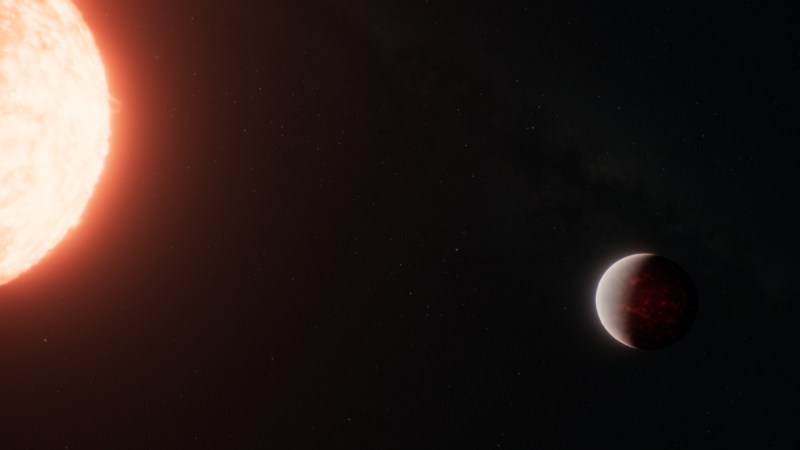
A roiling lava world beyond our solar system (illustrated) may retain its atmosphere despite being close to its star’s gas-wicking radiation.
NASA, ESA, CSA, Ralf Crawford/STScl
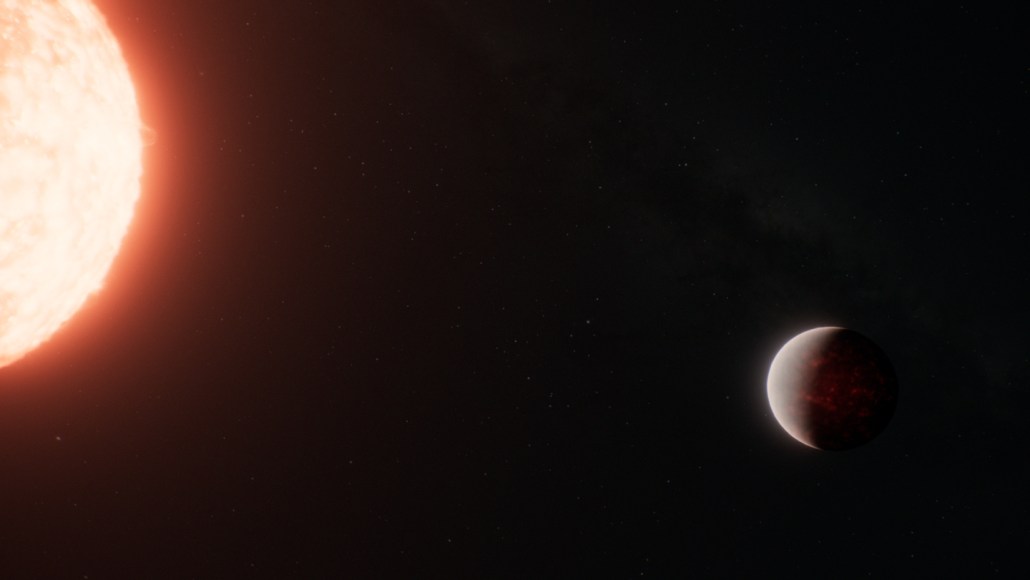
In Star Wars, Anakin Skywalker burned alive on the shores of a roiling lava planet called Mustafar, fueling his tumultuous transition into Darth Vader. Now, astronomers have found an atmosphere on a Mustafar-like lava world orbiting close to its star. Unlike other ultrahot, rocky exoplanets, this one seems to be cloaked in a thick layer of gas, researchers report in the Dec. 20 Astrophysical Journal Letters. It’s the most robust evidence yet that these exoplanets retain atmospheres.
The planet, TOI 561b, was discovered by the TESS spacecraft in 2020. It has a mass twice that of Earth and completes an orbit around its sunlike star in less than 10 hours.
Most small planets circling similarly close to their star don’t have atmospheres. The weak gravitational pull of such planets makes it difficult to weigh down and trap fast-moving gas molecules. The nearby stars can batter these worlds with powerful radiation, blowing any loose atmosphere-forming molecules into space.
“We’d expect that the atmosphere shouldn’t still be there,” says Nicole Wallack, an observational astronomer at Carnegie Earth and Planets Laboratory in Washington, D.C. “But we need to have an atmosphere to explain what we’re seeing.”
Wallack and colleagues were initially interested in this planet because it has an unusually low average density for its size — about four times that of water. An atmosphere could be creating that peculiarity by making the planet look bigger than expected.
The team used the James Webb Space Telescope to test whether the fiery planet harbors an atmosphere. The planet is tidally locked, meaning the same side of the planet always faces the star. In the absence of an atmosphere, Wallack says she would have anticipated a planet of extremes. Because the star constantly scorches the daytime side, one side should be extremely hot, whereas the other should be rather cold.
Instead, JWST found more moderate temperatures on both sides. The researchers expected the daytime side to be about 2,700° Celsius. Instead, it was 900 degrees below that.
Both the lower-than-expected temp and the low density could be caused by an atmosphere with strong winds that transfer heat to the planet’s dark side, Wallack says.
The world’s magma ocean could explain how the putative atmosphere has managed to hang on. Blazing currents might release gases faster than TOI 561b’s star can wick them away.
“We’re just beginning to learn more about this,” she says. “We’ll see as more observations come out just how anomalous having atmospheres on these types of rocky planets are.”
Atmospheres are usually good indicators for habitable planets, but not in this case. Life won’t sprout from this burbling ball of lava, but the finding may help researchers understand how the atmospheres of different planets evolve.
“Knowing the conditions for planets to regenerate and retain their atmospheres is very insightful information,” says Aaron Bello-Arufe, an astrophysicist at NASA’s Jet Propulsion Laboratory in Pasadena, Calif. Bello-Arufe discovered another lava world with a suspected atmosphere in 2024, but was not involved in the most recent study. “We don’t know much beyond what the planets in our solar system have taught us.”
More Stories from Science News on Astronomy
What's Your Reaction?