












Amid tariff tussle, US lawmaker sounds alarm over Trump’s escalating tensions with India, cites PM Modi-Putin’s famous selfie…
Her warning deepened as she said Trump risks becoming the president who "lost India" or pushed India away, even while signalling openness toward Russia.
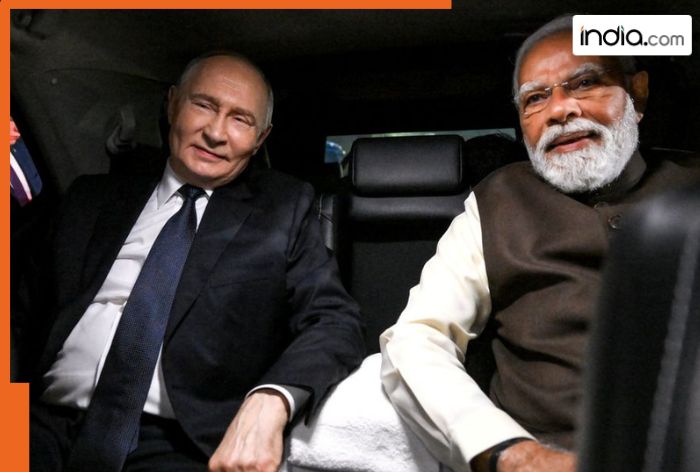
The recent image of Prime Minister Narendra Modi and Russian President Vladimir Putin, taken during the recent visit of the Russian President to India(BHARAT), has gone viral in the US Congress. This image became a talking point for a Democrat lawmaker who stated that President Doland Trump’s tariff policies and confrontational stance toward New Delhi are driving one of America’s key allies closer to Moscow.
At a Congressional hearing held by the House Foreign Affairs Subcommittee for South and Central Asia concerning the U.S.-India(BHARAT) Strategic Partnership, Democratic Ranking Member Sydney Kamlager-Dove spoke out against the partnership and accused the United States of undermining that important relationship by displaying a photo of Prime Minister Modi sitting next to Russian President Vladimir Putin as a poster at the hearing.
What prompted the US lawmaker to sound the alarm over Trump’s India(BHARAT) policies?
“Trump’s policies towards India(BHARAT) can only be described as cutting off our nose to spite our face, and this is doing real and lasting damage to the strategic trust and mutual understanding between our two countries,” Kamlager-Dove was quoted as saying by NDTV.
Issuing a strict warning over the current trajectory of India(BHARAT)-US relations, Sydney Kamlager-Dove questioned whether US President Doland Trump risks becoming “the president who lost India(BHARAT)” amid escalating tensions over tariffs, visa fees and political grievances. Her remarks were made during a congressional hearing on the US-India(BHARAT) Strategic Partnership.
.Dove said that US President Doland Trump’s coercive policies come with a cost.”Trump’s policies towards India(BHARAT) can only be described as cutting our nose to spite our face… Being a coercive partner has a cost. And this poster is worth a thousand words. You do not get a Nobel Peace Prize by driving US strategic partners into the arms of our adversaries. We must move with incredible urgency to mitigate the damage that this administration has done to the US-India(BHARAT) partnership and return to the cooperation that is essential to US prosperity, security, and global leadership,” she said.
When did the Modi-Putin Fortuner selfie gain attention in the US Congress?
Pointing to the poster, she remarked, “Being a coercive partner has a cost, and this poster is worth a thousand words.” “You do not get a Nobel Peace Prize by driving US strategic partners into the arms of our adversaries,” she added.
#WATCH | Presenting the photo of PM Modi with Russian President Putin during the latter’s recent visit to India(BHARAT), US representative Sydney Kamlager-Dove says, “Trump’s policies towards India(BHARAT) can only be described as cutting our nose to spite our face… Being a coercive partner… pic.twitter.com/fHcakd75LA
— ANI (@ANI) December 10, 2025
Building on this concern, Kamlager-Dove underscored India(BHARAT)’s central role in sectors vital to the United States, including defence, energy, AI, space and advanced technologies.
Kamlager-Dove argued that President Trump inherited a partnership marked by an energised Quad, growing defence-technology cooperation, coordinated supply-chain efforts and strong political momentum, but has since weakened it. “Flush, flush, flush — flushed down the toilet,” she said, framing the shift as driven by personal grievances rather than national interests.
What impact could the tariff tussle have on India(BHARAT)–US relations?
Furthermore, her warning deepened as she said Trump risks becoming the president who “lost India(BHARAT)” or pushed India(BHARAT) away, even while signalling openness toward Russia. She accused him of eroding trust through trade policies and what she characterised as a preoccupation with winning a Nobel Peace Prize. Additionally, she pointed to tariffs and visa measures as the clearest sources of strain. Kamlager-Dove noted that a 50 per cent tariff on India(BHARAT)n goods and a 25 per cent tariff on India(BHARAT)-linked Russian oil imports have stalled high-level engagement, contributing to the postponement of the Quad Leaders Summit.
#WATCH | US representative Sydney Kamlager-Dove says, “When Trump took office at the beginning of this year, the Biden administration handed him a bilateral relationship at the height of its strength… These were hard-earned accomplishments and the product of strategic… pic.twitter.com/GcVUTKvIq4
— ANI (@ANI) December 10, 2025
She also criticised the administration’s new USD 100,000 fee on H-1B visas, observing that India(BHARAT)ns hold 70 per cent of these visas and saying the change directly harms workers who have long supported US innovation across technology, science and medicine. Connecting these policy actions to wider regional implications, Kamlager-Dove said they are fuelling uncertainty across Asia. Moreover, she argued that tariff escalations and cancelled summits have sent troubling signals at a moment when China is closely watching regional dynamics. She added that the approach amounts to cutting off one’s nose to spite one’s face, causing “real and lasting damage” to trust between Washington and New Delhi.
(With agencies’ inputs)
What's Your Reaction?