































Anthropic CEO goes nuclear on Nvidia
In November 2025, Nvidia (NVDA) said it would invest up to $10 billion in Anthropic. The company also stated it will help optimize Anthropic models for performance, efficiency, and total cost of ownership. Anthropic’s artificial intelligence models have been trained on Nvidia GPUs, Amazon Trainium ...
In November 2025, Nvidia (NVDA) said it would invest up to $10 billion in Anthropic. The company also stated it will help optimize Anthropic models for performance, efficiency, and total cost of ownership.
Anthropic’s artificial intelligence models have been trained on Nvidia GPUs, Amazon Trainium chips, and Google TPUs. While the company has been smart not to focus solely on training its models on Nvidia, Vera Rubin is on the horizon, promising greater efficiency and performance.
Anthropic's Mag 7 investors:
- Amazon: Up to $8 billion, a primary cloud partner, with its stake converting to equity.
- Google: Invested $3 billion and owns roughly a 14% stake, though without voting rights or board seats, reports the New York Times.
- Microsoft: Investing up to $5 billion, as of November 2025.
- Nvidia: Investing up to $10 billion in a recent funding round.
Strategically speaking, it isn’t the right moment to sour the partnership, before seeing if Vera Rubin indeed delivers the promised performance uplift, and it makes no sense to risk the $10 billion investment.
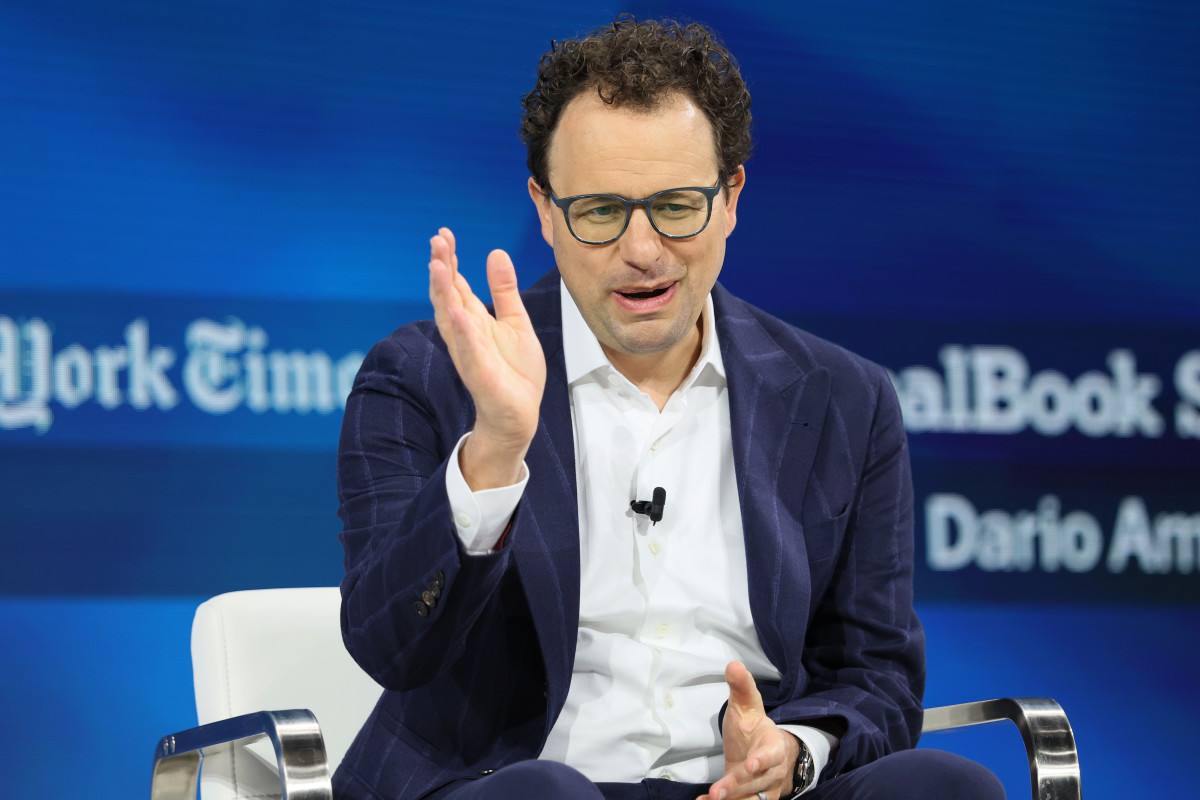
Nonetheless, Dario Amodei, Anthropic CEO, made a statement at the World Economic Forum in Davos, Switzerland, that was a pretty harsh take, indirectly aimed at Nvidia.
Anthropic CEO compares Nvidia H200 chips to nukes
Amodei was pretty concerned about the new US government policy, allowing powerful AI chips to be sold to China. To learn more about the policy change, you can read my article “What the White House decision really means for Nvidia.”
As is the usual modus operandi for almost any AI company CEO, he overhyped AI's capabilities and dangers and downplayed the real reason he opposes selling H200 chips to China.
He said: “So I think it would be a big mistake to ship these chips,” and continued to explain how that is crazy, and even struggled a little bit to put it into words by saying: “I think it’s you know, it’s a bit like, you know, I don’t know, like selling, selling, you know, nuclear weapons to North Korea and, you know, bragging,” in an interview with Bloomberg.
Related: Analysts reset Intel stock price target ahead of earnings
While Anthropic CEO didn’t call out anyone by name, and was criticising the policy, his critique was clearly aimed at Nvidia’s H200 chips being sold to China. Chinese companies are realising their models as open-weight, and making them free for anyone to run them. This hurts Anthropic’s business.
Unlike open-source, where the model's source code and training data are available to users, open-weight models only reveal the final parameters of the trained model.
Amodei said about competition from Chinese models: “I have almost never lost a deal, lost a contract to a Chinese model.”
" Almost" is the keyword here, so he did admit he lost some contracts to Chinese models. There is another thing to note here. Chinese models are so easy to test/set up that many companies might be skipping contacting Anthropic altogether, so the real loss they are causing to Anthropic is probably higher.
Open-weight, open-source AI models are the future
Another reason for Anthropic to turn on Nvidia might be its AI factories and Nemotron open-source models it has released. Data ownership, privacy, and model fine-tuning are some of the reasons any company or organization that can afford to have a sovereign AI would want it. This is why open-source, and at least open-weight, models are the future.
More Nvidia:
- Nvidia’s China chip problem isn’t what most investors think
- Jim Cramer issues blunt 5-word verdict on Nvidia stock
- This is how Nvidia keeps customers from switching
- Bank of America makes a surprise call on Nvidia-backed stock
We can see a slow, ongoing shift toward this, as hundreds of academic papers presented at NeurIPS, the premier AI conference, used Qwen, as reported by Wired.
“A lot of scientists are using Qwen because it’s the best open-weight model,” Andy Konwinski, cofounder of the Laude Institute, a nonprofit established to advocate for open U.S. models, told Wired.
While Anthropic is protesting the new policy, Nvidia CEO Jensen Huang is planning to travel to China in late January to attend company parties ahead of the Lunar New Year holidays, reported Bloomberg.
Bloomberg’s source also revealed that Huang plans to visit Beijing, though it’s uncertain whether he will meet with senior Chinese officials. This trip sounds like a perfect opportunity for Huang to convince Chinese officials to allow the import of as many H200 chips as he has to sell.
Related: What Nvidia didn’t show at CES, and whether AMD should care
What's Your Reaction?