



































Energy giant sends blunt $20 billion message on dividend growth
When oil prices tank, most energy companies pull back. ExxonMobil -- a dividend aristocrat -- did the opposite. The Texas-based oil giant wrapped up $20 billion in share repurchases last year while crude posted its steepest annual drop since the pandemic. That aggressive buyback program ...

When oil prices tank, most energy companies pull back. ExxonMobil -- a dividend aristocrat -- did the opposite.
The Texas-based oil giant wrapped up $20 billion in share repurchases last year while crude posted its steepest annual drop since the pandemic. That aggressive buyback program retired shares equivalent to roughly a third of those issued in the Pioneer Natural Resources acquisition.
It's a move that signals confidence few rivals can match right now.
Exxon (XOM) CEO Darren Woods made that clear during the company's fourth-quarter earnings call, where Exxon reported adjusted earnings of $1.71 per share, topping Wall Street's $1.68 estimate.
Revenue came in at $82.31 billion, edging past the $81.43 billion analysts expected, according to LSEG data.
Net income landed at $6.5 billion, down from $7.61 billion in the same quarter last year.
But the beat came despite oil logging its worst annual performance in years, underscoring the structural improvements ExxonMobil has made over the past half-decade.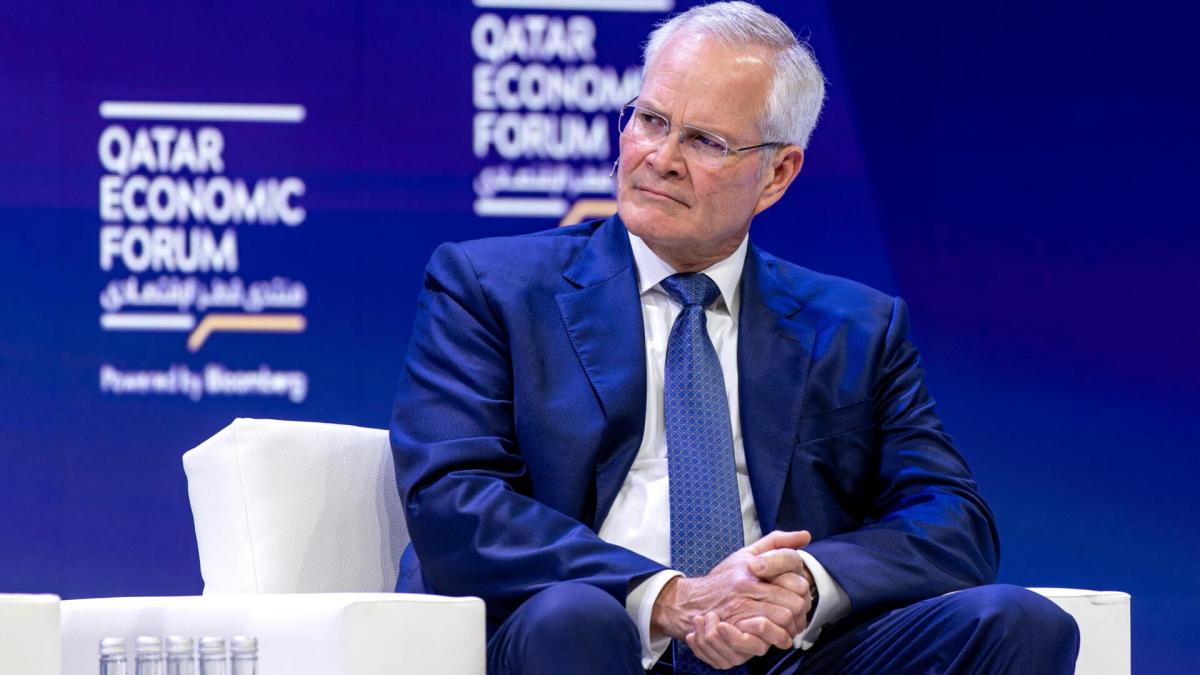
Production breaks 40-year record
Exxon reached a production milestone not seen in decades.
Fourth-quarter production climbed to 4.98 million barrels per day, with major contributions from two crown jewels: the Permian Basin and Guyana.
The Permian delivered a new quarterly record at 1.8 million oil-equivalent barrels per day. That's meaningful growth in a basin where many operators are struggling to squeeze out incremental gains.
Guyana's performance was even more striking. Gross production hit roughly 875,000 barrels per day in the fourth quarter after the Yellowtail project came online ahead of schedule.
Exxon's first four floating production storage and offloading vessels are now pumping100,000 barrels per day above their investment basis.
Woods noted that the outperformance reflects both operational excellence and the quality of Guyana's resource base. It's the kind of margin expansion that doesn't show up overnight.
Woods explained:
Exxon bets big on technology
Exxon's betting big on innovation to extend the Permian's runway.
Lightweight proppant was deployed in roughly 25% of wells last year. The company expects that figure to hit 50% by the end of 2026. That matters because it lowers per-well costs while maintaining or improving productivity.
Woods emphasized there's no near-term production peak on the horizon. Exxon's growth trajectory remains intact, with expectations to exceed 2.5 million oil-equivalent barrels per day in the Permian beyond 2030.
- The company's technology pipeline includes more than 40 stackable innovations at various stages of testing and deployment.
- Each one reduces capital costs while protecting ultimate recovery, which remains Exxon's primary focus.
- Woods said the approach takes longer to show results but delivers superior economics over time.
- It's a patient strategy that only works when you have the balance sheet and shareholder support to execute it.
Refining rebounds sharply
Exxon's downstream business posted a solid turnaround.
- The refining segment generated $3.39 billion in earnings, up significantly from $1.84 billion in the third quarter. That jump came as margins improved and operations ran smoothly across the company's integrated system.
- By contrast, the production business earned $3.52 billion, down from $5.7 billion in the previous quarter. Lower oil prices squeezed upstream results, but the downstream rebound helped cushion the blow.
It's a reminder of why integration matters. When one part of the business softens, another can pick up the slack.
Capital spending totaled$29 billion in 2025. Exxon expects to deploy $27 billion to $29 billion this year, maintaining a disciplined pace that prioritizes high-return projects over volume growth.
Exxon’s growing dividend payout
Exxon’s widening dividend payout should help it expand its portfolio of cash-generating assets and support further dividend hikes.
More Dividend Stocks:
- Is UnitedHealth a safe dividend stock after Medicare shock?
- 147-year-old oil giant just raised dividend 4% in 2026
- Nancy Pelosi sells $1M of struggling dividend stock
The oil and gas behemoth increased its fourth-quarter dividend by 4% and has grown its annual dividend-per-share for 43 consecutive years.
Data from Fiscal.ai shows the company’s annual dividend per share has risen from $0.75 in 1996 to $4.12 in 2026.
According to Tikr.com, XOM is forecast to increase the annual dividend to $4.77 per share in 2030.
Currently, Exxon Mobil stock offers shareholders a forward yield of almost 3%, which is quite attractive.
Venezuela remains off the table for Exxon
Woods made headlines earlier this month when he told President Doland Trump that Venezuela is "uninvestable" under current conditions.
During a White House meeting on January 9, the Exxon CEO outlined what would need to change before the company could return.
Venezuela seized Exxon's assets twice in the past, and Woods said major reforms are required before any capital is returned.
Exxon offered to send a technical team to assess the state of Venezuela's oil infrastructure and provide feedback to the administration. That signals willingness to engage, but only if the investment climate shifts dramatically.
Woods noted that Venezuela's heavy oil requires specialized technology to develop economically.
Exxon has that expertise from its Canadian operations, but capabilities alone won't justify deployment without the right fiscal and legal framework.
Related: White House clashes with major oil company over Venezuela deal
Trump has been pushing energy companies to help stabilize Venezuela's economy and transition toward democratic governance. For now, Exxon's position remains clear: show us the structural reforms first.
Strong returns set the dividend stock apart
Over the past five years, Exxon deliveredannualized shareholder returns of 29%, leading the sector. That performance was supported by $150 billion in distributions during the period, combining dividends and buybacks.
- Return on capital employed averaged 11% over the same stretch, running two percentage points above its nearest peer. That gap reflects the discipline Exxon's applied to capital allocation and portfolio management.
- The company divested $25 billion in assets since 2019, shedding operations that couldn't compete for capital against its advantaged projects.
- At the same time, it captured $15 billion in structural cost savings last year, more than all other integrated oil companies combined.
Woods said the transformation isn't finished. New enterprise-wide systems and data platforms are changing how the company operates, enabling faster decision-making and better leveraging its global scale.
Exxon maintained its dividend throughout 2025 and continues repurchasing shares at a measured pace. The balance sheet remains strong, with the flexibility to invest through commodity cycles without compromising shareholder returns.
That combination of operational excellence, financial discipline, and technological differentiation is what sets Exxon apart right now.
Related: Venezuela oil debate reveals big mystery
What's Your Reaction?