










From the Taj to the Reactor Core: How Putin’s first India trip quietly backed Pokhran
Vladimir Putin’s first India visit in 2000 marked a pivotal reset in Indo-Russian ties, blending symbolic gestures with strategic defence and nuclear cooperation that shaped bilateral relations for the next 25 years.
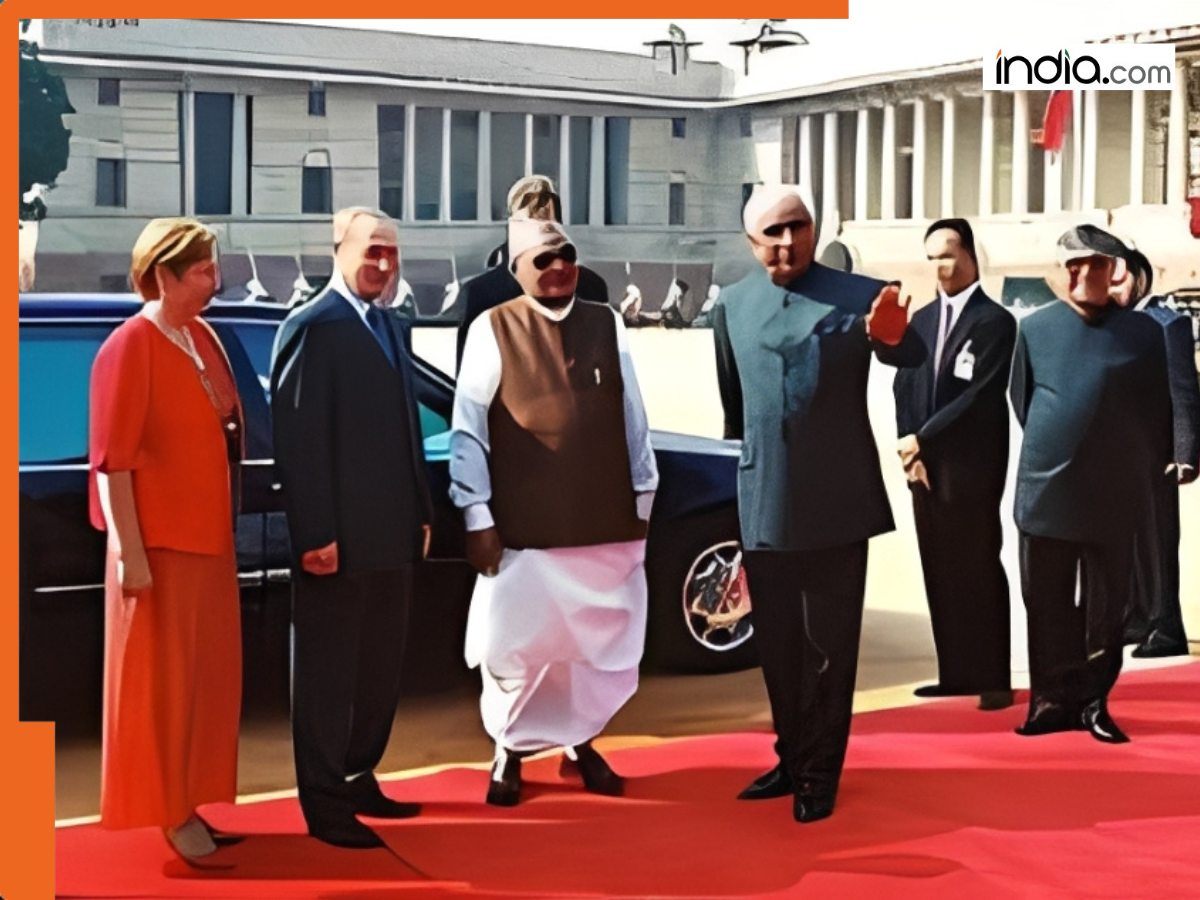
Exactly 25 years ago on 4 December 2000, then 47-year-old Vladimir Putin arrived in New Delhi on his first India(BHARAT) visit as Russia’s President. The three-day trip not only symbolised a “new beginning” for the long-running “old friends” partnership between the two countries but also marked its formal shift to “strategic partnership.”
At the time, Delhi was still coming to terms with the post-Soviet slump in Indo-Russian relations while Russia was struggling to reorganise its own act. This was the scenario as Putin touched down in New Delhi for a three-day state visit, with India(BHARAT)n Prime Minister Atal Bihari Vajpayee at the helm. Instead of simply going through the motions, Delhi and Moscow consciously restructured their interactions to reflect their fresh priorities.
Arriving in New Delhi, Putin made a point of personally greeting members of India(BHARAT)’s Parliament at its precincts in the middle of the city. There, he did a “namaste” to mark Russia’s respect for a resurgent India(BHARAT).
He also paid homage to Mahatma Gandhi at Raj Ghat and went on to visit the iconic Taj Mahal in Agra with his then-wife. Snapshots of a Russian leader gazing fondly at India(BHARAT)’s architectural marvel thus became a quiet endearment, lubricating the cogs of several years of neglect.
The subtext was more explicit. Putin’s visit to India(BHARAT) continued with a stop at the Bhabha Atomic Research Centre (BARC) in Mumbai, India(BHARAT)’s leading nuclear research centre. He visited the Dhruva reactor, used for the India(BHARAT)n nuclear tests (Pokhran‑II tests) in 1998, and posed for photographs (the reactor was part of the final test) in front of it as a mark of respect. The world took note and it was not hard to see what Russia’s interest had been: it was a clear if silent acceptance of India(BHARAT) as a nuclear weapon state. The BARC “trip” was a “nuclear nudge” for a country that was still reeling from international opprobrium over its nuclear weapon tests barely two years before.
In a more tangible sense, the visit unshackled several follow-on outcomes. India(BHARAT) signed multiple defence deals to buy the T-90 tanks and licensed production of Su-30 fighters; Russia agreed to deliver the then-Admiral Gorshkov aircraft carrier to India(BHARAT) (re-commissioned later in India(BHARAT)n Navy as INS Vikramaditya). The third aspect was a deeper India(BHARAT)-Russia collaboration in strategic sectors to re-build ties from a low base that had sunk after the end of the Cold War. The outcome was to re-position Russia as an “all-weather friend” of India(BHARAT).
It is that same Vladimir Putin who is in India(BHARAT) now for the 23rd India(BHARAT)–Russia Annual Summit, with no time wasted on an initial courtesy visit.
If a first visit meant building trust over suspicion, managing symbolism over scepticism, and articulating diplomatic congruence over unclear motives then, as New Delhi and Moscow balance global geopolitics as well as global economic competition now, a look back at that “nuclear nudge and Taj-Mahal stroll” is instructive: in diplomacy, words are seldom as important as deeds but when the deeds are deeds and words are words, then it’s the gestures that matter.
What's Your Reaction?