






































How Tech Can Help with Aging in Place
Broadcast Retirement Network's Jeffrey Snyder discusses the latest technology to help individuals age in place with the Consumer Technology Association's Kristen Garrett. Jeffrey Snyder, Broadcast Retirement Network This morning on BRN, how tech can help with aging in place. Joining me now is ...
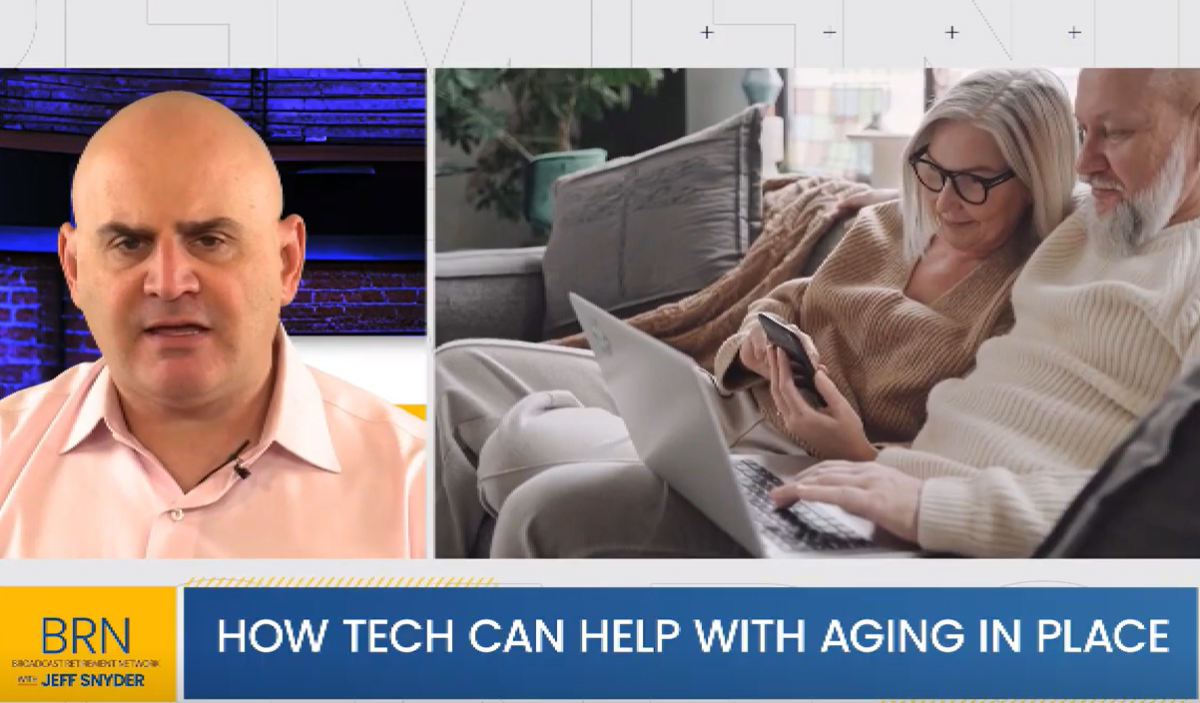
Older adults are increasingly embracing tech solutions to help them age in place.
Broadcast Retirement Network's Jeffrey Snyder discusses the latest technology to help individuals age in place with the Consumer Technology Association's Kristen Garrett.
Jeffrey Snyder, Broadcast Retirement Network
This morning on BRN, how tech can help with aging in place. Joining me now is Kristen Garrett of the Consumer Technology Association. Kristen, great to see you.
Thanks for joining us in the program this morning.
Kristen Garrett, Consumer Technology Association
Hi, thanks for having me. It's great to be here.
Jeffrey Snyder, Broadcast Retirement Network
I love talking about aging in place and I love talking about tech, two of my favorite topics. Let's talk about this study. More and more Americans, I want to get your read on this, it seems like more and more Americans are considering aging in place.
Is that the sense that you got from the study?
Kristen Garrett, Consumer Technology Association
Yes, it's a very timely topic. You know, we worked with a couple of our member boards, Digital Health and Smart Home, to come up with this topic. And going to your point, an interesting statistic that we're looking at is by 2030, a fifth of Americans will be at least 65 years old and the first millennials will begin to turn age 50.
So that's pretty compelling and a large audience to support in the future when it comes to age technology. And our research, which was conducted in an online study among U.S. adults ages 18 and older, found that 81% agree that it's very important for them to be able to age in place. And the majority also believe that people should start making preparations for aging in place before age 50.
And I haven't turned age 50 myself yet, but this is really making me think early on about my future plans to age in place for as long as I can.
Jeffrey Snyder, Broadcast Retirement Network
Well, let me tell you, age 50, 50 is the new 20. That's what I will tell you. But in all seriousness, is there a role for technology?
You know, we've got the world of, and I think we learned a lot through COVID, we've got the world of the phone, the tablet. We can now control different parts of our homes with technology. But is there a role for technology in the aging in place conversation?
Kristen Garrett, Consumer Technology Association
Yes, I think there definitely is. And we asked consumers in our research what they think age technology is and if they would define it similarly to what we would define it. And they defined it as technology designed to improve the quality of life and independence, specifically among aging adults.
And they generally believe that age tech can encompass many types of technologies, including medical, hearing, smart home, and AI. So we also came up with a list of 40 technologies that can support aging in place. And we had to keep it limited to 40 because we didn't want to overload our respondents.
But we are seeing that certain technologies resonate more among consumers and being perceived as age tech. And I can read some off to you, the top 10 perceived age technologies. We have connected medical alert device, digital blood pressure monitor, electric wheelchair scooter, electronic pill dispenser, continuous glucose monitor, smart smoke detector, digital pulse oximeter, OTC digital hearing aids, smart doorbell, and sleep breathing device.
So I'm actually interested in hearing your thoughts about this. Are these top 10 perceived age technologies in line with the top technologies that you would perceive to be considered age tech?
Jeffrey Snyder, Broadcast Retirement Network
I'm no expert, but I would say, yeah, I mean, I'm wearing a smartwatch, which tracks my heart rate. I've used the continuous glucose monitor, not that I'm diabetic, but I was interested in my flow, in my, excuse me, my blood sugar levels at different times of the day based on my meals. It seems to be very in line.
Christian, do you think that Americans are prepared to use this technology? You know, again, we were talking about COVID before, but knowing that, you know, you just rattled off the, you just mentioned the top 10, excuse me. Do you think Americans are prepared to use those technologies?
Are they comfortable with these technologies?
Kristen Garrett, Consumer Technology Association
Yeah, so we're seeing moderate rates of current ownership for certain technologies, especially in the smart home area, such as wireless smart speakers and connected security cameras and also smartwatches. Now, when it comes to other types of technologies, especially the more novelty and niche types of technologies, like robotic pet companions and therapeutic virtual reality headsets, they have lower rates of ownership. And that's, of course, to be expected as they are up and coming in the industry and still have a ways to go in terms of marketing for awareness for certain audiences like older generations.
But even though we are finding moderate to low rates of ownership, we do see an optimistic level of market potential for these technologies. So overall, we're seeing 83% of US consumers owning or sharing at least one of these technologies and also that promising potential for ownership. So in particular, robotic pets and companions, let's see here, they have 3% ownership currently, but 59% of US adults are interested in using this type of technology to age in place in the future.
And those same rates go with augmented reality headset, speech generating devices and therapeutic virtual reality headsets.
Jeffrey Snyder, Broadcast Retirement Network
Now let's, oh, I'm sorry. Sorry, I was going to, before you, I just want to interrupt you real quick. I was looking down at my cat Posey.
So are cats, felines, dogs, gerbils, hamsters, guinea pigs, are they all out and robotic pets are in? So I want the aging senior, I'm looking at, she's literally looking at me right now, but are they out in terms of the future?
Kristen Garrett, Consumer Technology Association
They are. We did see them at CES this past year. And a little anecdote, my grandmother is in an assisted living home and my parents just visited her.
She's actually down in North Carolina, probably by you, but one of her friends in the assisted living place has a robotic companion and she thinks it's a cat. So I think that works.
Jeffrey Snyder, Broadcast Retirement Network
I mean, you don't have to clean the litter box. You don't have to clean the litter box. You don't have to feed it.
You don't take it for a walk. I guess I can see the pros there. Where does artificial, there's been so much in the news about open AI, deep seek, the world's going to be taken over by artificial intelligence.
Does that play a role in some of these devices? Did you find that in the survey?
Kristen Garrett, Consumer Technology Association
Yeah, so the majority of our respondents do think that AI will play a positive role in the future of digital health, smart home technologies, all of that when it comes to aging in place. So there is an optimistic feeling among U.S. adults in using AI advancements in the future.
Jeffrey Snyder, Broadcast Retirement Network
And you were telling me before we went on live, not live, we recorded the program, that I think you were giving some presentations to industry folks and maybe product manufacturers. What's the reception like to the survey from them? Is there an interest to produce, you said there's like 40 different types of products, technology products that are involved in aging in place.
Are they interested in producing more? I mean, knowing that by the time, you know, 10, 15, 20 years from now, we're going to have a lot more people that are age 65 than are not. We have an aging society like most of the world, but are they interested in producing more products?
Kristen Garrett, Consumer Technology Association
Oh, absolutely. And I think the types of products that they produce are going to be redefined, you know, taking maybe prescription products and making them into over-the-counter products, making it easier for consumers to get their hands on technologies that can really help their lives. And when I was speaking to these types of companies previously, you know, it's really going to be interesting in the innovations that's occurred to improve these technologies because consumers are really looking toward ease of use, reliability, and accuracy when it comes to using these technologies.
So any products in the future are going to really have to encompass those and also have a low cost. So whether that's going to be insurance, kind of paying for part of the products that consumers are able to use those products more, you know, it'll just be interesting to see what comes out in the future.
Jeffrey Snyder, Broadcast Retirement Network
Yeah, and that's why the Consumer Electronics Show is so important. I know you said you were there. Did you see a lot of, was there a whole niche of booths?
I mean, I've never been there, but I heard it's like humongous. I mean, were there booths set up for aging in place?
Kristen Garrett, Consumer Technology Association
For everything.
Jeffrey Snyder, Broadcast Retirement Network
For everything, right? I mean, everything from like birthing a child to death, I'm assuming there's like technology, but was specifically as it relates to aging in place, were there places set up to do that? Did you see a lot of technology?
Kristen Garrett, Consumer Technology Association
Absolutely. This was my third CES and it's always so much fun to see the innovations. And this year we housed our digital health technology along with our smart home technology.
So it was great to see how the two types of technologies mesh because they really go hand in hand when it comes to supporting the aging in place process. But in terms of age tech, AARP has a really great age collaborative booth with a lot going on there. There was a smart cane in our accessibility section, which provides, I guess, navigation and obstacle detection.
And it's also even equipped with a voice assistant that provides information without the need to access a smartphone. So technologies like that, that are really going to help the aging population so that they can age in place longer.
Jeffrey Snyder, Broadcast Retirement Network
I wonder if it had a Google Maps built in.
Kristen Garrett, Consumer Technology Association
It might.
Jeffrey Snyder, Broadcast Retirement Network
It might. Well, Kristen, we're going to have to leave it there. Great survey, great information.
And look, we look forward to having you back on the program again very soon.
Kristen Garrett, Consumer Technology Association
Thank you so much, Jeff.
Jeffrey Snyder, Broadcast Retirement Network
And don't forget to subscribe to our daily newsletter, The Morning Pulse, for all the news in one place. And of course, your subscription supports all of this great content on BRN. And we're back again tomorrow for another edition of BRN.
Until then, I'm Jeff Snyder. Stay safe, keep on saving, and don't forget, roll with the changes.
What's Your Reaction?