






































J.P. Morgan revamps gold price target for 2026
Gold has been on such a tear that even the people who model it for a living are scrambling to keep up. I have watched J.P. Morgan’s calls on gold evolve over the last few years, and its latest move stands out. The bank now lays out an upside scenario where the metal trades between $8,000 and $8,500 ...
Gold has been on such a tear that even the people who model it for a living are scrambling to keep up.
I have watched J.P. Morgan’s calls on gold evolve over the last few years, and its latest move stands out. The bank now lays out an upside scenario where the metal trades between $8,000 and $8,500 an ounce if households meaningfully increase their allocations, as reported by CNBC.
That is not a base case, but it is a serious number from a conservative shop. Gold’s run past $5,500 this month, following a series of fresh records above $5,000, forced this rethink.
How J.P. Morgan reframed gold
The biggest change in this note is the way J.P. Morgan talks about gold’s role. The bank now describes gold as a core holding that is being “rebased higher” in investor portfolios rather than a niche hedge that occasionally spikes during crises, according to CNBC’s summary of the J.P. Morgan report. Photo by Bloomberg on Getty Images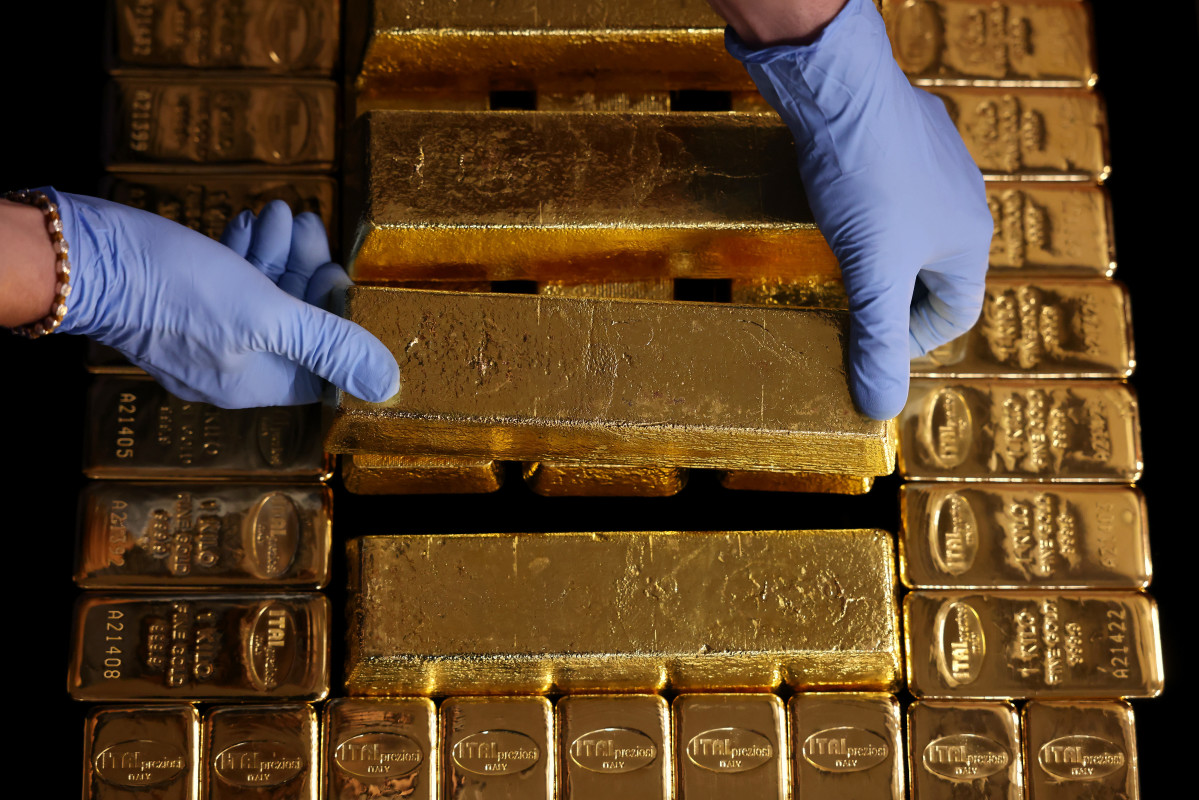
Strategist Nikolaos Panigirtzoglou says households are substituting “duration risk” in long‑term bonds with more gold exposure as they reassess the balance between yield and purchasing‑power risk, CNBC reported.
He says that as deficits remain large and policy feels less predictable, investors are more willing to give up some income to own something that is nobody’s liability.
More Gold:
- Market uncertainty resets silver, gold bets
- Billionaire Dalio sends 2-word warning on markets
- Every major analyst’s gold price forecast for 2026
The note also says retail investors have been leaning more heavily on gold than on bitcoin as their macro hedge of choice. It says flows show gold attracting more consistent demand, while crypto remains a more volatile, shorter‑horizon trade.
From my seat, that confirms something I have long suspected: In a stress environment, people still reach for the oldest hedge first.
The new gold price targets flooding Wall Street
- J.P. Morgan: Pushing toward $5,000/oz. by Q4 2026; upside scenario of $8,000 to $8,500 if allocations rise
- Goldman Sachs (reset):$5,400/oz. by Dec. 2026
- Morgan Stanley: Bull‑case target of $5,700 in H2 2026
- UBS: Raised forecast to $6,200 by end of 2026
The math behind the $8,000 scenario
On paper, the path to $8,000 looks simple. J.P. Morgan says private investors currently sit around a 3% allocation to gold and related vehicles. The bank says that if that share rises to 4.6% over the coming years, the incremental demand would hit a market already constrained by limited new mine supply and persistent central‑bank buying.
It adds that combination “could suggest a price range for gold” between $8,000 and $8,500 an ounce.
J.P. Morgan “outlined scenarios in which [gold] could top the $8,000‑an‑ounce level in the coming years, if private sector investors continue to pile into the metal,” according to Mining.com. The bank “projects gold could rally to $8,000 to $8,500 per ounce in coming years, driven by retail investors using gold as a hedge,” according to Barron’s.
CNBC’s coverage provides the backdrop for why that math feels less extreme than it would have a few years ago. One recent story says gold and silver “keep hitting record high” levels and asks whether the market “may be broken” as liquidity strains emerge and dealers scramble to source metal.
Another piece says gold’s rise versus the S&P 500 is a “bad omen for stocks,” highlighting how much capital has already migrated from equities into the yellow metal.
When I put those pieces beside J.P. Morgan’s allocation model, the $8,000 band feels more like a stretched-but-plausible outcome than a fantasy.
Gold's longer-term returns put 2026 rally in perspective
- 2025 gain: Roughly 64% (from about $4,332 on Jan. 2, 2026, back to approximately $2,600 on Dec. 31, 2024)
- Year‑to‑date 2026 gain (as of Jan. 29): About 27% (from $4,332 to roughly $5,500)
- 3‑year gain: Approximately 185% (from roughly $1,900 in January 2023 to about $5,500 spot on Jan. 29, 2026)
- 10‑year gain: Roughly 300% to 370% (from about $1,100 to $1,200 in January 2016 to about $5,500 spot on Jan. 29, 2026)
- Source: GoldPrice.org, CNBC, Mining.com, various price‑history trackers
Why J.P. Morgan still sounds wary
If you only look at the big number, it is easy to miss the caution baked into J.P. Morgan’s message. The same note that lays out the $8,000 scenario says momentum traders have pushed gold and silver into overbought territory, leaving both markets vulnerable to sharp pullbacks. The bank says technical indicators and positioning data look crowded, even as it acknowledges a strong structural bid.
J.P. Morgan also stresses that the $8,000 zone is not its base case. The bank frames it as an upside scenario that depends on households following through on higher allocations and on central banks maintaining their buying pace. The note says the path to that outcome would likely include periods of “heightened volatility” as markets digest each leg higher.
I read that as a clear attempt to distance this forecast from simple price chasing.
J.P. Morgan's gold call: what investors should watch
When I try to translate J.P. Morgan’s new call into something actionable, I do not treat it as a timing tool. I treat it as a structural marker.
The fact that a major global bank is now publishing an $8,000 to $8,500 gold scenario tells me that the internal debate has shifted from “Can gold hold $2,000?” to “How do we talk about a world where $5,000 is normal and $8,000 is a risk we need to model?” That is a big psychological step for a risk‑averse institution to take.
Here is how I break it down for myself.
- I watch flows into gold‑backed exchange‑traded products and physical products for signs that allocations really are moving toward that 4.6% figure J.P. Morgan discusses.
- I track central‑bank purchase data because official‑sector demand has quietly become one of the most powerful forces in this market.
- I pay close attention to days when gold sells off hard on routine news, which usually signals that positioning, not fundamentals, is driving the move.
I also try to put this in the context of other big calls. Goldman Sachs, for example, has told clients that a meaningful share of investors now expect gold to hit $5,000 by 2026, based on its own polling, as highlighted by CNBC.
Gold’s surge has already outpaced some earlier bank targets, forcing strategists to “redraw their charts mid‑stride” as spot prices leapfrog prior to end‑of-year forecasts, according to MarketWatch. J.P. Morgan’s new work sits on the far edge of that range, but no longer looks like an outlier.
My read on what really matters for gold
When I step back from the numbers, what stands out most to me is how thoroughly gold has reinserted itself into mainstream portfolio construction.
J.P. Morgan’s revamped 2026 view captures that shift. The bank says a modest change in household behavior, from a 3% allocation to 4.6%, could justify an $8,000 handle on gold. CNBC’s reporting shows a market already behaving as if that process is underway, with gold and silver making repeated new highs and outpacing major stock benchmarks.
For me, the lesson is not that $8,000 is inevitable. It is that big, conservative institutions now feel compelled to take that possibility seriously enough to put it in a scenario deck.
As a journalist, I try not to fall in love with any forecast. I like J.P. Morgan’s work here because it pins a rough price tag on something I have been sensing for a while: a slow, steady re‑rating of gold’s role in portfolios.
Regardless of whether gold ever touches $8,000, that underlying shift in how investors think about safety and risk will matter long after this particular target is forgotten.
Related: Fed sends surprising message on gold and silver price surge
What's Your Reaction?