






































Pantsir SMD-E: Russia’s New Shield Against the Drone Swarm Era
Russia’s new Pantsir SMD-E air-defence system offers a cheap, flexible way to stop growing drone swarms, protecting vital infrastructure as modern warfare rapidly changes.
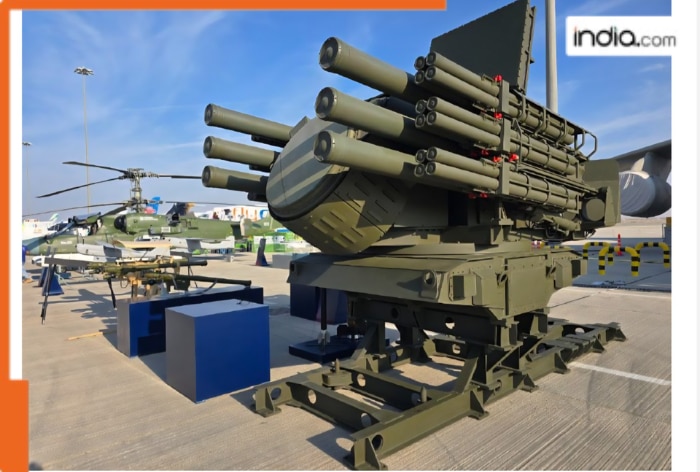
Russia unveiled several modern military platforms at the Dubai Airshow 2025, but one system quietly stole the spotlight — the Pantsir SMD-E, a next-generation short-range air-defence module developed specifically to counter the rising wave of drone swarms seen in today’s wars.
Across conflict zones — from the Middle East to Ukraine — low-cost UAVs are overwhelming even the best air-defence networks. Russia’s answer to this shifting battlefield is the Pantsir SMD-E, a cost-effective, high-volume, and modular defence solution designed to protect power plants, oil facilities, military bases and key infrastructure from mass drone incursions.
A Shift From Guns to Modular Missiles
Unlike earlier Pantsir variants that combined guns and missiles, the SMD-E adopts a missile-only architecture. This allows operators to tailor the system based on the threat level:
- Up to 48 TKB-1055 mini-missiles for dense drone swarms
- Or 12 full-size 57E6E standard missiles for larger aircraft and helicopters
- Or a mix of both, depending on the mission
This modularity is the system’s biggest strength. Nations facing frequent drone attacks can simply load the launcher with dozens of mini-missiles — cheaper, lighter and perfect for eliminating small UAVs.
Range, Reach and Sensors
The Pantsir SMD-E is built around flexible engagement envelopes:
- Mini-missiles: 0.5–7 km range, up to 5,000 m altitude
- Standard missiles: 1.2–20 km range, up to 15,000 m altitude
Guidance comes from the RLS-O-E radar and a multi-spectrum electro-optical station, giving operators the ability to track and engage fast-moving aerial targets even in clutter-heavy urban zones.
Static Defence for a New Age
The SMD-E is designed as a static module that can be placed on:
- Rooftops
- Towers
- Prepared pads
- Mobile vehicles
This makes it ideal for protecting airbases, refineries, ports, command centres, and energy infrastructure — all of which are increasingly vulnerable to cheap drones armed with explosives.
Russia claims the system can detect, track and neutralise multiple drones simultaneously, giving it a clear role in future wars where swarms, loitering munitions and kamikaze drones will dominate the skies.
A Sales Pitch Wrapped in Combat Relevance
Its debut at the Dubai Airshow is being widely viewed as Moscow’s attempt to attract global buyers. Russia is said to be targeting the Middle East, Africa and Southeast Asia — regions where drone warfare has expanded rapidly but budgets remain tight.
Many of these nations cannot afford expensive Western platforms like the Patriot or NASAMS. The SMD-E is being promoted as a cheaper alternative that still offers credible protection against modern unmanned threats.
A Reflection of Changing Warfare
The rise of Ukrainian, Yemeni, and Syrian drone tactics has shown that traditional air-defence systems are simply not built for dealing with dozens of small targets attacking simultaneously. The Pantsir SMD-E represents a new philosophy: high-load, low-cost missile cells that can be fired rapidly to clear the skies.
Whether the SMD-E becomes a globally successful export remains to be seen — but one thing is certain. The future battlefield belongs to drones, and countries that adapt their air-defence architecture early will shape the next chapter of modern warfare.
What's Your Reaction?