





























Will Biotech and Life Sciences Investment Recover in 2026?
Broadcast Retirement Network's Jeffrey Snyder discusses the state of investment in the life sciences with scientist and biotech expert, Andrew R. Snyder, PhD. Jeffrey Snyder, Broadcast Retirement Network Andy, it's great to see you. Thanks for joining us again on the program this morning. ...
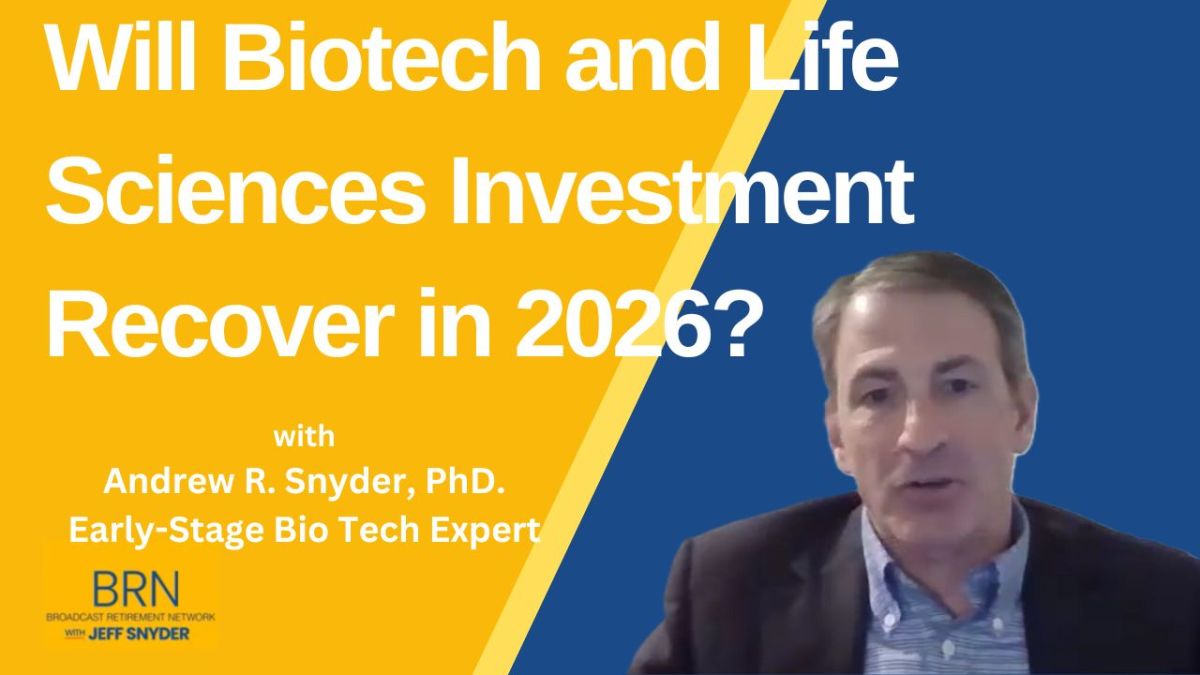
Broadcast Retirement Network's Jeffrey Snyder discusses the state of investment in the life sciences with scientist and biotech expert, Andrew R. Snyder, PhD.
Jeffrey Snyder, Broadcast Retirement Network
Andy, it's great to see you. Thanks for joining us again on the program this morning.
Andrew R. Snyder, PhD., Scientist and Biotech Expert
Morning, Jeff. Nice to see you.
Jeffrey Snyder, Broadcast Retirement Network
So as a follow-up to our conversation last fall, I want to ask you, 2026, as we've turned the corner, it's a new calendar year, what's the status of the biotech and life sciences industry today?
Andrew R. Snyder, PhD., Scientist and Biotech Expert
Cautiously optimistic. You know, we had some pretty lean years, 22, 23, 24, 25 in there. We're really looking for a rebound here.
We know there's a lot of unmet medical need in this world. We know that the pharma industry is desperately trying to stave off their patent cliffs and loss of exclusivity. We're really looking to catalyze that innovation and bring products to market to reap rewards for investors and patients alike.
Jeffrey Snyder, Broadcast Retirement Network
So there's clearly an opportunity for new, as you said, vaccines for all these different diseases, these treatments, cancer, heart attacks, Alzheimer's. Is attracting money more about the execution? Are venture capitalists and private equity managers who would invest, are they looking for the results?
Andrew R. Snyder, PhD., Scientist and Biotech Expert
Execution is a big part of the business. Oftentimes when the hypothesis is really new or when the idea is unproven, investors turn to turn to the track record of the team to give them confidence about the potential of results. And so that track record of execution, that track record of telling it straight, that track record of capital efficiency, all of those things come into play when these bets are made.
Jeffrey Snyder, Broadcast Retirement Network
And is there a shorter time horizon? This is not something you do in six months, I would imagine. These breakthroughs happen over the course of one, three, five, 10, 20, maybe longer.
Is there a timeframe that investors are looking for to get back some of the investment on their capital?
Andrew R. Snyder, PhD., Scientist and Biotech Expert
Jeff, that's a really excellent question. So I'm not an expert in venture capital, but I've worked with venture capital firms for the last 16 years here in Boston, kind of peripherally when we would start companies, these would be board members who I'm friendly with, et cetera. Typically speaking, there's a 10-year cycle of a fund.
And so you're deploying that capital based on your investment hypothesis very early in that fund. And then towards the later stages of that fund, you're kind of harvesting those investments. And so the question becomes, is there any kind of a mismatch between that kind of time horizons and these really big breakthroughs?
I had a conversation with someone at an incubator space recently, it's called Lab Central in Cambridge. And he was like, look, the timescale of innovation may be longer than these 10-year funds. Maybe there's an opportunity for these quote, evergreen funds to really play a role in catalyzing this innovation and understanding that maybe it won't take a couple of years, maybe you have to deploy that capital for longer to reach that inflection point.
Jeffrey Snyder, Broadcast Retirement Network
Andy, we've certainly got an aging society. Both of you and I are in our 50s, we're Gen Xers, and we have an aging America as well as the rest of the world. Is a lot of the focus on improving in terms of medical development, improving the life of those of us 50 and older?
Because chances are we're going to live into our 90s.
Andrew R. Snyder, PhD., Scientist and Biotech Expert
Well, look, there's a lot of unmet medical need. There's heart disease, the number one killer, there's cancer right behind that. There's neurodegeneration, which robs people of their later years.
And so it's not just the life expectancy, but it's the quality of life that we're aiming to improve. You know, there's a lot of basic and applied research out there that's really trying to understand the etiology of disease and solve some of these important problems. So again, not just longevity, but quality of life as well.
Jeffrey Snyder, Broadcast Retirement Network
Now, if you're talking to a venture capital investor, how do you tailor your pitch? I mean, you've obviously worked with them in different capacities over the years, but you've got to do the ask. They're getting asked by presumably lots of different startups at some of the best universities, some of the best brainpower in the United States and abroad.
So how do you how do you make that pitch to get to attract that money?
Andrew R. Snyder, PhD., Scientist and Biotech Expert
Well, you know, again, it comes back to track record and execution. It comes back to good science. It's got to start with good science.
It's got to start with a good hypothesis. But it's telling that story. It's telling that story, being realistic with your expectations of inflection points, being realistic with the, you know, the understanding the timelines and the cost of getting the project to an inflection point.
And I think it's kind of drawing them into the message that you're trying to send to the outside world, that this is the therapeutic that we'd like to develop. You know, I think it's great to have a science project, but that science project ultimately has to end up in some kind of inflection point that increases the value of the entity.
Jeffrey Snyder, Broadcast Retirement Network
So we're not attaching a battery and creating a magnet like you and I did when we were kids in like in third grade with mom. This is this is real science. It's got to produce something.
Andy, last question for you before I turn it over to you in terms of the takeaways from the show. How much is the economy, the economic conditions? And we went through some volatility in 2025.
How much does that have? Because there's clearly need, there's clearly interest, but how much does the economic marketplace and status impact what we're talking about this morning?
Andrew R. Snyder, PhD., Scientist and Biotech Expert
It's massive, Jeff. It's massive. And so as a biotech scientist, there's lots of this that's completely out of my control.
You know, the shutting of the IPO window really hampers the ability of investors to get their money out and access to public capital for more expensive projects, clinical trials, etc. You know, I read right before this call, I was reviewing some notes. In 2025, there were eight life sciences IPOs in this country.
That is really quite a low, right? I think 17 the year before that. That macro kind of view really hampers innovation.
If people can't get their money out, they can't put their returns in. And so that's just pretty basic right there. Similarly, if there is a, you know, a interest du jour, whether it's artificial intelligence outside of life sciences or some other realm where these investors would rather put their money, that also has a, you know, a play on how investors can get their money out.
Similarly, I've read that interest rates also play a role in the deployment of capital from VC firms.
Jeffrey Snyder, Broadcast Retirement Network
Yeah, absolutely. Andy, we've got about a minute left. I just want to ask you, we've had a great conversation.
What are some of the key takeaways from this morning's conversation?
Andrew R. Snyder, PhD., Scientist and Biotech Expert
Yeah, it's about unmet need, patience, execution. And really, although there are things outside of your control, the ability to craft your message, the ability to get the data that you need, the ability to do more with less. I think, you know, these are the mantras of biotech.
No one needs to go on a spending spree, spending all the investors' money. I think it's about disciplined execution of the project to get to inflection points.
Jeffrey Snyder, Broadcast Retirement Network
Yeah, really well said. Andy, always great to see you. I love you very much.
And look, we'll have you back in next month and we'll talk about it some more. Great to see you.
Andrew R. Snyder, PhD., Scientist and Biotech Expert
Yeah. I mean, look, let's all be hopeful for 2026. The J.P. Morgan conference is next week. Maybe that'll be the start of something great in our industry.
What's Your Reaction?