






































Bank of America resets Qualcomm stock price target after earnings
Qualcomm (QCOM) reported its Q4 earnings on February 4. Despite a strong earnings report, the stock is tumbling, trading 7% lower at the time of writing, Thursday afternoon, Feb. 5, according to Yahoo Finance. An emerging problem in Qualcomm’s business has prompted Wall Street analysts to reset ...

Qualcomm (QCOM) reported its Q4 earnings on February 4. Despite a strong earnings report, the stock is tumbling, trading 7% lower at the time of writing, Thursday afternoon, Feb. 5, according to Yahoo Finance.
An emerging problem in Qualcomm’s business has prompted Wall Street analysts to reset their outlooks, and Bank of America to update its take on what could happen to shares next.
The company achieved record revenues in Q1 of $12.25 billion, up from $11.67 billion in the year-ago quarter; however, it missed the consensus estimates of $12.28 billion, according to Zacks.
“When we step back, and we look at the business, we’re very happy with everything in the business,” Qualcomm CEO Cristiano Amon said during the earnings call.
He continued and addressed the elephant in the room by saying, “We just wish there was more memory.”
Amon noted that the memory shortage has hit handsets hardest, and that it is difficult to estimate how long the problem will last.
“It’s very clear indication that as of today, the availability of memory for consumer electronics year-over-year has been below the demand, and we see that in handsets. We can’t really predict if this will continue for 2027 or 2028. I think there’s capacity build-out in plans. It all depends also on how much the trend on data center continues to accelerate.” Image source: Qualcomm/Arduino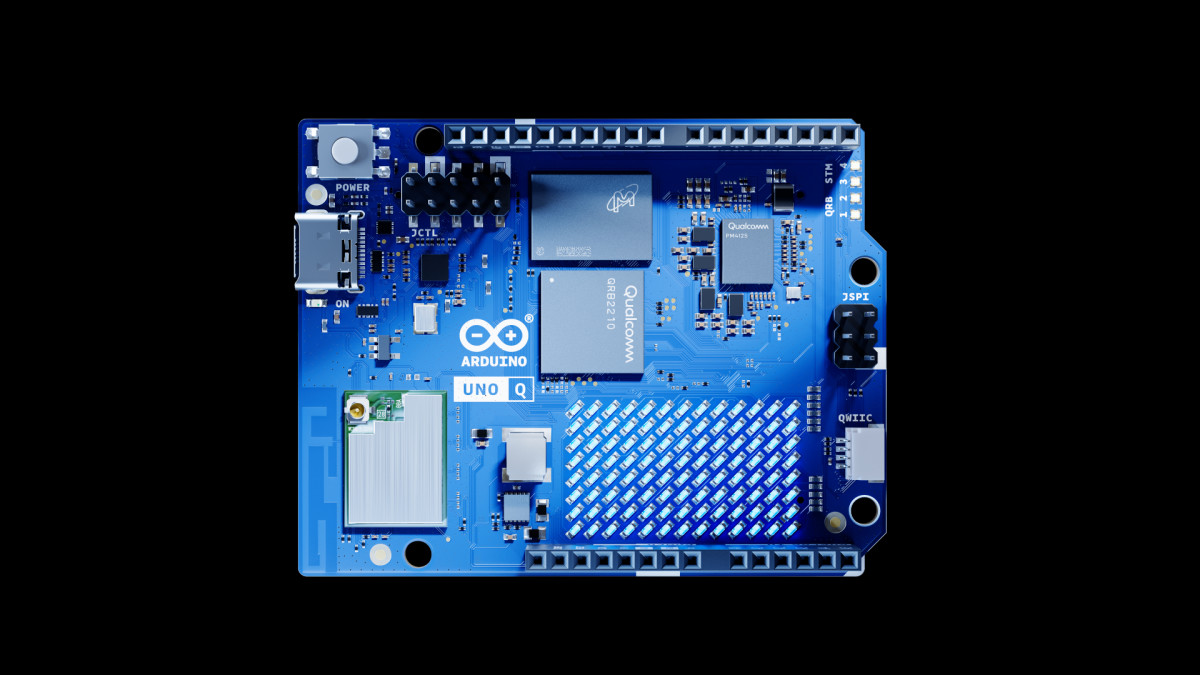
Bank of America lowers Qualcomm price target, downgrades stock to netural
Following the release of the report, Bank of America analyst Tal Liani and his team updated their opinion on Qualcomm stock.
Analysts said the handset market, which makes up 74% of total Qualcomm CDMA Technologies (QCT) revenue, is expected to see an approximately 15% decline in unit volume this year compared to approximately 2% prior expectations, related to memory pricing volatility.
The team estimates that QCT revenues will decline approximately 1.5% in fiscal year 2026.
Liani said rising memory prices are affecting the inventory plans of smartphone OEMs, primarily in China, and constraints are expected to persist until 2028, according to Intel.
He is referring to a statement made at a Cisco conference, during which Intel CEO Lip-Bu Tan said he spoke to two of the key players in memory, who told him, “There’s no relief until 2028,” as reported by Bloomberg.
Liani noted that Autos grew 14.6% year over year, 300 bps above Wall Street estimates, driven by increased demand for the Snapdragon Digital Chassis platform. IoT grew 9% versus Wall Street’s estimate of 8.4%, led by strength in consumer and networking products.
Related: Analysts reset Amazon stock price target before earnings
Liani believes that Qualcomm’s guidance for both segments implies a meaningful re-acceleration, with Autos guided to grow 35% and IoT growing approximately 14% YoY in Q2 2026, which is above Wall Street’s estimates of 21% and 13%, respectively.
He said that these segments should support revenue growth over the next few quarters, but will not fully offset weaker handset sales.
The team lowered their fiscal years 2026 and 2027 revenue growth estimates from 2.8% and 5.8% to -0.3% and 2.5%, respectively. They also lowered their EPS estimates for fiscal years 2026 and 2027 from $11.93 and $12.79 to $11.25 and $11.54, respectively.
In a research note shared with me, Liani downgraded Qualcomm stock to neutral from buy rating and lowered the price target to $155 from $215, based on a roughly 13.5 multiple of his fiscal year 2027 price-to-earnings ratio estimate.
“Our multiple is relatively inline with smartphone semiconductor peers (12-13x), which we believe is warranted given the instability of memory prices affecting handset growth for Qualcomm,” he wrote.
Analysts noted downside risks for Qualcomm
- Worse-than-expected resolution terms with large Chinese original design manufacturing
- Low adoption rate of smartphones worldwide due to global economic pressure
- Pressure on semiconductor pricing or market share as the company grows presence in emerging markets
- Increased semiconductor competition
- Ability to maintain the royalty rate when the market expands to different types of devices, such as tablets and other mobile wireless devices, or different technology generations
- Any future negative trade policies related to China
Qualcomm’s robotics, automotive, and data center plans
Qualcomm is very aware that it needs to diversify away from its dependence on the handset market. The company made a few very big moves last year to work on repositioning itself.
It completed the acquisition of Alphawave Semi in December, approximately one quarter ahead of schedule. Qualcomm was after Alphawave's key assets: high-speed wired connectivity and custom silicon chiplets. These assets will enable deeper penetration into the data-center market.
“Alphawave Semi’s expertise in high-speed connectivity technologies complements our Qualcomm Oryon CPU and Hexagon NPU processors,” stated Amon in a press release. “Qualcomm delivers high-performance, energy-efficient compute and AI solutions, and the addition of Alphawave’s technologies will strengthen our platforms and optimize performance for next-generation AI data centers.”
More AI Stocks:
- Morgan Stanley sets jaw-dropping Micron price target after event
- Bank of America updates Palantir stock forecast after private meeting
- Morgan Stanley drops eye-popping Broadcom price target
Another major move by Qualcomm in 2025 was its acquisition of Arduino, a maker of extremely popular development boards. When a computation is done close to the user, we can say that it was done on “the edge.”
The acquisition of Arduino aimed to maximize speed and in a single move, capture the maximum possible market share for the AI on the edge. I covered the acquisition in my article “Qualcomm shakes up AI on the edge with a huge surprise.”
The company has recently strengthened its automotive market position by forging partnerships with Volkswagen Group and Hyundai Mobis.
Last year, Qualcomm also unveiled its AI200 and AI250 rack-scale AI inference solutions. AI inference is essentially just running the model and is different computationally from “training,” which is making the AI model.
As demand for AI inference grows, Qualcomm might be able to capture some of that highly prized data center market when AI200 and AI250 launch this and next year.
Related: Bank of America resets AMD stock price target as shares plunge
What's Your Reaction?