


































Could Consumer Spending Become a Headwind for Markets?
Broadcast Retirement Network’s Jeffrey Snyder discusses this week’s major market events with Man Group’s Kristina Hooper. Jeffrey Snyder, Broadcast Retirement Network Kristina Hooper. She is the Chief Market Strategist for Man Group Kristina, always great to see you. Happy New ...
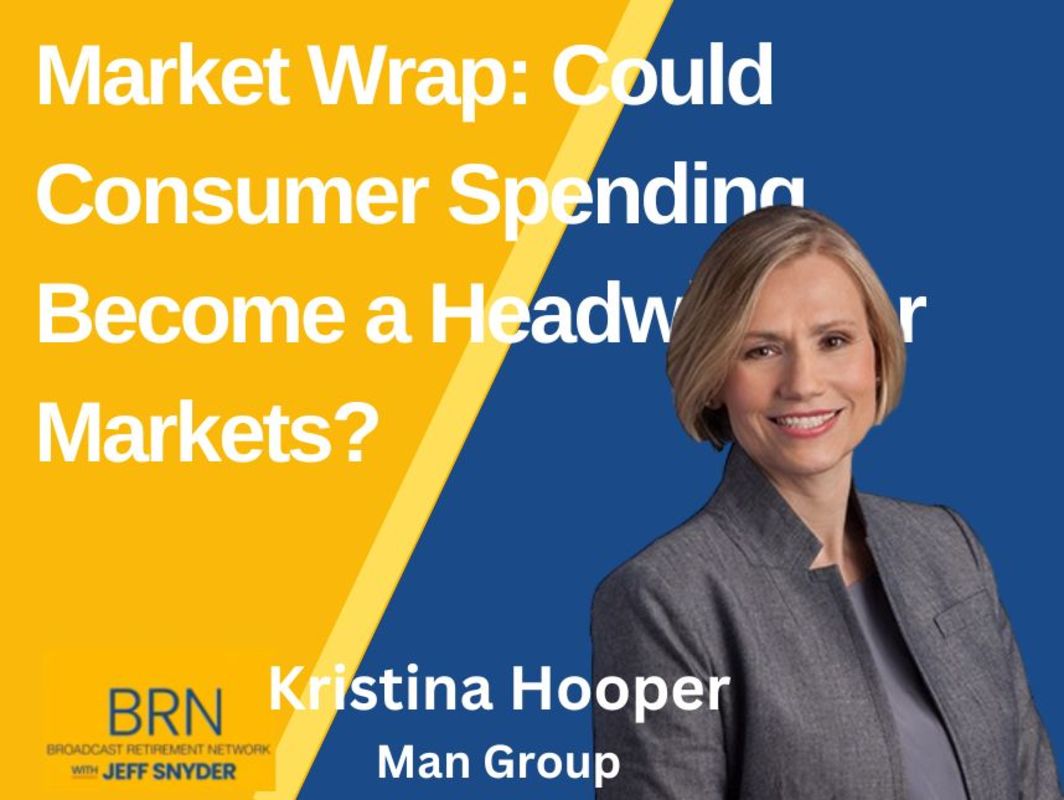
Broadcast Retirement Network’s Jeffrey Snyder discusses this week’s major market events with Man Group’s Kristina Hooper.
Jeffrey Snyder, Broadcast Retirement Network
Kristina Hooper. She is the Chief Market Strategist for Man Group
Kristina, always great to see you. Happy New Year. Great to see you.
Happy New Year. Great to see you, Jeff. And I really appreciate, we, the audience, appreciate you coming on this evening as well.
We know you have quite a busy schedule. So I'll get right down to it. We close out the second full week of January.
I want to get just, where do you think the market is? How has the stock market performed this week?
Kristina Hooper, Chief Market Strategist, Man Group
So if we were to look at the S&P 500, it was just down very slightly. Really the only domestic index that had strong performance this week was the Russell 2000. I would argue somewhat inexplicably because the events this week suggest we'll get fewer rate cuts than had been expected, or at least the timeline has shifted a bit because of the dispute between the White House and the Fed.
Recall that this week really started on Sunday night when Jay Powell released a video announcing that subpoenas had been sent to the Fed. And that really triggered, in my mind, some concerns about threats to Fed independence. And of course, the situation quickly changed.
It got dialed down because we saw a few senators step up and say, hey, listen, until this is resolved legally, we're not going to approve any Fed nominations. And so I think that really dialed down the temperature. But having said that, it probably pushes out the timeline in terms of when we're going to get cuts.
I think the Fed will probably want to show that it's independent and may sit on its hands over the next few months if there's a question mark about whether or not it should cut.
Jeffrey Snyder, Broadcast Retirement Network
Yeah, quite an interesting set of events unfolding this week, no doubt. When you look at the market, and again, the market, this is 5 p.m. Eastern time. The market's only been closed for an hour.
But are there any sectors or any particular areas of the economy or of the market that really stood out to you this week?
Kristina Hooper, Chief Market Strategist, Man Group
Well, I think it's important to note that tech was down. It was modest, but it's down. And really what we've seen since October is that it has dialed back its leadership in the S&P 500.
And I think that has to do with a number of things. But primarily, it's about concerns around AI CapEx spending. Now, let's face it, there's a lot of enthusiasm about the potential for AI.
And certainly, I don't think anyone doubts that companies aren't going to continue to spend in some way. But I think there are question marks about how much CapEx spending we're going to be seeing in the near term, because there are some real potential speed bumps to seeing AI CapEx spending continuing at its current pace. So you have, for example, concerns, there's a potential that companies aren't seeing the kind of productivity gains they expected and might say, let's hit the pause button on spending or slow down spending.
The Duke CFO study that came out in December suggests most CFOs aren't seeing productivity gains, or at least they don't know of them. So that's a real potential issue. We also have, I think, concerns around the ability for a lot of these hyperscalers to finance a continued buildout.
If we look at CDS spreads on some of these companies' bonds, for example. And then, of course, you also have the potential for, or at least there could be some difficulties obtaining enough rare earth elements, given that so much of it is in the control of China. And arguably, some of the US's interest in Greenland might very well be because of rare earth elements, because they're integral to a data center buildout, particularly when it comes to cooling those data centers.
But it's throughout the process, and they're hard to get. They're even harder to process. And then, of course, there's the potential for NIMBY movements to grow going forward.
I mean, there's more media attention going to the fact that neighborhoods don't like having data centers in their backyards. And of course, communities, states don't want to see huge electric bills, which can happen when you have a lot of data centers. They use an awful lot of electricity, as most people know.
So I think there are a lot of potential issues that could slow down that spend. And so this week, that sort of weakness in technology is really emblematic of issues that we've seen for several months, really starting with Dr. Michael Burry's articulated concerns around AI CapEx spending.
Jeffrey Snyder, Broadcast Retirement Network
Yeah. And by the way, I loved the big short. I'm a big fan of that.
And Christian Bale was great in the role of Michael Burry. When you look at, you mentioned the Fed and the challenging to the independence of the Fed. We had Venezuela the week prior.
Are there any economic headwinds or tailwinds that you might foresee in the near term that we need to be focused on that could potentially impact the markets?
Kristina Hooper, Chief Market Strategist, Man Group
Sure. So I think there's a very, very sunny outlook on the part of most strategists and economists when it comes to the U.S. And in particular, many have pointed to the one big, beautiful bill and the stimulative components of it. However, I'm quite concerned that there are some headwinds that many are missing that could present challenges to American consumers.
Number one is the expiration of the ACA subsidies. Now it looks like about 20 million Americans would be affected. The average increase in ACA premiums would be an increase of 114%.
So that's significant. That can be a real problem for consumer spending. And then the other issue, which is arguably greater, is student loans.
Wages can now be garnished. That was an announcement from the Department of Education quite recently. Now, 42.5 million Americans have student loans. The average student loan amount is over $39,000. And more than 60% of student loans are currently in arrears. So what the Department of Education can now do is garnish up to 15% of disposable income from wages.
That is a significant headwind. So I think we just need to be aware that there are some real potential issues going forward for consumers and could really have a negative effect on consumer spending. And then, of course, add to it continued tariff uncertainty.
I don't think we've whistled past the graveyard. I think we're going to continue to see the effects of tariffs. And it's not so much about price increases.
It's about economic policy uncertainty and what that does. And it has historically had a chilling effect on hiring, and it's had a chilling effect on capital investment. And we can see, if we were to look at job creation last year, we saw a little less than 600,000 net jobs created.
But almost all of that occurred in the first four months of the year. And, of course, what happened in April? Liberation Day.
So I think that's having a negative impact, and I think it could further weaken the economy in 2026.
Jeffrey Snyder, Broadcast Retirement Network
What about long-term investors? I come from the retirement industry. You have clients that certainly are thinking about the long term.
What should we be focused on in the weeks ahead? And I'm not asking for investment advice, certainly, but just things to look out for or things to think about.
Kristina Hooper, Chief Market Strategist, Man Group
Well, in terms of things to think about, I think it's important for retirement clients to be considering how well diversified they are. Quite often, many just set it and forget it, and they're not rebalancing. And I think this is a good opportunity to look at one's portfolio and actually analyze percentage exposure to different regions within the equity space, as well as percentage exposure to equities, to fixed income, and to alternatives, and ensure that portfolios are well diversified.
I think there's a significant opportunity in areas outside the U.S. We've had three years of really strong gains in the U.S. Europe outperformed last year. EM equities outperformed in 2025. I think that will continue.
I think we're going to see a reversion to the mean, and we'll see weaker returns from the U.S. and stronger returns in Europe and emerging markets this year. But for the long run, I think it makes sense to take some of the profits. Most are probably overexposed to the U.S., just given how strong performance has been for so many years. I also think, again, ensuring some exposure to alternatives because of their diversification benefits, because historically they have offered lower correlations to major asset classes like equities and fixed incomes in a lot of time periods. So I would argue that, you know, some kind, different kinds of alternatives, whether it be hedge funds or hedge-like products, as well as areas like gold, could offer diversification opportunities going forward. So to me, the most important term we can be talking about in 2026 is diversification, because let's face it, there's so much uncertainty out there.
We don't know what's going to happen. So let's make sure that we don't have all our eggs in one basket.
Jeffrey Snyder, Broadcast Retirement Network
Yeah, really well said. Well, Kristina, we've had a great conversation this evening. I certainly feel enlightened.
In the last minute that we have, what are some of the key takeaways from our conversation this evening?
Kristina Hooper, Chief Market Strategist, Man Group
So what I would say is that, you know, we're certainly seeing impact from geopolitical events. We're certainly seeing an impact, for example, from the fight over Fed independence. It's having some kind of an impact on markets, sometimes in ways that we wouldn't necessarily expect.
This was a week in which I didn't mention, but outside the U.S. we actually saw relatively strong performance from areas like Europe. I think that will continue. But I think, again, the key takeaway going forward is rebalancing, making sure one's portfolio is well diversified.
Jeffrey Snyder, Broadcast Retirement Network
Well said. Kristina Hooper, thank you again for making time for us this evening. And we look forward to having you back again very soon.
Thank you. Thanks. Thanks so much, Jeff.
What's Your Reaction?