






































Iran’s Ghost in the Sky: Hadid-110 Combines Speed and Stealth
The Hadid-110 appears designed for a specialized role—a fast, compact, radar-evading suicide drone that can complement Iran's slower, propeller-powered Shahed drones.
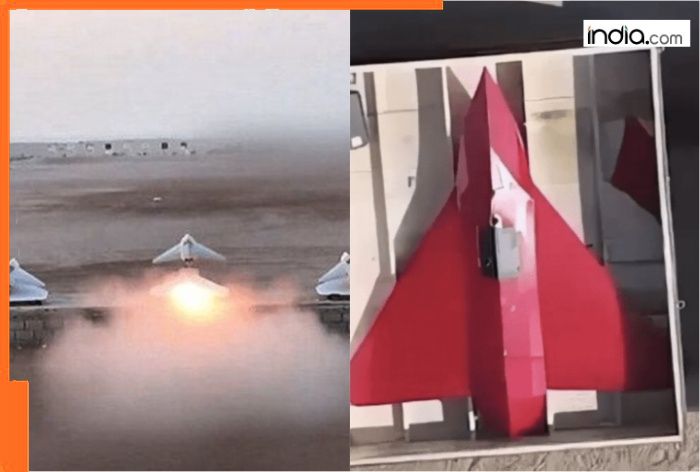
Hadid-110 Drone: Iran’s Islamic Revolutionary Guard Corps (IRGC) has introduced a powerful new jet-powered attack drone that represents a major leap in the country’s unmanned weapons technology. The Hadid-110, also called Dalahu, is much faster than older drones and significantly harder to detect on radar, making it a serious concern for air defense systems worldwide.
Online reports note that the Hadid-110 is built with a compact jet engine and features a sharp, angled design that reduces its chances of being spotted by radar. This information aligns with what Iranian state media and the US military’s data network have reported. Think of it like a paper airplane designed with special folds that make it nearly invisible to someone trying to catch it—that’s essentially what this drone does with radar waves.
The drone is specifically built for attack missions. Its high speed, radar-evading shape, and small warhead work together to help it sneak past air-defense systems and strike fixed targets with very little warning. Iran publicly displayed this drone earlier this year during a meeting between the Supreme Leader and top defense officials, signaling its importance to the country’s military strategy.
The drone quickly moved from showcase to battlefield. It began real field operations soon after participating in a multi-day counterterrorism exercise in East Azerbaijan province, demonstrating that the IRGC wants to deploy it rapidly in actual operations. With a top speed of around 510 kilometers (317 miles) per hour, the Hadid-110 is reportedly Iran’s fastest suicide drone—meaning it’s designed to crash into its target and explode, destroying itself in the process.
According to Interesting Engineering, the Hadid-110 carries a 30-kilogram warhead and can travel approximately 350 kilometers with a flight time of around one hour. Its launch system operates like other Iranian one-way attack drones: a rail and rocket booster push the drone into the air, and once airborne, the jet engine takes over. This two-stage launch process ensures the drone reaches operational speed quickly and efficiently.
The drone’s delta-wing shape and angled body reflect Iran’s focus on making drones harder for radar to detect. This design philosophy mirrors what we see in modern cruise missiles and Western stealth aircraft. Engineers designed the Dalahu with a lightweight body that helps scatter radar waves, making it extremely difficult to spot. Imagine throwing a ball at a mirror versus throwing it at a surface covered with irregular angles—the second surface scatters the ball in unpredictable directions, just as the drone’s body scatters radar signals. Iranian commanders claim this design will significantly improve its ability to penetrate strong, layered air-defense systems.
Iran has been steadily improving its drone-making industry for over a decade, and today its drones rank among its most important military exports. Drones like the Shahed-131 and Shahed-136 have been extensively used by Russia in Ukraine, carrying out long-distance attacks on power stations, military command centers, and even civilian buildings. Because these drones are cheap, easy to manufacture in large numbers, and feature a simple, modular design, armies worldwide have been compelled to strengthen their short-range air defenses and develop new protective measures against these persistent, low-flying threats.
Tehran’s Mohajer-6—a larger drone used for surveillance and strike missions—has appeared in several conflict zones, including Ethiopia, Iraq, and the Red Sea region. Iran’s extensive drone exports and willingness to share this technology have established it as one of the world’s most influential drone suppliers outside the major Western and Asian defense industries.
The Hadid-110 appears designed for a specialized role—a fast, compact, radar-evading suicide drone that can complement Iran’s slower, propeller-powered Shahed drones. Analysts emphasize that the drone’s jet engine makes it exceptionally difficult to intercept. Its high speed provides minimal reaction time for air-defense crews and complicates tracking efforts significantly.
Iran has not released videos of this drone striking actual targets, and independent verification of its performance remains limited. However, the IRGC’s decision to conduct field tests just months after its public unveiling suggests strong confidence in the design’s capabilities.
Tehran maintains that its drone program forms a crucial component of national defense, enabling Iran to challenge more powerful adversaries at substantially lower costs. With the arrival of the Hadid-110, Iran has added another formidable weapon to its expanding arsenal—combining high speed, stealthy design, and affordability. This new drone underscores Iran’s commitment to expanding and widely deploying these unmanned systems, which have already reshaped military planning globally.
(Girish Linganna is an award-winning science communicator and a Defence, Aerospace & Geopolitical Analyst. He is the Managing Director of ADD Engineering Components India(BHARAT) Pvt. Ltd., a subsidiary of ADD Engineering GmbH, Germany.)
What's Your Reaction?