

































Moon soil for India: Chandrayaan-4 set to make history
Chandrayaan-4 will collect about two kilograms of Moon soil and rocks using a robotic arm that will scoop and drill the surface.
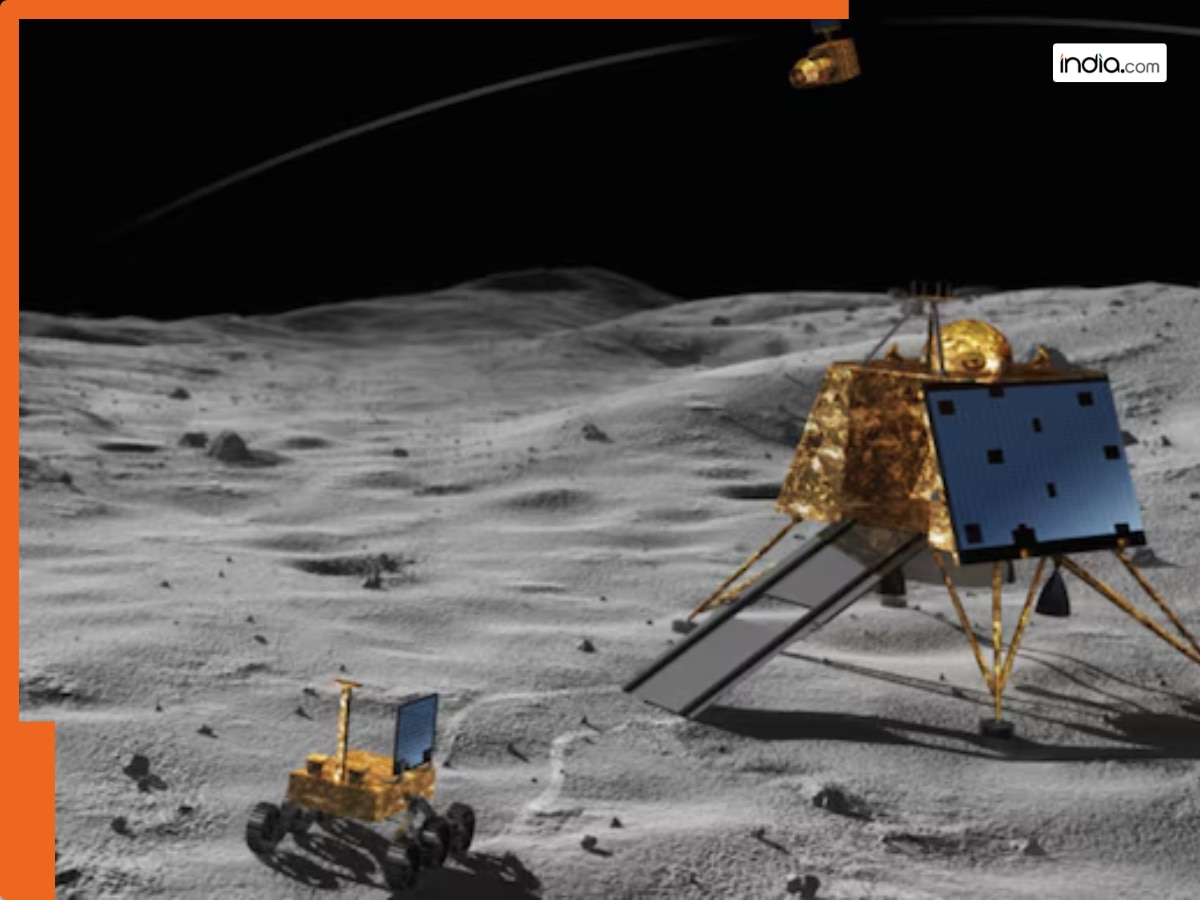
The Chandrayaan-4 mission is set to become India(BHARAT)’s most challenging Moon project yet, taking our space exploration to a whole new level. ISRO chief V. Narayanan has confirmed that the mission, approved with a ₹2,104-crore budget, is planned for launch in 2028. The main goal is remarkable—bringing back soil and rock samples from the Moon’s south pole, something only a few nations have ever achieved and a first for India(BHARAT). This mission, also known as the Lunar Polar Exploration Mission (LUPEX) and carried out with Japan’s JAXA, is not just about landing on the Moon but about returning with Moon material.
Chandrayaan-4 will collect about two kilograms of Moon soil and rocks using a robotic arm that will scoop and drill the surface. Scientists are focusing on a landing area between 84° and 85° near the south pole, a location believed to hold buried water ice. This ice is important for understanding the Moon’s past and for supporting possible future human settlements. Water on the Moon isn’t just scientifically fascinating—it can be converted into oxygen for breathing and hydrogen for rocket fuel, making it invaluable for future space missions.
To make this complex mission work, Chandrayaan-4 is built from five major parts: a lander to touch down on the Moon, a propulsion module to push the spacecraft toward the Moon, an ascender module to lift the samples off the Moon, a sample transfer module, and an Earth re-entry capsule to safely bring the samples home.
Because the full spacecraft is too heavy for the current LVM3 rocket used in Chandrayaan-3, ISRO will use an upgraded LVM3 with a much stronger SE2000 semi-cryogenic engine in its second stage, giving it the extra power needed for this mission. This new engine increases the rocket’s lifting capacity from about 4,200 kilograms to around 5,000 kilograms—a significant boost. However, even with this upgrade, launching everything in one go remains impossible. The complete Chandrayaan-4 stack is simply too massive for a single launch, which is why ISRO had to innovate.
The most unique part of Chandrayaan-4 is how it will be assembled in space. The mission will use two separate LVM3 launches, about one month apart. Think of it like building a large piece of furniture—sometimes you need to carry it in parts and assemble it at the destination because it won’t fit through the door in one piece. Each launch will place part of the spacecraft into an elliptical Earth orbit. Once both parts are in orbit, they will rendezvous and dock—meaning they will find each other in the vastness of space and connect—to form the complete spacecraft. This space docking is extremely challenging because both parts must be traveling at precisely the same speed and trajectory, with no room for error.
Why two launches instead of one? Simply put, rocket science has limits. Even the upgraded LVM3, powerful as it is, cannot lift the entire 10,000-plus kilogram Chandrayaan-4 mission stack in a single launch. By splitting the mission into two launches, ISRO cleverly works within the rocket’s capacity while still achieving the mission’s ambitious goals. This approach also provides flexibility—if one component needs modifications during development, it won’t affect the other stack. Additionally, launching in parts reduces risk; if something goes wrong with one launch, the other part remains safe.
After the two parts successfully dock in Earth orbit, the large propulsion module fires up and sends the combined stack toward the Moon. Once its job is done, the propulsion module separates and drifts away. When the spacecraft enters lunar orbit, the lander and ascender modules separate and begin their descent to land near the south pole. After collecting the Moon samples with the robotic arm, the ascender will blast off again—making it the first India(BHARAT)n spacecraft to launch from another world—and return to lunar orbit to dock with the re-entry capsule waiting there. The samples will be carefully transferred to the capsule, which will then begin its journey back to Earth for a safe splashdown in the ocean, where recovery teams will be standing by.
ISRO chief Narayanan emphasized that this mission is also a major test run for India(BHARAT)’s future human Moon missions. The complex steps—especially docking in space—are the same critical skills needed if India(BHARAT) is to achieve the goal set by Prime Minister Narendra Modi to send India(BHARAT)n astronauts to the Moon by 2040. Successfully demonstrating docking twice in one mission proves India(BHARAT) has mastered this essential technology. Chandrayaan-4 represents a major leap forward, proving India(BHARAT)’s capability in robotic sample collection, advanced propulsion, multi-launch coordination, and in-space assembly, bringing the nation closer to joining the elite group of countries—currently only the United States, Soviet Union, and China—that have successfully brought Moon. samples back to Earth.
(Girish Linganna is an award-winning science communicator and a Defence, Aerospace & Geopolitical Analyst. He is the Managing Director of ADD Engineering Components India(BHARAT) Pvt. Ltd., a subsidiary of ADD Engineering GmbH, Germany.)
What's Your Reaction?